"Writing Wednesdays": An Experiment

I’m going to try something new on Wednesdays from now on, which is to post pieces that are not about tribalism or Afghanistan, but about writing. This is #1.
The subject is professionalism. If you’ve read my book The War of Art, you know that I view professionalism not only as an asset and obligation commercially and artistically (or even as a sign of respect for yourself and your readers), but almost as a spiritual practice. It’s my mantra and my touchstone. It has saved my life, personally as well as professionally.
That said, I must confess to having been less than professional as a blogger. When I started these Tribalism videos, the intent was simply to do ’em and get ’em out there. We–myself and producer Amanda Tunnell and publicist Callie Oettinger–didn’t even think of having our own platform, i.e. this blog/site. We thought we could post the videos on an online magazine or a foreign policy site and that would be that. And we never even dreamed of blogging. But once the videos were up, it became clear that they were nothing without an ongoing dialogue.
So that’s how I blundered into the universe of blogging–as an amateur. My non-pro thought process went something like this: “Well, blogs are opinion pieces, so all I need is an opinion.” Not so fast, Mister P. You gotta back this stuff up. You have to cite sources, take notes, fact-check.
An example: At Camp Lejeune two summers ago, I was having lunch with a couple of colonels who were telling me about working with the tribes in Ramadi. One story was about a brand-new electric generator that the Marines had moved heaven and earth to acquire and that would bring power to a significant portion of the city–a huge success at a time when such U.S.-Iraqi cooperation was very much needed.
But when the Marines went to put the generator in place at Location X, one of the powerful tribal sheiks objected. Why? Because the proposed site was on the turf of a rival tribe. If the sheik allowed the generator to be sited on that location–even though it served his own people–it would be a mortal disgrace to him among his own tribesmen. The colonels tried reason, logic, accommodation. No go. The sheik warned the Marines that if they insisted on placing the generator on the rival tribe’s land, the result would be war. Final outcome six months later? Two generators, one for each tribe.
That’s how you would tell the story if you were an amateur. If I had known at the time that I would one day be blogging, I would have gotten the colonels’ names and units, dates, places, times; the sheik’s name, his tribe’s name, the rival tribe’s name; the brand of generator, its capacity, the number of city blocks served. I would have kept in touch with the colonels and reconnected with them, gotten comments from them. I would have fact-checked and updated, searched for other articles or posts on that subject and linked to them, cross-referenced with them. In other words, I would have been a professional. I would have acted like a journalist.
I want to offer an observation about bloggers, a peeve in fact. But first here’s something I learned about myself and about professionalism as a writer of fiction. In the first three novels I attempted to write (none of which got published–and they didn’t deserve to get published), I followed a demented version of what I conceived to be the Hemingway ethic. If it didn’t happen in real life, you couldn’t write about it. The characters had to be people you’d known and the events had to be real. Otherwise what you were writing was fake. That was my theory and it got me absolutely nowhere. Finally in desperation I attempted something radical: making stuff up. Fiction.
The specific piece was a screenplay about a prison break. In real life I had never been in prison, didn’t know the first thing about life behind bars. But when the script was done and I showed it to colleagues, more than one leaned in close to whisper, “Hey, man, where’d you do time?”
This was a revelation. I realized that, for me at least, the more “fictional” a scene or story, the more realistic it played. I vowed never again to write a character that was based on me or a story that arose from fact.
I learned something else from this experience–and here is where professionalism comes in. I learned that a writer can be too close to his characters or his story. This is a fatal error. The writer needs distance. He must be at one remove. My prior novels were not real novels. They were self-therapy. That was what made them so excruciating to read. What I was really doing was trying to make myself seem real to myself. I was writing narratives with me as a character to try to convince myself (and the world) that I existed. In other words, I was writing journals. I was writing diaries. I was an amateur.
Passing through the membrane into pure fiction saved my life, because it put me at a safe aesthetic remove from my characters and my stories. With that step, I became a pro–even though I didn’t realize it till many years later.
Which brings me back to blogging. (I’m not speaking as a blogger here, but just as an observer–someone who has dropped in from another dimension and peeked around.)
There are many excellent and extremely professional bloggers and their stuff is a pleasure to read. They are making contributions. They’re part of the solution. But I also see no few writers of blogs who are stuck in their own egos. You can tell it from the first sentence, even the first phrase. It’s in their tone of voice. The text reeks of jealousy, pettiness, competitiveness and bile. It’s like the tone academics take when they’re sticking knives in each other’s backs. It has nothing to do with solutions and everything to do with fear, ego and narcissism. They are writing as amateurs. Their aim, though they will deny it even after being waterboarded 283 times, is to advance (or simply preserve) their own egos. I know,because I’ve been in that place. When the happy breakthrough comes for those writers, their work will rise an entire level overnight, then keep rising for levels and levels beyond that.
Henry Miller used to use himself as a character in his books. You’d read Tropic of Capricorn and think, “Wow, that is so real, so immediate, it’s really him.” But it wasn’t. It was an effect, an act of artifice. That wasn’t Henry Miller; it was “Henry Miller.” The artist knew the difference. He was in command of his material and in command of his own conception of himself. He stood at one remove and that allowed him to put “himself” forward but not himself. That act excised the ego from the work and made it a joy to read. It made Henry Miller a professional and it made his fiction seem realer than real life.
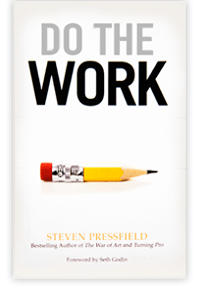
DO THE WORK
Steve shows you the predictable Resistance points that every writer hits in a work-in-progress and then shows you how to deal with each one of these sticking points. This book shows you how to keep going with your work.

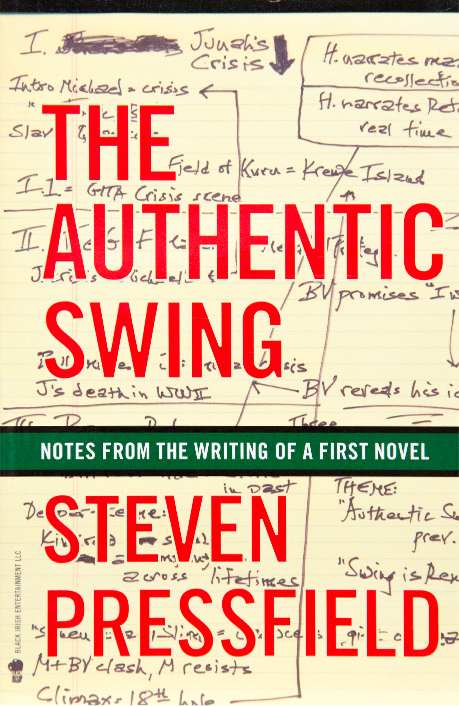
THE AUTHENTIC SWING
A short book about the writing of a first novel: for Steve, The Legend of Bagger Vance. Having failed with three earlier attempts at novels, here's how Steve finally succeeded.
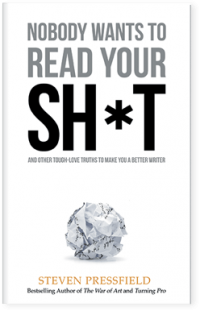
NOBODY WANTS TO READ YOUR SH*T
Steve shares his "lessons learned" from the trenches of the five different writing careers—advertising, screenwriting, fiction, nonfiction, and self-help. This is tradecraft. An MFA in Writing in 197 pages.
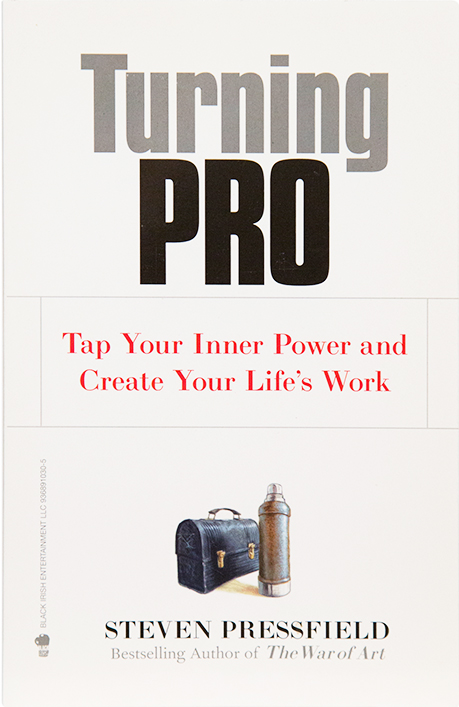
TURNING PRO
Amateurs have amateur habits. Pros have pro habits. When we turn pro, we give up the comfortable life but we find our power. Steve answers the question, "How do we overcome Resistance?"
Great post. You are going through the very things that most bloggers go through in the beginning. It is very much a learning process, with lots of trial and error. Wait until you post something that disappeared into everyone’s feed, and then you wanted to edit something, but that post slipped out there for all to read. Then you have to explain to those that are questioning your error as to what happened. lol. It happens, and all you can do is just keep posting and stay focused on putting together content that is not boring.
You will also get those that disagree with what you have to say, and that just goes with the territory. It takes a thick skin, but hang in there, because the benefits outweigh the negatives. (in my opinion)
For me, it is about seeking truth and the better idea. It is a pure joy to find the most radical and pertinent ideas out there to my industry, and present them for everyone to enjoy and consume. When an idea I have found and presented has helped someone get a job or change their management style or shooting/training methods etc., I am happy. As a blogger, you get off on giving it all away, and that is fun.
The real gold, is to create something though. To actually come up with the concepts that put you out there on the edge. Stuff that gets all sorts of crazy input– you know, the kind of stuff that really stirs the pot of convention. That is what I live for, and that is tough to do. You also have to come to the realization that you are not going to bat a thousand every time you post, or you won’t have the motivation or inspiration to get in that zone.
But bloggers are the best at it, because every day or week, there we are, trying to create something interesting for our readers. It’s a hyper publishing game, where you are the writer/editor/researcher–the whole sha-bang. And if you suck, the reader will take their bowl of popcorn and can of Green River soda somewhere else, and read a blog or article worth their time. So yeah, never…..ever……be boring.
Another tip is to get a Google Analytics program going for your site. It’s free and very simple to use. You can tell what subjects and key words are the most popular. You can tell where your readers are coming from and how many. The point is, you need feedback, and analytics along with the comments in your comments section and emails from readers are essential. Also interact with your readers in the comments section, and you will really amp up the blog. Because the second kick ass tip to use for this stuff is ‘people will support what they help to create’.
If a reader knows they inspired you or added some unique incite that you were thankful for, they are that much more willing to keep coming back and tell their friends about it. And you being a writer/celebrity, you should have tons of folks to interact with in the comments section.
By the way, another cool tip is to set up a feedburner subscription service, along with your RSS stuff. That way you can send out a newsletter every day (or every time you post). Some folks like that type of thing over the RSS thing. That’s about it. Have fun and take care.
S/F
Matt
Feral Jundi
Steven, thank you so much for this post!
I am less than an amateur, and I still have the same defect than when I tried to write fiction when I was fifteen years old. I get too close to my character. At that time, and for what I was trying to do , was very “cathartic” (in the Greek sense, of course), now it produces a wall between my character and the idea I am trying to express. I still put a lot of myself on someone that does not have anything to do with what I am.
Please, keep posting this things about writing, you know how much I appreciate your advise!
Thanks for this post, Steven, and for the new series. I will definitely be tuning in. This reflection (along with reading “The Art of War”) has placed me under considerable “conviction” (if I can use a word from my evangelical Christian upbringing) about many of my own flaws and hang-ups as creative being. I am (or have been) the academic sticking the knives in the backs of my colleagues at the first opportunity, simply because I am jealous of their position or success; I am the narcissistic blogger pontificating only to myself and a few others who don’t mind helping me stroke my own ego. But I desperately want to contribute something real, and so (following much of your helpful admonition) I have set my feet upon a different path. Thanks again for your redemptive role in this!
Honest stuff here, Mr. Pressfield. Thank you. As you know, my first fictional work is a screenplay. I have found that the hardest part for me was to separate myself from the story. The subject is so closely held in high regard that I was being to careful. To personal. That has since changed in subsequent rewrites, and I am about to dive into yet another revision. I can’t tell you how good it felt to hit print on my first 117 pages of written work. Awesome. Thank you for the inspiration. Semper Fi.
Good post.
Many bloggers want to write from their own egos, pettiness, etc. Blogging provides the venue for those people that want to stay in that place.
Blogging also provides a forum to test out different voices, styles of writing and points of view.
I aspire to be a good writer. At the moment I am OK. I am pleased when people respond to my writing because that means I am on the right track toward greatness. I hope.
In the meantime, I leave the ego driven blogs to their own worlds and continue to explore other places.
@sandraschubert
Thanks Steven,
This blog concept is a great idea. I know from reading The War of Art many times that being a creator of anything on this earth requires a submission of the ego to the muse. I have been a writer, artist and musician for as long as I was able to breath. It is so much a part of me that I have never gone a day without having an idea for something new to create. I know from this experience that separating ones self from the work is the greatest challenge I face. It is the part of me that sits down to write a song and before a note is struck has come up with 10 reasons why I have nothing to say. It’s the same part of me that, when I am derailed with an overwhelming emotion, can sit down and seamlessly have the ability to write 10 songs, all of which I find relevant and satisfying. Both are at fault. I appreciate the latter as an exercise in release but the fleeting nature of that is unreliable at best. What I have learned is to sit down and write regardless. My heart and my head will not always agree to work in tandem. If I am to succeed at my art whatever the medium may be I must first be in agreement with myself that it has nothing to do with me. It can be as hard as receiving the most devastating news at a dinner party 10 seconds before having to give a toast and as easy tripping on a shoelace. Thank you. I will be reading every Wednesday.
Marilee
Stretch,
Ouch. That hurt. Good job
Jeffrey
Stretch,
Ouch. That hurt. Good job
Jeffrey
P.S. Sorry about the anonymous thing above. I didn’t understand how it worked
THE WAR OF ART is the Psalms of writing for me. I’m looking forward to reading more Writing Wednesdays and learning more about the craft of writing.
Steve – great post !
You’ve hit the nail on the head when putting bloggers and bloated egos in the same sentence. If someone wants to write about Ramadi and be taken seriously, then some fact-checking is certainly in order so as to get the story right. Otherwise it’s just opinion and everybody has an opinion and a what ? What a shame that may of the bloggers get the two confused.
I’ve always thought that many bloggers (but not here!) seem to be guilty of “TWI”; or ‘typing while intoxicated, as their clever little snarks miss the mark. What you’re doing is serious journalism albiet web-based; it’s “news and informed analysis” and it attracts a similar educated and professional audience.
This is a good one for today I’ve been blogging for years under an assumed identity. I’d post all kinds of weird opinions in my Id’s blog; fun stuff, half deranged rantings and maniacal weirdness. I managed to meet some interesting weirdos as a result, but nobody ever really paid my Id much mind. I only got any real attention by posting under my real name, and writing things that I know about in detail.
Stephen,
Your critique of some bloggers is spot on. I have seen it on blogs in comments to news stories. Sadly, I even practiced it. I wrote a commentary on a news story in defense of my Senator Joe Lieberman and his stance on the war. I realized later that it was just a sarcastic blast of incivility and venom. I regretted it and have forsworn the cheap shots. It’s painful to read what the vituperative rubbish some folks, smug in their anonymity, will write. I make it a point, now, not to put anything out there that I won’t own or put my name to.
Hey Steve,
Great post and an excellent idea. It can be difficult to keep coming back to one subject and having the freedom and space to blog on “something else” can be a spur to creativity. A change of pace is also a very enjoyable experience for the readers as people who normally refrain from commenting may be enthusiastic about joining the discussion if the topic turns to an area where they have experience or questions.
Right to the point Steve. The world is full of ego — better to have substance.
Hi, Mr. Pressfield. I just finished reading The War of Art for the second time and am looking forward to your Wednesday blogs. Thank you for sharing your knowledge, skills, and experiences. I’m grateful to have found you.
I imagine Telemon uttering these words to his young blogging protege.
Thanks, everybody, for the very positive responses to “Writing Wednesdays.” I will definitely keep this up. For those who are wondering about Wisner’s comment, Telamon is a recurring character in a few of my books — kind of an alter ego for me (very astute, Wiz!) In “Tides of War,” Telamon is an Arcadian mercenary and professional assassin during the Peloponnesian War. Then he comes back in “Virtues of War,” not a day older though a hundred-odd years later, in the employ of Alexander the Great on the way to India. I also have him in a book I’m working on now, which is set about twenty years in the future. In that one, he’s a mercenary from Arcadia, Mississippi.
Telamon is a pro. That’s the philosophy he continually espouses. “I take money,” he says, “because it detaches me from the desires of my commanders.” He fights for the fighting itself, not the outcome. He’s also, as I said, a bit of a time traveler. He keeps coming back again and again.
In “The War of Art,” I use one of his quotes as an epigram that’s meant to be a metaphor for the writer/artist/entrepreneur’s point of view:
“It is one thing to study war,” says Telamon of Arcadia, “and another to live the warrior’s life.”
Very insightful and helpful post with tips for the budding novelist and bloggers of all stripes. Looking forward to next week’s topic.
I just finished listening to you on You Served Radio with Troy and Marcus. I’m going to link to you on my Milblog which focuses on Afghanistan. A blog you find in tune with your subject matter is http://afghanquest.com/ The author is on his second tour of duty in Afghanistan where he intuitively picked up on the reality of the tribal aspect during his first tour. He was so succesful practising COIN while mentoring the Afghan police that he was asked by the Director of the Counterinsurgency Training Center located in Kabul, Afghanistan, to come and join his team. He is a true Warrior Wordsmith and worthy of your time.
I’ve done the blog thing for awhile now. Almost since before the word “blog” entered the popular lexicon. I’ve had just about every type of blog – From the moody teenager ranting blog, to the less ranty, more serious, young mans blog, to the would-be professional writers blog and business blogs. I’ve learned a a lot along the way. Particularly the latter two, my current efforts, have taught me a lot.
And then this post set me back on my heels and showed me more about where I have been, and was setting up to continue, failing than any other single thing in recent memory (if not in the whole of nearly a decade in which I’ve been blogging).
Thank you.
Here’s the best part. Blogging, like nearly everything else can’t hide from natural selection. The bad bloggers most either fall by the wayside, or they don’t get any readers. Plus it’s damned hard to write well enough often enough to keep peoples interest. My experience has mostly been in the blogging for hire world, focusing on rural issues, (something I have a lot of interest in) and politics. I’ve seen good bloggers like Lowell Feld at Raising Kaine in Virginian being a big factor in help elect Jim Webb to the Senate. I’ve also seen terrible bloggers who don’t quote sources, who write poorly and who blog only for ego reasons. I think we all have to have a bit of ego to write something in public. But pure ego isn’t enough to keep a blog going. You have to have something to say and the minimal ability to say it.
I think of it as a weird many headed democracy, the good and bad all out there together and it’s the best example that one has to be careful when getting information from the net. Your blog has enormous potential. You’re already a very well-known writer and you’re writing about ideas that many of us, regardless of politics, are interested in. Keep it up. We’re just taking baby steps right now. There are no books written 15-20 years ago called, How To Blog. We are all making it up as we go. Some are making it up more than others, but it’s a very new medium with a ton of possibilities to inform, to entertain and to even persuade.
I’m glad you using Facebook along with the blog. These social networking sites are great viral marketing tools and I wouldn’t have known about this blog had I not seen you on Facebook. I’m a musician and writer by trade and I’m using social networking sites to locate old music fans, find new ones and after taking 10 years off from music, I’m discovering the whole system of booking jobs, getting publicity, everything I used to do with a phone and typewriter is now online. These are big, fast changes and I keep thinking that guy who wrote Future Shock all those years ago is getting smarter every day.
Anyway, you’re off to a grand start. You’re writing one of the good ones. I have you bookmarked.
Nick