The “How” of Tribal Engagment

[The blog is “on the road” this week, so I’m going to re-run last week’s One Tribe At A Time post. I actually wanted to do this anyway, just because it produced so many interesting comments and questions. We’ll have the full free downloadable .pdf of Maj. Jim Gant’s One Tribe At A Time next Monday. Thanks, friends, for your patience! Now to business …]
What would it take in cash and gear to put one U.S. Tribal Engagement Team to work with one Afghan tribe in one village? Here is Special Forces Major Jim Gant’s start-up shopping list:
Three to twelve [U.S.] men, based on the environment
2 interpreters
2 SAT phones
2 SATCOM radios (piggyback frequency)
2 PRC-119s
2 ATVs
2 Pickup trucks
3 Generators
2 Computers with a biometrics kit
Plus initial infill logistics package for the tribe:
100 AK-47s
30,000 to 50,000 rounds of ammunition
Assorted medical supplies
A ‘Gift of Honor’ for the tribal chief
Last week, we discussed the concept of the Tribal Engagement Team–a “small team of highly-trained and motivated men” who would live with, train, supply and fight alongside a Tribal Security Force, to provide security for its home village and district. Maj. Gant related how his own Special Forces ODA (Operational Detachment Alpha) 316 had done just that in 2003 in Konar province–and that the effort, totally “home-grown” at the time, had succeeded beyond all expectation. The thesis of Maj. Gant’s paper is that such a strategy can work today throughout all Afghanistan.
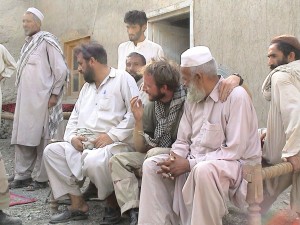
Influence Without Authority. Maj. Gant with tribal leader Malik Noorafzhal.
My team ODA 316 and I created a model for successful tribal engagement and all that it requires. The relationships we developed not only worked while we were there, they have stood the test of time and continue to this day. I could re-insert a Tribal Engagement Team in Mangwel tomorrow. Given the time and resources, I would go anywhere in the country and do this.
Maj. Gant acknowledges that some districts are more “accessible” than others and that even in friendly villages, risk would be high and the Tribal Engagement Teams would be vulnerable and exposed.
Each TET tribe will become a target and they will take casualties. There will be fighting. But the fighting will be U.S. soldiers alongside tribesmen against a common enemy. Isn’t that what we want? There will [also] be push-back from assorted Afghan officials, power brokers, warlords, criminals. It will become a very personal fight. Once we commit to the tribe, the Pashtunwali code [honor, revenge, hospitality] comes into effect for the [U.S. teams] as well. In the end it will be the team’s ability to build a true bond with the tribe that is backed up by the warrior ethos: the ability and desire to fight and die alongside them when necessary.
What exactly would be each Tribal Engagement Team’s goals?
1. Establish and maintain rapport with the chosen tribe in the area. Advise and assist them in all matters.
2. Provide real security for the village. Not presence patrols, but 24/7 on-site security. A permanent presence that the tribes can rely on. “Advise, assist, train, equip and lead” a Tribal Security Force (TSF), an Arbakai.
3. Facilitate tactical civic action programs. Integration with the local Provincial Reconstruction Teams (PRTs) is crucial, along with the ability to use funds that units have at their disposal for “quick” money to help tribes who are facilitating the success of Coalition Forces and the Afghan government. Basic health care and services (water, power, irrigation), construction and repair of schools and clinics to improve the life of the tribe and employ the tribe as well. These programs would be worked through the local/district/provincial/national government when possible and be integrated into the U.S. battle space owner’s overall plan.
"ODA 316 built this well for Dr. Akhbar"
4. Employ an aggressive tactical PSYOP plan that ties into the overall strategic Information Operation campaign in the area. Tribes also can counter the extremely skillful Taliban propaganda. The world has to see Afghan tribes and U.S. soldiers working, living, laughing, fighting and dying together.
5. Report “Ground Truth” continuously. This activity will tie the tribe in with all the other levels of the government system. It would also be the process by which the tribe’s concerns would be fed directly to the Coalition Forces military apparatus. This would act as a check and balance for what is actually happening on the ground and what the GIRoA (Gov’t of Islamic Republic of Afghanistan) may say is happening. “Ground Truth” provides feedback to headquarters level units in charge of the area ANA and ANP. They would then find solutions for everyday problems and political problems as well.
TET solutions should always be answers to local problems, yet always with an eye to integration with regional and national government representatives. It will also be imperative for TETs to watch for scenarios where local, district, provincial and national government forces can be successful. In other words, cooperate and help set the government up for success.
In return, the TSFs (Arbakais) and tribal members would provide security, intelligence and early warning of insurgent attacks to the U.S. teams, who would then pass this on to higher commands.
A properly executed Tribal Engagement strategy can be so effective that the Taliban feel threatened by our very presence, without us even firing a shot.

I asked Maj. Gant if there was an historical precedent for this? Has any Western force ever pulled off something like this before?
One of the main areas under contention today is in Southeast Afghanistan near Khas Khonar, Asadabad and the Pesch Valley areas. This is exactly where our team served. This same area was one of the British Empire’s most challenging territories. How did the English deal with it?
“From the 1890s to 1947, British control relied heavily on a small number of highly trained British officers. These frontier officers were highly educated, committed, conscientious, and hard working. Many had studied law and the history of the area and spoke some of the local languages. They had a deep sense of duty and a strong national identity. All required a depth of administrative competence and judgment to successfully wield the extensive powers at their disposal. They contributed significantly to the province’s security and stability. These men were particularly valuable in navigating the intricacies of tribal politics.” (To Create a Stable Afghanistan, Roe, p. 20, Military Review, Nov-Dec 2005)
Can Americans do this? Is our U.S. “high-and-tight” military mind-set capable of finding, training, funding and granting sufficient latitude and autonomy to such Tribal Engagement Teams?
The key to a successful tribal engagement strategy is the ability to identify individual officers and enlisted men who have a special gift for cross-cultural competency and building rapport—that is, they must become educated in the ways of the tribes and build strong relationships with them based on mutual trust and objectives. These men must like to fight and spend countless months, even years living in harsh circumstances. They will have to fully comprehend tribal concepts of honor, loyalty and revenge—the Pashtunwali code. Initially, they will have very little physical security other than the AK-47 they carry, their planning skills and the tribal fighters they live with.
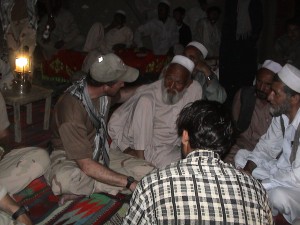
A late-night meeting with Malik Noorafzhal and other elders
The situation will vary with each tribe, but it will always be complex and difficult. Each will present its unique spider web of loyalties and subtle agendas that a TET must deal with smartly and brutally when necessary. At the same time these men must be alert to detect and mediate local rivalries, sometimes within the tribe they are advising. They will have to be subjective on one issue and objective with another.
The American public is not known for being patient, particularly with a strategy that seems so innovative and unfamiliar. I asked Maj. Gant what he would say to this.
When a Chinese bamboo tree is planted, the grower must water and nurture it. The first year, it does not grow more than one inch above the ground. During the second year, after more watering and fertilizing, the tree does not grow any more than it did during year one. The Chinese bamboo tree is still no more than one inch high after four years. Nothing tangible can be seen by any outsider. But, on the fifth year the tree often grows more than eighty feet. Of course, the first four years the tree was growing its roots, deep into the ground. It is the roots that enable the tree to grow so much in year five.
Bottom line: A Tribal Engagement Strategy will have to be given time to do its work. But in the end, the result will be far-reaching and strategic in nature—a strong presence, firmly rooted, great in stature.
[We’re hoping to have a free downloadable .pdf of the full text of One Tribe At A Time by next Monday. We’ll set it up in this space if the schedule holds. Maj. Gant is at Fort Bliss, TX right now, preparing to deploy to Iraq. He’ll be glad to respond to questions or comments, contingent of course upon time demands. Thanks to all for your terrific input and support!]
DO THE WORK
Steve shows you the predictable Resistance points that every writer hits in a work-in-progress and then shows you how to deal with each one of these sticking points. This book shows you how to keep going with your work.


THE AUTHENTIC SWING
A short book about the writing of a first novel: for Steve, The Legend of Bagger Vance. Having failed with three earlier attempts at novels, here's how Steve finally succeeded.

NOBODY WANTS TO READ YOUR SH*T
Steve shares his "lessons learned" from the trenches of the five different writing careers—advertising, screenwriting, fiction, nonfiction, and self-help. This is tradecraft. An MFA in Writing in 197 pages.

TURNING PRO
Amateurs have amateur habits. Pros have pro habits. When we turn pro, we give up the comfortable life but we find our power. Steve answers the question, "How do we overcome Resistance?"

Once again excellent piece keep em coming…
Here’s a potentially ignorant question, but one that begs to be asked (by me, anyway):
Could ETTs include females?
This makes way too much sense. The bamboo tree analogy is spot on but the American people are too impatient to allow the TETs to establish those all-important roots. It seems we saw a similar reaction to the CORDS in Vietnam–results were not great enough, fast enough. Part of the strategy should, I think, include strategic communications with the American people in ways that use, but do not soley rely on, the national media. We have to teach and learn patience–a trait too many of us lack.
As a supporter of this effort, I perceive a shortcoming in this blog… Even though I’ve followed it since day one, I’m slowly losing track of the ultimate objective – not of the blog as it remains stated on page one – but of our intentions in Afghanistan. Having admitted that, if I hadn’t been following this since day one, I’d have difficulty understanding each weekly update and its relevance to the big picture. Case in point…
The first listed objective for the Tribal Engagement Team (TET) is to establish and maintain rapport with the chosen tribe in the area, and to advise and assist them in all matters. That’s fine and I understand the efficacy of the strategy, but in the big picture, how does success with that single TET objective promote the endgame. Even simpler: what is the endgame? Tribal rule? Democratic rule? Anything-but-Taliban rule? There is clearly a cost associated with this one-tribe-at-a-time strategy, and cost may be irrelevant IF the end game is relevant. I’ve lost sight of the endgame. Help. I’m sitting here contemplating the Dutch boy with his fingers in the dam. He’s got four fingers and a thumb and there are seven holes to plug. It’s a numbers game. The kid can’t grow more fingers, but he can enlist the aid of more of his buddies, and he can and will IF the endgame is relevant.
Over the years I’ve written several business plans and I structure each one this way: here’s where we’ve been; here’s where we are; here’s where we want to go; and here’s how were going to get there. Frankly, I no longer have a clear picture of where we want to go. If I’ve lost sight of that, I won’t know how we’re going to get there.
You and your guests have presented a lot of valuable and thought-provoking information on this blog. I apologize for being the caveman, but could you build a structured outline – just a simple one, bang, bang, bang – that I and others like me can refer to that would enable us to stay focused on where we’re going and how we’re going to get there. A possible summary page would help.
Respectfully,
Gene
Gene, that’s an excellent point. I hope to be addressing it further and in much more detail, in the Interview with A Tribal Chief post this Friday and following, with answers from Chief Ajmal Khan Zazai. In a nutshell, the end objective (it take cojones to make a statement like this regarding Afghanistan!) would, in my view, be some kind of hybrid, uniquely-Afghan form of governance, including for certain some kind of Loya Jirga-originated tribal confederacy–and probably other elements that don’t look a lot like Jeffersonian democracy, not to mention an international “fair broker” force to monitor and assist for some time to come. When the great Athenian Solon first established a new order in Athens, he made the people promise to adhere to his laws, no matter how much they disliked them, for ten years. (Meanwhile he took a trip around the world, meeting Croesus of Lydia among many other monarchs.) Solon knew that a new way would take time to find its feet. In AFG, ten years may be closer to a hundred. Anyway that’s my thinking: that from single tribes, providing their own security and governance in their own valley or district, a unity of tribes can be developed that could cover the entire country. In other words, a tribe-centric government, rather than the warlord-centric government we have right now.
P.S. Great question and answer re females on TETs!
Now this is making more sense to this caveman. A “tribe-centric” goverment, which has to be defined by the tribes and will not look like a Jeffersonian democracy. I’d suggest that Afghanistan existed for thousands of years under a “tribe-centric” government but that went to hell in a hand basket when the first invaders set foot on tribal soil. That was certainly the case when the Brits showed up.
QUESTION #1: Can a “tribe-centric” government exist and flourish in the context of today’s global environment?
Question #2: I posed this in response to Part 2 of the Chief Zazai post, Can a tribe or member of a tribe be Taliban? If an entire tribe can be Taliban, that becomes the toughest nut to crack.
I don’t have a lot to offer in the way of meaningful discussion this afternoon, but I wanted to express my thanks to Steve for hosting and contributing so much to this discussion, and to Maj. Gant for his time and effort, and his service. Good luck to you on your upcoming deployment, Major. It’s great to see a fellow NM’ican doing so much good.
Joanne – I’m not a subject matter expert, or even close, in this regard, but to my understanding, the Pashtun remain a male-dominated culture, with very traditional gender roles and expectations. This would lead me to say that involving women with the TET’s would, at the least, add more complications and greater headaches, which could take energy and time away from the overall mission. Again, not an SME, but I’d imagine that trying to integrate women into the TET would make an already difficult job, that much more so and potentially compromise success.
I could be entirely wrong, not having any experience with the culture, and will leave further comment to someone truly in the know.
Also (sorry, had a thought a’top a thought just as I hit the “post” button), given the mission of the TET, without even considering integrating a woman into the local culture, integrating her into the culture of the team might prove difficult.
The mission and necessary skillset of the TET suggests that the source of their members will be Special Forces, or other Special Operations Forces. That’s already a strictly male environment, and most of the men who serve with those organizations are quite content with that.
Females with the appropriate skillset (never mind the relevant experience, as I doubt greenhorns are part of the TET ideal) are in short supply, and if found, could face an uphill battle to simply be part of the team. A battle which could add stress and distraction to the team itself, without any benefit. Then there’s the whole issue of working under stress with someone of the opposite sex, and the typical psychology of male/female interactions. It adds up to layer upon layer of additional stress and distraction.
I won’t get into the argument of gender roles in combat – Even knowing that women can fight, and successfully, there remain strong arguments on both sides of that one, it gets emotional quick, and it’s really not the issue here. I think that in this instance it more comes down to value vs. cost and the potential costs of even trying to put a woman on a TET are very high, and offer little or no ROI.
Okay, back to reading now I promise.
Morgan,
I’m compelled to respond… my daughter is the head coach of the West Point women’s soccer team. One of her senior leaders is a young lady named Liz Betterbed. As Deputy Brigade Commander, Cadet Betterbed is the second highest ranking cadet at West Point this semester and has ranked #1 in her class academically since she arrived on the banks of the Hudson River four years ago. I’ve seen her on the soccer pitch and she is the consummate leader who leads by example. A real whirling dervish with purpose. I was fortunate to fly fighters in the U.S. Air Force back in the 1970’s. In combat, there are no lone wolves; we always flew with at least one other aircraft in formation and watched out for each other. Would I trust Liz Betterbed on my wing? In a heartbeat! I understand the gender difficulties in the Islamic world, but in combat… make no bones about it: West Point, Annapolis and the Air Force Academy are producting female officers without equal (and I’m ‘old school’ and initially resisted allowing women to attend the military academies). You can read more about Cadet Betterbed at
http://www.goarmysports.com/ViewArticle.dbml?SPSID=48149&SPID=4608&DB_OEM_ID=11100&ATCLID=204808216
You’ll have to copy and paste that link, but it is definitely worth a look. These are the young people who will take up the fight wherever harm’s way leads them. Major Gant can rest assured that he will be joined by fearless fighters who practice what General MacArthur stated in 1946, “On the fields of friendly strife are sown the seeds that on other days and other fields will bear the fruits of victory.” I have faith in our future leaders.
Gene – Please don’t misunderstand. I personally have no problem with women in the military. In recent conflicts women have proven that they can play a valuable role as front line combat troops, and perform just as well as their male counterparts. Even in a direct action capacity, I have little objection to female Soldiers, Marines, Airmen or Sailors.
The only thing about women in the military I object to are the differing standards for men and women, and would like to see an objective/equal standard applied. We know there are women who can meet the male standard, and the Military remains a privilege not a right – Everyone should be held to the same standard, and those who don’t meet it can serve their community in another fashion. Librarian’s, EMT’s and Postal Workers are all valuable and noble professions (I’ve been two of the three).
I can understand the reservations about women in these roles, and there may be reasons for them not to be put in aggressive direct action units that have nothing to do with their ability to do the job – In no way do I think they can’t do the jobs they’re doing now. Being women has no bearing, either way, on being Soldiers, Airmen, Sailors or Marines.
That said – That’s all my personal argument and stance. This is an issue of strong opinions, and many people have differing ideas, and could take us off-topic very quickly. In this context, I think we can’t afford to indulge this, not in this discussion, nor in the application of the idea if/when it comes.
Full integration of women into the Military is a long ways off, and will probably not happen in Special Operations for some time. There will be many battles fought, internally, as that happens.
The TET’s, if they happened, would not be the place for that battle. Particularly given the poor suitability of women for engagement with typically male-dominated tribal societies. The ideal selection pool (as I’m seeing it) is made up of men exclusively. The other arguments, the resistance of the men in those pools, the difficulty of integrating a woman to their culture, etc. are just icing on the cake of those two things, in my opinion.
There are just too many reasons for that not to happen here. Somewhere else? Of course. We’ll get there eventually, but, here is not the time or place.
Ok- riddle me this… Have Gene and Morgan missed the last 8 years of two wars on two fronts? Females have been engaged in both wars …mmm..let’s see… the entire time! A CADET deputy brigade commander?? Really? How about, perhaps, making your point with someone who’s actually in the Army? Oh, I don’t know…like PFC Monica Brown, Silver Star Recipient who ran through gunfire to treat her wounded comrades? As for females on TETs?? We already have female engagement teams. The Marines have an all-female unit who’ve been working in the Now Zad Valley of Helmand Province going village to village to engage the women. It’s in the news..you just gotta read it. Hey Stevo- maybe you can showcase those Women Marines to show a two pronged approach in our quest to empower the tribes…
Giselle – Was typing my above reply to Gene when your comment came in, but I think some of it applies to your concerns as well.
I’m well aware of the successes of women in our current wars. It’s an area I’m fairly interested in, personally, as I’m a big fan of women (Really, I think they’re the best thing since… anything). Note that I give credit where due, or at least try to. Women are a valuable part of the armed forces.
However – Women in Special Operations are a no-go at present, and will be a difficult transition when it comes.
If, and I could be completely off base here, the ideal selection pool for these TETs is the SO community, that’s already going to make the integration of women a difficulty, as there aren’t any. Bringing them in from elsewhere could damage team cohesiveness and raise other issues.
Also if I’m right in my understanding of the role of women in Pashtun tribes, women could be more detrimental to the overall mission than helpful.
I don’t think this is a womens rights, or a women’s capability, issue so much as it is an issue of what will, and won’t, work for the mission.
Again, I’d like to hear some commentary on people who truly know, on both these issues, and welcome being schooled by a true SME.
Thanks for the discussion so far!
My aim is not to steal the thunder of this very powerful series of articles on tribal engagement and divert it into an argument on gender in the military, but to engage us further in this discussion on what a truly successful TET would look like.
I never meant this to be an argument about women’s rights.
It’s about thinking out of the box to achieve mission success.
Women might be integral.
Joanne and Morgan,
Women are already an integral part of the war. They man check points, they patrol, they get shot at, they shoot back, they save lives and some of them go into villages. I don’t think female counterparts to American males have to specifically be SO at all. The Women Marines have been very successful in their interactions with the Afghan women. The last 8 years have brought military females to the forefront and many have proven that skills, ability, courage, audacity are not specific to traditional combat jobs exclusive to men. PFC Monica Brown was the only female when her patrol was hit and she did not think twice about running through a field of fire to save her buddies. I can tell you that when my husband was trapped in a burning vehicle in Iraq, the American male soldiers on his team stood by and did nothing to save him. Those POS bastards were going to watch him burn to death. It was an Iraqi Officer who risked his life to save my husband. Had he 6 females like Monica Brown, they would have saved him without hesitation or reservation. Additionally, while not necessarily on TETs, Special Operations females in Civil Affairs and PSYOP engage indigenous women all over the world. I can tell you from personal experience, without SO training of any kind, women in societies like Afghanistan and Iraq find American women fascinating. If for anything, that they are in a military uniform fighting along side the men. Of course, the males in that society have a complete opposite opinion but, who cares? The women are very curious about us and are amazed by the simple freedoms we enjoy. I believe that if MAJ Gant’s TET concept were implemented today, females would be a very viable asset…the Women Marines have proven it. I only wish we could get one of them give us some insight….
Ma’am, with all due respect, it appears you’re arguing for things you don’t fully grasp.
Saying “Of course, the males in that society have a complete opposite opinion but, who cares?” represents a real failure to understand the environment or the stakes. The men are everything there. This isn’t a womens lib issue… It’s a war issue.
The above comments have assessed the situation pretty good. It’s terrible that your husband had that experience, and great that there’s women who can act bravely in our Army. That doesn’t represent most of the men in the military though.
Above comments are right when they say if the tribal teams are doing direct action, the best candidates are going to be male. Those men would brave hell for a comrade, and are absolutely a different breed of soldier. Do some googling on Major Gant if you dont understand what that kind of man will do for their team.
I track what you’re saying completely Giselle, and have been very aware of the role women have been playing for the last eight years outside the wire – another reason to have brought this question to this forum.
Women have been active in both kinetic and counter-insurgent environments during these engagements because they have obvious intrinsic and strategic importance to the fight and because forward thinkers in the military (male commanders in the USMC came up with this? now that’ll bust a civilian stereotype) put them there.
While women already have proved themselves in direct action as turret gunners, MPs and medics under fire, those of us here who insist on restricting this discussion to fitness for combat are missing the far bigger picture of what this type of longterm mission involves.
It is about complete, longterm cultural immersion.
And again, it’s easy for us to get stuck in stereotypes. Why do so many males in so many backwater villages in this Muslim culture so sincerely want their daughters to go to school?
Giselle – My apologies, I didn’t realize in my initial reply to you that I was speaking to a subject matter expert. I had a momentary failure of situational awareness, but intended no insult. Glad to have you in this discussion, Major.
I’d like to clarify a little, as I think there’s been an interpretation of my comments as negative towards women in the military, which wasn’t my intent.
What I took away from reading this post and the others is that the TET would be performing similarly to the classic Special Forces ODA among indigenous people, just on a long term scale.
Goal No. 3 above mentions the Provincial Reconstruction Teams. Wouldn’t the PRT be the place, if my understanding is correct, for women engaging with local women “woman to woman”?
The Female Engagement Teams the Marine’s have fielded are doing good work, and it is important work. We cannot ignore a vast swath of the population and expect to make progress in the region. However, I think it is important that we uses the right resources, in the right way at the right time. My amateur take is that women have an extremely important role to play in Afghanistan, but maybe not in the TETs as outlined here, so much as in something related to that effort. Something the TET’s would make possible, by their work.
Also, I’d like to clarify for Joanne and others who may not grok the term – When I say Direct Action, I don’t just mean engaging in combat against enemy forces. I’m speaking in the terms the DOD uses to define Direct Action, to wit:
”Short-duration strikes and other small-scale offensive actions conducted as a special operation in hostile, denied, or politically sensitive environments and which employ specialized military capabilities to seize, destroy, capture, exploit, recover, or damage designated targets. Direct action differs from conventional offensive actions in the level of physical and political risk, operational techniques, and the degree of discriminate and precise use of force to achieve specific objectives.”
To my understanding women cannot be in a combat MOS, which I would hazard precludes participation in Direct Action.
I’m certainly not saying women are incapable, or haven’t proven themselves in combat – We certainly know better at this point in time. Nor am I saying women have no place in combat – I’m not even certain they don’t belong in Direct Action positions. However, at present time that is conjecture and opinion, and has little-to-no bearing on implementing teams now.
What we may wish, or believe in, nice as it may be has little to do with what’s in place currently. And whats in place currently, is whats available to work with building something new like this. One hurdle at a time, I would think.
Again I may be entirely off base, and overestimating the demand for DA on the TETs.
If there is a place for women in the TETs and they can be integrated and utilized to good ends, I’ll be thrilled. As I said above, the mission should be the most important. If women are necessary to that mission, then bring it on. As a supporter of women in the military, nothing would actually make me happier.
Giselle,
I have read this entire strings and am giggling. It is funny all of the assumptions people are making about you! Nick said to do some “googling” on MAJ Gant! Do itttt!
Seriously though, this proposal, as I see it is rooted in the foundation of SF and while simple in principle, and complicated in other ways should be considered from another perspective. If, hypothetically, we were invaded, and there were a war outside of my door everyday, and a group of trained, SF guys showed up on my doorstep and said hey, those taliban that are running all over trying to get into your home, and threaten your saftey, we don’t like them either. We want to help, can we move in? Can we teach you what you know? Will you teach us what you know? Can we pull our resources together? Can we help ensure you are doing all you can to keep your family safe? Can we be a part of that saftey? I would say yes, please help me and I will help you. I am only one man, but if we work together we can pull this off. It is the same principle if you move aside the politics, the big military, and the media . It is a solid, age old principle about the willingness of one man working with another to defeat a common enemy. While I do not mean to barney level this all, I can not help but consider it from this view, from mine if I were in the worn shoes of a village elder that had lived through the things this man has, and all of the other village elders of Afghanistan. It is not only a kind principle, in the way of a warrior helping a warrior, but I belive essential to winning this war.
MAJ Gant – question – in your upcoming installments of this paper, do you talk about the need to address cross cultural issues? What are your thoughts?
MAJ Gant’s paper is spot on and it is difficult to argue with any of the points he makes but (there’s always a but…) I think that Gene has also hit the nail on the head for this theatre: what is the endgame? What is it that we are trying to achieve in Afghanistan? Fill the vacuum left when AQ departed? Return the country to its pre-1979 state? Make it a font of democracy – and if so, why?
Examples of the British on the frontier, SF in Vietnam and even successful initiatives all have one thing in common: there are clear issue of national interest at stake and relatively clear (however achievable) objectives. I’m not sure we can say the same for Afghanistan – maybe we we can, then the way ahead will appear clearly….?
The narrow goal, as stated by Obama, is to prevent Afghanistan from passing into a condition that would allow Al Qaeda to use it as a resource in creating threats to our security and national interests.
I think we advance this goal by increasing stability and security in Afghanistan, and preventing the Taliban from regaining control of the country.
We can’t do that without the support of the people, and there has to be an alternative to the Taliban. Fixing the national government is iffy. Authority then has to devolve to lower levels. The “tribe” seems to be the basic social unit.
Maybe a national democracy and a reliable and competent civil service can and will arise over the years, but we can’t rely on that, so we shouldn’t.
One long-time observer thinks the big threat is that there are incipient “Talibans” in the other states of Central Asia; a Taliban victory there would lead to an outbreak of insurgencies. Given the nature of the governments in some of the “stans” a Taliban movement might be an improvement. But destabilizing the region is perhaps not something we want to encourage at this juncture.
GREAT PBS Frontline documentary last night 13 Oct elucidating the nuances of the current debate on Afghanistan strategy, now available in entirety on PBS.org. Major voices including McChrystal, Petraeus, Kilcullen, Exum and various figures in the Afghan and Pakistan governments along with remarkable combat footage from Helmand. Every American should see it.
I believe Major Gant’s TET strategy is absolutely integral to overall success and that yes, indeed, it would take an extraordinary breed of warrior/diplomat among of a team of such to make this happen. However, for a special few this could be the calling and commitment of a lifetime.
All,
I am going to address all the issues that are being posted right now, however, I am currently at Fort Polk, La, recieving training prior to Iraq on a Transition Team.
The second I can get somewhere where I have a little time and internet connection, I will respond!
STRENGTH AND HONOR
Jim
My commendations to Mr. Pressfield and Major Gant for their efforts and their insight. The only realistic way to build up a security regime for Afghanistan in the near term is this bottom-up approach. Kabul is too disconnected from the people.
We might say the same about the war and the US public. The mission is unclear, the strategy is doubtful and risky, the threat is uncertain.
Yet soldiers fight under like conditions of uncertainty every day. They fight because of esprit de corps, and particularly of dedication to their fellows.
We’re not going to get that kind of dedication out of US civilians – but we can strengthen the bonds with the troops on the ground.
We civilians also see little value in fighting for the Afghanis. The Afghan people are derided as feudal and bloodthirsty. We are told frequently that they despise us as outsiders.
So to stay in Afghanistan long enough to change the game, we need to foster identification with the troops and the people.
Let me suggest that Major Gant add a couple of good, rugged videocameras to the kit of the TETs. And then set up a competition in the US to sponsor TETS. Cities, companies, civic organizations, scout troops would be invited to apply to sponsor a team. They would receive videoblogs from the front and national recognition at home for their support – maybe with a ‘sponsor of the week’ winner announced by the White House. They could send little gifts to the troops, and support the development projects among the Afghans. They would come to know the soldiers and understand the Afghanis.
Just a thought.
add a couple of good, rugged videocameras to the kit of the TETs.
On the high end, something like the RED One (or another of the RED line), would fit the bill, and provide excellent material to work with for this type of propoganda. Some of the best quality footage possible, actually… and at an “affordable” (relative to other cameras) cost for extremely high quality footage. There may already be some in the system, as I know they’ve been used for Combat Camera in Afghanistan.
j2hess,
Thank you for taking the time to write. You are 100% correct about the “IO” (Information Operations) campaign that you describe. In the full paper that will be out soon, I outline that one of the key tasks is to give the media complete access to the program (of course, once a suitable level of security is established). From the military’s PSYOP programs, the overall IO plan, national level media outlets from all countries, to include those “not so friendly” with us…seeing Afghan tribesman and Americans working together would be of strategic value. Of course, it would also add to the overall “threat”. But once again, that is the point. We (the TET and the tribe) would then do one of the primary reasons for conducting this type of operation…the “enemy” however they are currently being labeled would have to come to us. We would become such a “threat” that they would have to do SOMETHING. Now, I want to be very clear. The “enemy” has shown multiple times over the last several years that they can plan and mass soldiers and conduct large scale attacks on US firebases and combat out-posts. There is a difference here however. In the TETs case, they would have to attack a tribe in a village. In order to get to me, you are going to have to kill many (hundreds) of Sitting Bull’s men. Will they do that? What happens if they do? Will we now make the committment to send a US infantry company to protect that tribe because they lost 125 men fighting to protect a TET? That tribe has now lost an enitre generation worth of fighters. Is that worth it? What now? These are all very hard questions…but all of it has to be covered and reported to the world – that is a key task in the strategy, as you described. As far as the “funding” portion of the plan – I love it. When I retire from the Army, I’ll give you a call. I bet it could be pulled off…
Thanks again for writing.
STRENGTH AND HONOR
Jim Gant
Major Gant (and Mr. Pressfield),
Like the others, I thank you for your invaluable contribution to the Afghan puzzle.
A couple quick points. If you feel that they merit any response, that’s great. If not, that’s fine, too.
1. Is there a specific reason, based on your experience, that the tribal engagement must (or can only) be done by a small team of 12 or so soldiers?
For example, as I recall, the Marine units in Anbar Province, Iraq, had quite a bit of success building similar bonds with local sheiks and tribal leaders among the Sunnis. Perhaps the U.S. just got lucky and it so happened that there were a handful of extraordinary Marine commanders on hand to build the personal connections you describe so well. But it would seem that Americans have an uncanny knack for these interpersonal skills that you describe when it is clear that the mission demands it and the troops are given latitude to do so.
To restate just a bit differently, is it possible that a Marine battalion could somewhat replicate their Anbar approach in Afghanistan by, for example, taking up residence near the largest, local village (or most strategic location and, of course with compensation to and permission of the tribal leaders) and then allow the unit to do what they did in Anbar? As a sub-question to this, have you had a chance to talk to any of the Marine commanders who were in Anbar between 2006 and late 2007 and compare notes?
2. Is it possible from your experience that the same or nearly the same results could be accomplished by one or two Lawrence of Arabia-types supported by a more traditional rotation of hand-picked Marines or Soldiers?
In other words, the SF leaders build and maintain the relationship with the tribes and give that continuity but they are complemented or supplemented by a less-permanent force. Perhaps the tribe could have two units that trade off with each other every 12 months so there is some continuity. Just spit-ballin.
3. Does the footprint necessarily have to be such a light one?
If the currency with the tribes is money and guns, isn’t there some value in having ample force projection– similar to the Rapid Reaction Force idea in Iraq– nearby? Not a huge force by any means, but local assets that the TET’s can call upon with near-instant results as both a demonstration of the American tribe’s commitment and power against its enemies and in support of the tribe. You would know best what type of assets this would be, but it would not be out of the question for each province to have several bases with artillery and air. And joined with your tribal approach which is out among the people 24/7, this yields the vital intel we need to avoid the current disgrace of huge FOB’s that can’t operate outside of their fortifications without getting IED’d.
I guess what I am getting at is the idea that a ready reserve of forces would impress the tribes along the lines of the “strong horse” theory and give the TET’s the extra punch they may need from time to time.
Thank you again for your service.
TS Alfabet,
Thank you for reading the blog and asking a few questions. First, there are many very smart soldiers out there who have similiar experiences in different places using different methods…this is just my view point on what I know and have seen. There are many other soldiers who may have a different (and just as relevant) of a view point as me. So here goes:
#1: One of the things I tried to do was keep the “foot-print” as small as possible. Why? Resources, to include time, money, logistical support, etc…I think it is very important to also understand that one of the reason I believe this is such a viable option is because it is an economy force operation. It would help free up more number of troops to do any other number of tasks. With that being said in the paper coming out soon I talk about infiltrating into several different types of environments. i just know i could go back to Mangwel tonight with two hand-picked personnel. Going back to 03, there was no way possible to get to Mangwel from our firebase in Asadabad without atleast three vehicles and nine personnel. It was a life threatening event. We fought the “enemy” on a little less than half the trips to Mangwel. Obviousely, the more soldiers you take in the more securoty you have, the more training you can conduct, etc…also remember the number of personnel you take in has to be at an “acceptable level” for the tribe. So, no there is no set number, I just feel like one of my intents was to keep it as small as possible. To continue with your first question, I talk about the “Anbar Rising” in the paper. It is important to first point out that what was done in Anbar was remarkable. However, there are HUGE differences in the tribal structure and systmes in Iraq and Afghanistan. There will be no similiar “uprising” in Afghanistan. I was not in Anbar, but as I researched the subject there were many major differences that are all addressed in the paper. I do however know this: I would want to speak with those marine officers and NCOs who were on the ground when all of this occurred if I were put in charge of doing some type of tribal enagemengt strategy (TES) on a large scale in Afghanistan.
As for question #2 – that is the intent! Let’s get the most talented, most culturally astute, most dedicated soldiers (regardless of branch of service or rank) and give them “special trust and approval” to make deals, negotiate, fight, spend money, and broker deals on behalf of the US military and government. The talent to do this is not a function of one specific type of “unit”. I do believe that specifically the US Army SF soldiers are across the board better equipped to do this but that is a product of the selection and training process, and even that process has changed substantially over the years. However, I have seen first hand soldiers from many different backgrounds who could do this. am currently at Fort Polk undergoing training to be an “advisor”. Some of the “regular” Army officers here are very well-equipped to do this type of mission – others are not. There are soldiers in SF who do not do this type of thing very well, it is just a lower percentage than other branches because we try and select and train specifically for this type of mission. Even in SF however, the wars in Iraq and Afghanistan have caused us (SF) to have to focus on many different skill sets and missions. But the entire military can say that. As far as Lawrence of Arabia goes, I admire him greatly and have studied his writings extensively.
#3: A great point and once again you are correct. The TET has to be able to call in close air support (CAS) very quickly. As far as a ground force type of QRF…I don’t like that. As you know, they will get IED’ed. An aerial QRF that is two/three hours away from notification? I’ll take it!
Once again, thank you for writing and I didn’t fully answer your questions or you have more points and ideas – please write – who knows – I may get to this someday.
STRENGTH AND HONOR
Jim Gant
TS Alfabet,
Just so you would know…
This type of mission/plan would not be done in a bubble. there are LITERALLY hundreds of people I would like to consult prior to attempting this tribal engagement strategy (TES) on any type of “large scale.” However, on the tactical level, the every day “doing it on the ground”…I will put my skills, knowledge and attributes out their for the world to see, but also know THAT I DEPENDED ON THEN (in 03) and I depend on now a handful of people who have great in-put, have great latitude to make decisions, and that I trust completely. My loyalty to them and their loyalty to me is unquestioned. That is what the TET has to have. Here is an example. I have a very short list of the people who I know right now are willing to do this and CAN do it. About two weeks ago, myself and one of those people got into a deep discussion about the number of people the TET should take – even into Mangwel. I cannot give you his name, but here is his response:
+ For 6 Guys:
1) Sustainability (simply pulling security over the long run as we discussed)
2) Evasion if necessary (6 guys can fight, treat a casualty, talk on the radio)
3) Ability to Task Org into multiple manuever elements
4) Function with existing LRRS-D doctrine for combat situations/US directed-US interests type missions
5) Provides the ability to pull guys out of the situation to report to higher, take a rest, plead our case to higher, or bring needed resources (money) back to the operational area without halting critical activities on the ground
6) Allows for us to bring in more specialties/expertise without additional preparation time to provide additional skills to 3 guys or over tasking ourselves.
– For having only 3 Guys:
1) Sustainability (above)
2) Flexibility in task organization and moving people in and out for various reasons. Somethings they will never just “drop” us. (Money)
3) Protection
My thoughts:
More important than numbers of guys is finding the guys who understand your intent and have a passion to accomplish those same goals. We do not need to be coaching guys on the ground.
Too many guys will raise our signature and make us appear to the tribe as something we do not want to be…builders, defenders, COIN forces, self-sufficient. I would think that we do not want to appear too strong or too capable so that we will not incur the expectations of fighting their fights FOR them or building their villages FOR them etc etc. I believe we are there to learn, to establish a deep relationship built on mutual respect, and to find common ground with the US and the Tribe to create a local environment that is not hostile to appropriate, and culturally sensitive Western presence. We are there to identify and define a new paradigm. The relationship will be built on trust gained through vulnerability, exposure, and mutual hardship. That is impossible to do if we arrive self sufficient. Finding the balance between meeting mission essential tasks with the appropriate troops to task, finding the “right guys”, having the right capabilities for sustained effort, and having the right “appearence” to the Tribe I think sits at a number between 3 and 7. As we spoke, I think that 6 is a good number on the high side.
So…you see my friend, I have very smart and able people around me who have a great deal of input into my thought process. The number of them is small. They are both officers and NCOs who I have both a deep personal and professional relationship with, and a great deal of thought would be put into every single detail of this mission if I were given the chance to do it. I am a professional and I would surround myself with the very best of the best.
Have a good one.
STRENGTH AND HONOR
Jim
Thank you for all your posts, Major. I look forward to reading your full report when it becomes available here.
What you envision seems a little similar to the now-famous efforts of SOF in A-stan in 2001, where just a handful of operators joined up with Northern Alliance forces and wreaked absolute havoc on the enemy. A small force with recourse to CAS, perhaps.
Best regards.
Steve and Jim,
Well done, and a breath of fresh (if unwanted by some) Central Asian mountain air.
Believe me I am an advocate of all you propose, but I would add the following:
1. I think Jim understates how friggin’ hard this is going to be; even with unlimited approvals and authorities granted to TETs by higher HQs. Even by current US Special Forces standards, we are going to need the true best, brightest, hardest and most patient hardmen (and in select cases hardwomen) the DOD has to offer to execute this successfully. They must be prepared to endure extended sacrifices and privation and be able to ID and articulate the glacial trend shifts that will mark movement towards a productive endstate (whatever that is). That means no more rolling out of the Fire Base in MRAPs with a few token indig (in unarmored Ford pickups), whacking a few “bad dudes”, then rolling back to th FB in time to post a metric laden SITREP, and then hit the gym and pound a few Red Bulls. Forget that. By, with and through as a method not a tag line. Hop ya’ll like footbread and chai.
2. TET isn’t going to work everywhere in AF-PAK. There are some places that just won’t fit. I remember early on in the GWOT listening to a General Officer who at the time was revered as “authotity on Afghanistan” (now a poster child for mental retardation). His little story had to do with alligators and swamps when dealing with terrorists or those who would harbor them. In his War College mind, it was all as easy as draining all the swamps and killing all the alligators (kill sacks and Fulda Gap type American way of war stuff). I think that 8+ years of GWOT/OCO/ whatever you want to call it has taught us is that there are a lot of alligators out there, not all of whom need to be turned into cowboy boots; and there are a lot of swamps that you can’t build a golf course on. Long story short: some swampland will always exist. We will always need to deal with that to.
And as additions to the shopping list, I would add a one eyed projector, a projector screen, a dvd player and a good selection of Charlie Chaplain and Fatty Arbuckle movies. I’ve never met an Afghan who wasn’t amused by the Keystone Kops. And I can say that with a straight face as multi tour Kop in good standing.
George Hayduke,
The second I get to Fort Bliss I will reply. All great points and you obviousely have some great insight.
Take care and thanks for writing.
STRENGTH AND HONOR
Jim
When I consider the future of Afghanistan, I return to the notion that we cannot hope to create a democracy like we are accustomed to here in the US. We have a bad habit of trying to re-create what we have in other countries. The best that we can hope for in Afghanistan is a “loose confederation of tribes.” Think of a congress composed of elder members of each tribe that comes to represent issues of import to that tribe at some set dates/times each year. The only h0pe for a “traditional” government is found in the bigger cities; but…Afghanistan is mostly tribal villages, not big cities. Such gatherings would not put an end to inter-tribal fighting, however, the tribes might be able to get some assistance from the central government for basic services and the like. Generally, the tribes don’t want the “modern” conveniences – they want to stay the way they are, but some can benefit from help with drilling wells, medical care, etc… Just a thought…how to get to this point is the question that MAJ Gant and his men (hopefully his TET teams) gets to sort out…
A big “amen” to S. Tabriz.
In fact, in the early days of our republic (when we had one, that is), most everything WAS local politics. It was far more responsive to the average citizen. Today, far too much power is concentrated in D.C. and far too little at the local/county/township level.
Not to stray off topic, but just to remind folks that an Afghanistan that looks more like early, 1790’s America and less like the federal super-state we have today would likely be a very good thing. Who knows? Maybe one day we will have foreigners coming to the U.S. to re-teach us what local politics is all about.
Morgan,
Sorry about that – I answered your comment in TS Alfabet’s reply…
But you are right…the more documented it would be – the better. Steve and I talked about documenting the whole thing a few months back when it looked like I was headed back there.
Take care and thanks…
STRENGTH AND HONOR
Jim
S.Tabriz,
Thanks for writing…the term “loose confederation” of tribes is exactly the proper term and vision that I believe is possible. one of the problem is getting “us” to be OK with an Afghani/Tribal solution. “Good governance” to them means something than to us. there was “good governance” in Mangwel. Also as is mentioned in the paper, one of the TETs tasks will be to be very mindful of opportunities to inform the higher echelons of government when they can help with a situation.
Thanks again for writing and keep the ideas coming…
STRENGTH AND HONOR
Jim Gant
S. Tabriz,
Thank you for writing. The answer to your question is…NO! I do not go into an detail about cross-cultural understanding, cross-cultural awareness, cross-cultural competency and the last step, cross-cultural confidence. Understanding these and how to get there is the most critical step in establishing rapport. It is that TET team leader’s ability to establish true rapport (rapport=relationship) with the tribal leader that will determine its ultimtae success. I could write two seperate books on how I was able to establish rapport with Sitting Bull and Col Chafer (my Iraqi commander in 06/07 in Baghdad.
I do not address in detail in the paper.
Take care.
STRENGTH AND HONOR
Jim Gant
[…] Pressfield is on the road this week and has reported his One Tribe At A Time article from a couple of weeks ago to keep the dialogue alive. Of all the online discussion regarding the […]
MAJ Gant, we have been discussing this today and the topic of Robin Moore’s Vietnam book The Green Berets came up (please note: NOT the movie!!). This describes what was the classic ‘hearts and minds’ mission that was SF bread and butter in the 60s. Just one wondering if you get a moment, how you might compare some of the experiences in that novel with the TET concept…cheers, Simon.
I apologize for taking up space here, but below is a comment posted by “BruceR” who blogs at “Flit” (address: http://www.snappingturtle.net/flit/archives/2009_10_19.html#006565).
This is via The Captain’s Journal commentary, so it is a bit round-a-bout, but he raises some good points in contrast with Major Gant’s ideas.
****************
On October 20, 2009 at 8:55 am, BruceR said:
TS: I can only speak for the Kandahar experience, of course. I actually think Afghanistan’s big enough to support a multiplicity of approaches. Same as Iraq: “arming the tribes” made sense in the Anbar context, and “strong central army” made sense in the Basra context.
In the Kandahar context, the “Afghan National Auxiliary Police (ANAP)” experiment, our version of the “arming the tribes” solution in 2007 was, it is generally conceded now, a dismal failure: to the point where the entire experiment had been disbanded by late 2008 when I arrived. It still wasted a lot of ISAF’s time and energy.
Kandahar City itself is not currently a city of tribes. Swelled by massive refugee flows and recent immigration, it’s more like a “Gangs of New York” era American city. Saying “arm the tribes” in that context is kind of like saying “arm the Irish,” or “arm the Sicilians.” The country around does have some areas of strong mono-tribal affiliation, such as Arghandab, and where possible those have been respected in the creation of trained ANP units for that area. That has its own problems of course: some of the best ANP we saw were the Hazara imports in Zhari district, who were not imbedded as deeply in local politics. But mileage certainly varies on that score from place to place.
One reason arming the tribes tends to fall apart in Afghanistan because of the “clear zones of fire” problem. There are more than enough people running around with guns now. At least with the “good guys with guns” limited to mentored ANP and ANA, and private security guarding road convoys, we have a reasonable chance of providing some “green” positional awareness. But an arming the tribes solution broadly adapted would extremely limit the ability of attack helos, UAVs, fast air and artillery, as the positional awareness checks required to avoid fratricide (are they Taliban, or tribes?) would become next to impossible. So we give up a lot of our technological advantages in exchange for dubious benefits. And you tend to risk more situations like earlier this year where the Kandahar Chief of Police was gunned down by an unidentified armed crew passing through the AO. (Here’s another question: say a tribal policeman captures a bad guy… now what? Tribal jail? Sent to the central court system and thrown out for the inevitable lack of evidence? A stern talking-to to his elder? You need to define these sorts of things better before you can put it broadly into practice.)
I think an Arming the Tribes experiment could well work in a tribally homogeneous low conflict area which is in relatively pro-government hands now and has an extremely limited Western presence, such as the Hazarajat or parts of the north, and any further experimentation on that score should be done in those areas, before trying to import the idea to a hot zone like Kandahar Province once again.
PS: In the Kandahar context, I’ll tell you right now that the first locals to get new guns, etc. from any new arming the tribes project we envision will be the already heavily armed local cronies of the President’s brother. There is no way to avoid that. You can’t ever “bypass the Karzai government” in K.C., any more than you could “bypass the Mafia” in Palermo.
Debatable whether the ‘clear zones of fire’ (free fire zones from another war?) or technological advantages are major contributors to a successful conclusion to this campaign (an Afghanistan that can not be reoccupied by AQ or its like?) At best the technology is an enabler for the initiatives that may lead to success; free fire zones, IMHO, are a legacy from conventional (Fulda Gap) mindsets and do not meet the spirit of proportionality, discrimination and precision required for countering irregular threats in a complex environment. It is these that may be more suited for “..low conflict area which is in relatively pro-government hands…” and NOT for an environment like Afghanistan where ‘everyone’ (outside the cities) has traditionally been armed – the only real way to discriminate between good guys, bad guys, fence-sitters and genuine non-combatants (who may still be armed) is up close and personal. This why, over the last week or so, I have gone from mild opposition to the TET concept to a firm advocate. After eight years of high-tech and big guns (which have proven of limited utility in other low level wars), it is time to get back to first principles:
– ditch any coalition partners are can’t/won’t step up to the plate, and/or won’t comply with the theatre strategy. This is not peacekeeping where the number of different flags waving in the wind outside the theatre HQ is a reportable metric: this is warfighting with no time for passengers or social members.
– confirm the campaign objectives; identify the lines of operation to achieve those objectives; and then implement the tactical operations necessary to progress those lines. This isn’t COIN/CIT-specific – it must be 101 material from just about any military school in the Western world.
– Implement the best Information Operations campaign on the planet to seize the new high ground – Al-Jazeera will fight you for it.
It’s all very easy to pick holes in concepts like Tribal Engagenent Teams and that’s how I started. BUT it is even easier to pick holes in the current strategy where we once again seem to be winning all the battles and losing the two wars (in-theatre and homefront).
[…] if the aim is really to counter Al-Qaeda, then for these $$$ could we not be smarter about it: Jim Gant’s Tribal Engagement Team concept starts to look even better…I do think, though, it […]
Jim,
My professional experience is quite like yours, and I reckon your TET concept is right on the money. I’m actually in the early days of working to develop a remarkably similar “Seven Samurai Redux thesis” and hence am looking forward to your paper greatly. The ‘boots on the ground’ mantra is, I agree, becoming all too prevalent as THE panacea to our COIN woes. We’ve got to drive down our profile and empower locals, but give them the help they need in an appropriate manner.
Two quick questions if I may:
1. You mentioned a familiar problem;
He said “people” (between the lines it was personnel from HIG) had come down in the village and accused him of allying with the Americans and that he and his village were becoming “Christians” and that Allah was going to make them pay for their actions.
Did you give any thought to minimising your profile even further than it was already? e.g. only visiting at night, adopting a fully ‘local’ guise during infil/exfil, training by proxy or at deniable distance?
2. You also mention your response to an ever present dilemma;
We could not stay in the village 24 hours a day due to our other mission requirements and in retrospect and many more years of experience under my belt, not moving to Mangwel was a mistake. Since we could not maintain a 24 hour presence in the village (which they had asked for on two separate occasions), I decided to give them as many weapons and as much ammo as I could get my hands on.
Did you consider and reject any other ‘remote support’ options that could have been honoured by your small ODA?
Regards,
Al
Al,
Thank you for your comments and questions. There were many times when we traveled to and from Mangwel at night. The terrain in this particular part of the Konar was such that when you left the firebase you had two options: go north or go south. That’s it. The base was watched 24/7 and leaving in vehicles of any type would have been noticed. Also we hit multiple IEDs that inflicted serious casaulties…driving in anything less than an up-armor (unless allowed to go in full Afghan garb in a IOV of some sort, which was very rarely allowed) was suicide. Hmmmm, training by proxy could have been an option, however, the catch here would have been – who? Their was a very good Afghan force on our firebase with us, but using them would have put the situation out of our hands. As I say in the paper, we should have moved down there on a 24/7 basis. Then all of the tactical problems of their security and our main problem of having to fight to get there and then to return to our firebase would have been null and void.
As for question number two, at the time, I just didn’t see any other options. There were other people I could have gotten involved, but was just not comfortable with their participation.
Take care and please keep writing…you have brought up some good points and it has gotten me thinking.
Thanks.
STRENGTH AND HONOR
Jim Gant
[…] really bitten over this comment on Steven Pressfield’s One Tribe At A Time thread. My first reaction to Jim Gant’s Tribal Engagement Teams (TET – possibly an unfortunate […]
Hope this article by Khalil Nouri an Afghan native who is giving an alternative to Major Jim Gant’s option is of interest.
http://www.veteranstoday.com/2010/03/13/khalil-nouri-afghanistan-revision-to-major-jim-gants-doctrine-%e2%80%9cone-tribe-at-a-time%e2%80%9d/comment-page-1/#comment-45067