The Full Document at last!

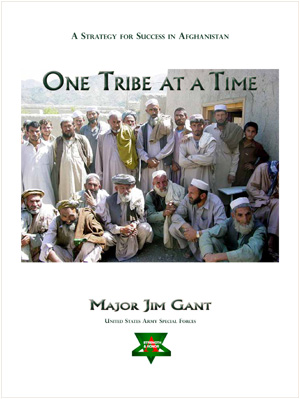
[Because of the extraordinary response to Maj. Jim Gant’s paper, One Tribe At A Time, I’ve decided to leave it up all week in the “Number One Slot.” My ongoing interview with Chief Ajmal Khan Zazai will pick again next Friday; the Chief has been in Kabul all week, meeting with U.S. and British commanders, and we haven’t had time to speak. So all’s well that ends well!]
The downloadable and open-able .pdf of One Tribe is here, on the right. On a personal note, let me say again that I consider it a privilege to offer this document in full, not only because of my great respect for Maj. Jim Gant, who has lived and breathed this Tribal Engagement idea for years, but for the piece itself and for the influence it is already having within the U.S. military and policymaking community.
One Tribe At A Time is by no means a super-pro Beltway think tank piece. What it is, in my opinion, is an idea whose time has come, put forward by an officer who has lived it in the field with his Special Forces team members–and proved it can be done. And an officer, by the way, who is ready this instant to climb aboard a helicopter to go back to Afghanistan and do it again.
Questions and comments
At the moment, Maj. Gant is at Fort Polk, Louisiana, getting ready to deploy to Iraq, where he will lead an Iraqi commando battalion. He’ll be available in the meantime, however (depending of course upon time demands), to answer questions or take criticisms. Just respond in the comments section below. And I myself have further thoughts I’d like to offer on this subject in the coming weeks.
Here’s a quick one:
The most common response I anticipate to the Tribal Engagement concept (and it’s a valid criticism, shared by Maj. Gant) will go something like this: “Yeah, this is a great idea–but where are we going to find the men to implement it?”
Men for the job
Tribal Engagement Team members, should this concept be adopted, would be called upon to commit for multiple tours under the loneliest, harshest and most hazardous conditions imaginable.To succeed with the tribe they are assigned to, they would have to demonstrate impeccable combat credentials and, even rarer, possess the “people skills” to establish and maintain rapport across a cultural chasm—Western to Tribal Afghan—that has defeated every outside entity from Alexander the Great to the British and the Soviets.The task would be extraordinarily difficult, dirty and dangerous, and in the end would almost certainly be rewarded neither by career advancement (because the enterprise would be unprecedented and outside the normal channels of military promotion) nor by recognition from the public at large, who in all probability will rarely hear of it and wouldn’t understand or appreciate it if they did.
How can we identify and attract such men?
Do you remember this tiny, three-line ad from the London Times, December 29, 1913?
Men wanted for hazardous journey, small wages, bitter cold, long months of complete darkness, constant danger, safe return doubtful, honour and recognition in case of success.
5000 volunteers queued up in response to this advertisement, posted by Ernest Shackleton seeking crewmen for his Antarctic expedition.
I may be wrong, but I don’t think our young American warriors would respond with any less enthusiasm than their British cousins did a century ago to a similar call. Do you?
Again, many thanks to Maj. Jim Gant for writing One Tribe At A Time, to Printer Bowler for designing and editing the .pdf and to Callie Oettinger for managing the outreach. I’m proud to put this document in circulation with as much reach as this modest blog can offer. We all hope it proves of interest and of use.
DO THE WORK
Steve shows you the predictable Resistance points that every writer hits in a work-in-progress and then shows you how to deal with each one of these sticking points. This book shows you how to keep going with your work.


THE AUTHENTIC SWING
A short book about the writing of a first novel: for Steve, The Legend of Bagger Vance. Having failed with three earlier attempts at novels, here's how Steve finally succeeded.

NOBODY WANTS TO READ YOUR SH*T
Steve shares his "lessons learned" from the trenches of the five different writing careers—advertising, screenwriting, fiction, nonfiction, and self-help. This is tradecraft. An MFA in Writing in 197 pages.

TURNING PRO
Amateurs have amateur habits. Pros have pro habits. When we turn pro, we give up the comfortable life but we find our power. Steve answers the question, "How do we overcome Resistance?"

Steven,
Thanks for posting this! I look forward to reading MAJ Gant’s full paper. I’m sure it will reach all the right people…
Shamus
Major Gant’s experience reminds me the Jesuits’ work in their South American Missions in the 17th and 18th centuries. With a deep cultural and spiritual empathy, the Jesuits laid a highly succesful strategy not only to catechise the Guaraní Indians, but also to give them new economic development opportunities and even creating an Indian militia to fought the Bandeirantes (Portuguese slave traders).
Although Major Gant does not use the word empathy in his document, I feel there is a deep empathy with the tribesmen in his work in Afghanistan. If possible, I would like him to share some reflections on this.
Congratulations to Major Gant, and many thanks to Steven Pressfield for sharing the document .
R. Camacho,
Thank you very much for reading the blog and the paper. First, although by far the most important and hardest part of this strategy (or any strategy that involves working with indigenous forces) I do not touch on it in the paper in any detail. That subject, by itself, is another paper or even book…I am very impressed that you picked up on the most critical piece of the equation…In a nutshell here is what I believe about “building rapport”.
Rapport equals Relationship.
In order to build a true relationship in this type of scenario (and thousands of soldiers((from PFC to General)) have been doing this extremely well for many years now) one must have very good inter-personal skills, intelligence, good experience (notice I say ‘good” because all experience is not ‘good’), technical and tactical competence, patience, sincerity, true self-awareness, but most important of all is EMPATHY.
One must be able to put themselves in someone else’s position. See what they see. Feel what they feel. With this empathy and a little perspective – everything changes. I, however, also believe that the ability to do this is a God given gift, much like leadership. Although through professional development, reading, training and hard work one can become “better” at building rapport or being a leader, I believe the ones who are great at either are born with a lot of the necessary attributes. But yes, you are 100% correct, without empathy, one can have everything else and they will fail.
Once again thank you for writing and reading the blog.
Take care.
STRENGTH AND HONOR
Jim Gant
[…] The long version is written by Maj. Jim Grant, US Special Forces and is called One Tribe at a Time (45 pages, PDF). The piece outlines the formula for proven success in dealing with the Tribes of Afghanistan […]
Two takeaways I especially enjoyed:
The bamboo plant analogy.
The TET concept.
At first, I thought this was going to be “just another COIN” document. It isn’t. It is essentially a demand for a tribal equivalent to the Embedded Training Team. Of course there arn’t enough SF to go around to do this, so it will require yet another shift in our soldiers and Marines’ thinking.
I enjoyed the read.
The bottom line on page P43 says it all.
I don’t believe that it will that difficult to find the troops to fill the TETs: certainly Canada, the US and the UK now have something we all lacked ten years ago and that is a current generation of combat-experienced troops: those with the skills and attributes for a TET should be easy enough to identify. While commanders may resist losing some of their best to the TETs, in terms of the long game, this is something we must do – much the same way as artillery units have been reroled to fill the need for CIMIC.
Very great thanks to Steven Pressfield and MAJ Gant for sharing this pivotal document with us.
Great post!!
Steve/Jim,
Grewat post as always
While I have no doubt that we can find such men (an women to as the situation requires); I think you all underestimate the institutional obstacles that need to be overcome before the first dude sets foot in a tribal area.
How are you going to ensure that these TET experts are relevant in a system where long term engagement is measured in one 12-15 month rotation for conventional forces and a 5-7 month rotation for SOF. Currently, it is pretty much make the metrics (i.e. EKIA, EWIA, Detainees, and a few MEDCAPs sprinkled in for good measure) over your rotation; or suffer at the hands of higher HQs that measure success to the tune of “on with the body count” or how well they “protected the force” (never mind that neither is going to do what needs to be done (WIN THE WAR(s)).
With the current paradigm; a guy assigned to a TET for 3 years would see (or not see if the higher HQ doesn’t deploy) 3 x Company Commanders and 2+ x battalion commanders over the course of the 3 year tour. And oh yea, that doesn’t even count the unsynched conventional battlespace owner rotations (with US conventional commanders or NATO counterparts in the case of Afghanistan) swapping out as least as often as SOF higher HQs. How about the whole deal for unity and continuity of command!?!
We talk persistent presence and enduring engagement, but the personnel system is just not set up to support it. Without even factoring overseas contingency operations in two major operational areas and about a half a dozen minor ones (the artist formerly known as GWOT); the DOD personnel system introduces so much turbulence that you would need to set up a completely unique personnel system to support TET. New service? Maybe.
Bottom Line Regardless:
For it to work, we need to tell dude signing up for TET on day one that the endstate is to WIN THE WAR(s)!
– Not redeploying with all men, weapons and equipment at a set period of time.
– Not beating out you fellow commander with metrics.
– Not to get back with no bad paper so you get picked up for CSM or the War College.
WIN THE WAR one counterpart at the time, regardless of what progress is measured in (forward, lateral, or even backwards movement)!
What a concept.
Sometimes it seems like that is not part of the mission analysis.
Jorge
Jorge,
I for one, cannot argue AGAINST one single point you made. You are correct on ALL accounts. That is one reason why I believe this has to be a “special” unit. I hate using that term…lets see…how about “different”???
Yes, you are right. It is that “drastic shift” on page six paragraph number one that I also knew would be the biggest obstacle.
You definately know what you are talking about. I hope I get asked to do this and if I do – I’ll blog you and we will get to work.
I wish I could have made this a more interesting argument – but I can’t.
I do however, believe that it could be done. We could find the men, we could find the right C2 element, we could find the right place and time, we COULD do this. But WILL we?
STRENGTH AND HONOR
Jim
All I know about Afghanistan is that they didn’t attack us, as President Bush and Obama have claimed. According to 9/11 Scholar Emeritus, Dr. David Ray Griffin, nine books on the tragedy under his belt, the last about Osama bin Laden: he wrote that Osama was dead, died around December 16, 2001 from kidney problems. Was buried in an unmarked grave in Pakistan. And so announced in Pakistan papers. Yet the tapes, DVD’s and such keep coming, produced by CIA. It behooves US to keep Osama myth alive, to influence US policy at home, and so that there’s a bad guy to blame. Yet Osama in his first tape never admitted to causing 9/11 and did not think it was the Muslim thing to do to kill innocent people, particuarly women and children.
Voice morphing was used in later tapes and stand-in Osama’s, some with fuller faces, lighter beards, no paralyzed left arm, one with a died beard, wearing gold ring, prohibited in Muslim tradition. Dr. Griffin also received information of Obama’s death from former CIA Station Chief and author, Robert Baer. Thus, if Obama is dead, why are we still blaming the Afghans for harboring him? Why are we blaming Afghanistan for attacking us. They didn’t. The US Government was behind the false flag operation of 9/11, used to create the War on Terror, and to attack Muslim countries, Afghanistan and Iraq, the latter for its cheap sweet crude oil, the former for a pipeline route north to the Caspian Sea Basin and its oil and natural gas, and to deliver it north via pipelines built to Europe, southbound to Pakistan and the Indian Ocean. The oil would then be exported to the East. That’s what our our Afghanistan emnity is all about.
And now our General Big MacKrysol wants 80,000 more of our boys to harass the Afghanis and get themselves killed, especially as winter comes on and the land deep-freezes. The whole project is a lie and insane. What’s more the CIA wants to hold onto the opium crop to finance its black ops. When the Taliban was in full power, production went down 98%. Now it’s all the way back up. I don’t believe in keeping one American soldier there. Pack up, come home, call it eight ugly years. What Alexander the Great, the British Empire, or the Soviet Union couldn’t accomplish, the conquering of Afghanistan, we will not either. Suicide mission. Many thanks for listening to an alternative voice. God bless America. Best wishes for your safety and immortal soul.
Jerry Mazza, NYC, where it first happened,
[email protected].
Dear Jerry,
in the most of your oppinions , you are right.. it sounds strange to send army to afganistan , to try to control the stuff there….I dont know what things you know about them , there, in USA, but here, in Greece, we are closer to them and , as i know , whe have an clearer view of the situation there…exept this, unfortunatelly, we have many afgan illigal immigrants here, and i can assure you that, because of the Talibans government , those people live like neaterdals….
They dont have respect to anything exept what their politically moving priests say to…they treat to women like animals and worst… before some days, allmost a month, they kidnaped an Greek teacher, because his was a teacher to Kalash people, people who live there from Alexander the Greats times, and they call themselves as Greeks, sons of Alexanders soldiers…Their anatomy doesnt seem like an arabian or afganistanian…but as a greek…I cant imagine what would happened if those people, taliban , stay alone, without UN troops there….
I think the “Download” hyperlink is messed up. I received it as a “.php.pda” file. Obviously that is not right. Is the link broken or am I?
it sounds too good !!! Mr Pressfield , do you know if it will be published at Greek, from the Greek publisher…?
Mr. Mazza,
You must be one of Nancy Pelosi’s boys. You may be from NY where it all started but you’ve obviously missed the forrest for the trees. I can tell you that I personally know someone who lost his Dad the morning of September 11, 2001. I also work, everyday, with someone who lost 40 friends/colleagues from the NYPD with offices in the World Trade Center. He left the NYPD to show support to the men and women of the US Military by coming to work for us. I say to you, he would be appalled if he read your comments. The fact that you think your President and my Commander in Chief would put us in harms way to influence US Policy at home is treacherous. Neither President Bush nor President Obama ever said that Afghanistan attacked us. President Bush said that we would go after anyone who harbored terrorists. That’s why we’re there. The difference between the United States and Alexander the Great and the Russians is that they went in to Afghanistan to conquer and take over the lands. The United Kingdom invaded Afghanistan because they feared Russian encroachment into Central Asia. The United States is not trying to conquer Afghanistan and take it as a common wealth. We are there to disrupt and destroy Al-Qaeda. US National Security Strategy is to strengthen alliances to defeat global terrorism and work to prevent attacks against us and our friends. Stability, or lack thereof, is not just National…it’s Global. If you think for a second that Osama Bin Laden is dead then you are as ignorant as your comments portray you to be. Additionally, General McChrystal is not asking for 80,000 troops. He’s asking for 40,000. Since you are not on the ground in Afghanistan and you do not carry the weight of responsibility that our Generals and Admirals carry, you do not understand nor are you willing to understand. It is with a heavy heart that General McChrystal requests 40,000 additional troops. While I can appreciate your concern for the many lives in harms way, rest assured that we all willfully volunteered to be in the greatest military of the greatest country in the world.
Erryn,
STRENGTH AND HONOR
Jim Gant
I have a boy in the Marines, adopted from Romania in 2001. I am wondering if those born abroad, particularly in peasant areas such as he came from (he was a boy shepherd, and we have joked he will have to milk goats again in Afghanistan), fare better or fare worse in the type of operation you describe?
Funny, I thought the same thing about my own boy, adopted from Moldova in 2000, but he’s only 11 now. Still, a special personality, incredibly smart, brave and tough, I think he’d have the ‘touch’.
great idea! Getting back to Warburton with a modern grasp of the issues.
Steven and MAJ Gant, I intend to read the book, thank you very much for posting it. Re: recruitment. I think you are right about the availability of volunteers, so the next question is training and selection.
From colonial times through the end of the Indian campaigns in the Western US there was a need for men very much like those described above. The often came from the ranks of those captured and escaped from the Indians themselves, others came from settlers who grew up on the frontier either or both living and fighting with the tribes. Others came from people who lived far away from North America but whose life mimicked that of the frontier (Scots Highlanders and Scots-Irish for the most part). Others like Sir William Johnson, acquired the skills from serious study over a long time.
During WWII the OSS recruited heavily from refugee camps to find agents with the language and cultural skills necessary to go back to their home territory and lead partisans.
The British experience in India and elsewhere shows a similar eclectic and flexible approach. The raw material is out there.
I think todays Special Forces already have a selection and training program that is pretty close to what is needed. So the question is , do we expand SF to provide the necessary pool of operatives or do we form some semi-permanent task force where suitable recruits are cycled through on repetitive tours? There are arguments for both approaches but that is for another time.
[…] Steven Pressfield: “One tribe at a time, a strategy for success.” […]
Before reading the book, I’m certain it’s got a huge core of correctness — a good future Afghanistan will be based on Tribes. My own gov’t predjudice would be for Tribal Cantons, like Switzerland more than post Civil War USA.
Tribes and Tribal leaders will win in Afghanistan — the USA can help choose which tribes and which leaders in those tribes. It might even help create methods of peaceful cooperation and wealth creation (based on peaceful agreement, also called capitalism).
I fear, tho, that no strategy can win if heroin remains illegal — so that opium selling tribal leaders will remain “criminal”.
To create a prosperous Afghanistan, rather than one ruled by drug/warlords, some legalized poppy buying must be done in a big way.
Tom Grey, you have hit the nail on the head!! We can run a COIN campiagn OR we can run a moral minority campaign. If we try to inflict our won mores and customs on host nations and make them like us, then we will fail. As a part of a successful COIN campiagn we must accept that at time we will have to accomodate some things and people that we don’t agree with or condone at home…if we are that worried about the drug trade out of Afghanistan, there are other ways of interdicting it…
Well for what it’s worth, I submitted a link you the Major’s paper to the Whitehouse.gov site. Who knows?
Mollie,
Thank you!
STRENGTH AND HONOR
Jim
Major Gant,
First off, I’d like to thank you, ODA 316, and all the other American forces fighting in the GWOT to keep fat, middle-aged, computer programmers, like myself safe.
I found your personal narrative of engagement with the Pashtun tribes around Mangwel to be fascinating, and a possible example of how Obama may be able to shift strategies to both achieve his heretofore seemingly impossible goal of reducing our military footprint in Afghanistan and still achieve success (not victory, I agree with you that there is no victory for the US in Afghanistan. There may be victory for the Afghans, there is only success for the US).
This may be an opportunity for the Obama administration to adopt an unconventional strategy in Afghanistan, much like, “the Surge”, in Iraq, to lead us to a successful conclusion of our extensive military involvement in the Afghan conflict. Your strategy holds great promise for the Obama administration because it does not call for significantly more troops, it just calls for the best and brightest and most dedicated troops (and officers and NCOs). IMO, this should be a strategy Obama can embrace, he can pander to his liberal base by not sending additional numbers of troops to Afghanistan and he can still attempt to engage successfully in the conflict, the one he considered, during the campaign, the central war on Islamic terror. It’s a win-win situation, unless there are influential elements in his administration more invested in losing in Afghanistan than in succeeding.
Sorry for the long post, but one question I had was about the dynamic between the tribes and the warlords. I recently read Doug Stanton’s, “The Horse Soldiers”, which is very warlord oriented. It seems that your experience was quite a bit different. For example, Stanton suggests that soldier and unit allegiance is very fungible (“Today my enemy, tomorrow my comrade”), but you state that allegiance to the tribe is fundamental. I realize that these are not necessarily mutually exclusive, nor even in opposition. I’d just appreciate hearing your take on this (maybe) apparent juxtaposition of ideas. Do the tribes pledge allegiance to the dominant warlord or is it more like individual mercenaries (or some combination of these)?
Kind regards,
An Average American
Major Gant,
I took the liberty of emailing your paper to my Senators (Dodd and Lieberman), the White House, and to Senator John Kerry (Chairman of the Senate Foreign Relations Committee).
An Average American,
Thank you for taking the time to read the blog and post. I appreciate you passing this work on as I believe it to be relevant and necessary…the more people that read it, the better.
Thanks again.
STRENGTH AND HONOR
Jim Gant
I will address your other post in a short while!
The British Empire’s military, political and social culture differed vastly from ours. Her young men of education and status, e.g. Winston Churchill, were deeply engaged in military, political and commercial activity throughout the empire,and achieved their positions as a result of same. American military strengths rest primarily in our popular armies rather than in our political elites, which makes it difficult to implement a plan like this. Our young Soldiers are redeploying from Iraq and Afghanistan with extensive combat experience, and many go on to get good educations. However, while they are excellent at fighting the enemy, few have any desire to become more familiar with their cultures. In a way, this is good news, as deployments provide young Soldiers with strong antidotes to their relativistic, multicultural ‘educations.’ Their schools haven’t informed them of what is great about our civilization, but at least they know what isn’t great about the Middle East and Central Asia. On the other hand, our educated elites (with some outstanding exceptions), who could invest the time and effort to learn the languages and cultures, aren’t participating in the GWOT (oops, that is, the campaign against ‘man-made disasters.’). We’d need those elites to implement a plan like this. Sorry, but the limited number of highly talented, intelligent, fit adventurers who could do this job are already occupied in the Special Forces.
I appreciated your article. I’ve been commenting on Military.Com and sent an email to LTG Kearney about setting up “Mike Forces” in each tribal area. It seems some things don’t actually change over 40 or 50 years. Also asked him to please have his boss rethink the move into the cities because my feeling is that the center of gravity is with the tribes not the city folk. Shades of the Montagnards and the Vietnamese. From what I could gather from your discussion I think you believe the same. The only thing I think needs to be expanded upon is “inter- tribal fratricide”. You address a fairly vague, sort of a short paragraph to the problem. Might be a great subject for the next discussion. I used to joke (?) about two adjoining tribes, each counseled by a different A-team, who had an honor disagreement. Would there be a possiblity of two teams trading rounds in support of “their” tribe? Presumably not, with the two teams somehow overcoming 2000 years of vendetta/revenge motivations and getting each tribe to compensate the other in some way to satisfy Honor (good luck on who wronged whom, and how to get each to compensate the other when they both think the other is wrong).
Your approach seems far superior to my nemesis, a retired Armor LTC who thinks the British have actually ever won an insurgency other than by using concentration camps/peace villages. Finally, I hope the SF teams are successful in getting the “legs” to let them go native as required. I once had a leg Colonel radio me to ask if all my men had shaved that day. Fortunately my radio broke up badly during my reply. Good luck and welcome home. (I put this reply in another forum on a similar subject, thinking it was about this publication-my apologies)
Jim,
If you guys are really going to set up this Tribal Engagement Team, I think getting people involved will be as easy as putting it out there. There are many of us who did very similar things in Iraq between 2006-2008. I know it’s a different world in Afghanistan, but many of the principles are the same. Also, you might look at National Guard and Reserve folks. We do the whole “people skills” things on the civilian side and could take our skills to this kind of fight.
I’m interested in your team.
Chris
Dear Major Gant,
I have just finished reading your “One tribe at a time” strategy. Your views on the tribal approach are, at the very least, interesting and thought provoking. I have the following comment though:-
In the event the TETs are deployed on a national level, how would you address potential inter-tribal conflicts where the tribes involved have their own and separate TETs? Would this be a scenario where the American TETs would have to favour one tribe over the other as regardless of the independance of the TETs, American soldiers would nonetheless be subject to the US chain of command?
You do have my support for what you have already accomplished in Afghanistan especially the efforts you have made to understand and live with the tribes. Not many people would be brave and selfless enough to risk their lives for the purpose of making life for foreigners in a foreign land better and this is what needs to be done in Afghanistan. Thanks for your time.
Zaki
Zaki,
Thanks for reading the blog and posting. This question was asked earlier by “Joe” but I get asked thid quite often so I will address it again as it is extremely important:
Here is what I think…First, the reason we first went to Mangwel was because of a “problem”. That “problem” was a fued withing the same tribe. Now this is where things get “sticky”…We very rarely operate in the “black” or the “white”…it is usually in the “grey”. I would venture to say the great teams spend almost all of their time there…so, I decided with very little actual information to tell Malik Noorafzhal that we would support him in whatever he wanted to do. Risky? I don’t know – but it was a good decision. Now to your question: Obviousely TETs would not “face off” against one another…now, as it is with security and protection, it is the relationship you have with the tribal leader that will decide what happens. Now, everything you have done since day one to build a true relationship with the tribal leader and his advisors come into play. Do you have enough “influence without authority” to keep this from happening? Can you influence the underlying issue/problem? Does the other TET have more influence than you? Can you make him see why we can’t do this? Can you and the other TET work “together” to find a mutually beneficial solution? Do you understand the culture enough, to include Pashtunwali, to use it to your advantage? Can you also determine when, in the worst case scenario , you know you can no longer influence the situation and the other TET is in danger? What do you do now? Have you planned for it? Do you stay? Does just one TET exfil? Do you both?
So! As you can see – I do not have the answer. I believe that “being there” with the right people can keep situations like this to a minimum. In closing, one of the most important pieces of information that a TET would need would be as much information as possible on the “human terrain” in the entire area. I would want to know prior to “infil” if possible, if a situation like this existed.
But I can assure you this…I would want other great team members with me to help me deal with a situation like this.
STRENGTH AND HONOR
Jim Gant
Jim,
I was reading the below article from John J. Kruzel and felt it reinforces my case that even when we know what right looks like, we can’t put a square peg in the square hole. I think based on your extensive experience in AF ( and the Tribal Insight) that you would be a great candidate for “Af-Pak” Hands.
Why do you think the Army won’t let you do it and are sending you to do a Training Team Mission in Iraq to work with Iraqi Security Forces? Important sure, but surely your skills and knowledge of AF would nest perfectly in AF-PAK Hands.
To me it is kind of a waste of talent? I wonder if the US Army Human Resources Command got the Mullen memo?
‘Af-Pak Hands’ Strives for Continuity in U.S. Mission
WASHINGTON, Oct. 27, 2009 – The U.S. military is building a cadre of officers who each will serve a multi-year assignment dedicated to a narrow piece of the U.S. strategy for Afghanistan and Pakistan.
Known as “Af-Pak Hands,” the program steeps officers in the language and culture of the region, and limits the range of their duties and focus on a single area for a four-to-five-year cycle. Officers will serve in a similar job at home and downrange, an aspect of the program military officials say will enable them to create and maintain relationships with the local populace abroad, a lynchpin of counterinsurgency doctrine.
“They’ll be a group of experts that will learn to speak the local languages, understand the dialects, become attuned to the culture and remain focused on the problem for an extended period, rather than just on a rotation basis,” a military official said, speaking on background.
In a normal rotation cycle, troops returning to the United States from deployment would likely occupy a different job from the one they held downrange. But the continuity of Af-Pak Hands would reduce the learning curve usually attendant to fresh boots on the ground, with officers building on their knowledge of local culture, language and tribal dynamics upon each of multiple, relatively short deployments.
“The idea is that you’re not reinventing the wheel each time a new servicemember replaces an old one,” another defense official speaking on background said of the program. The department has identified 300 billets that will comprise Af-Pak Hands personnel, including 121 new positions created as part of the initiative.
Af-Pak Hands training began recently, with about 30 officers enrolled in courses taught by the Defense Language Institute, the department’s flagship language and cultural training center. Dari, Pashto and Urdu – the region’s three dominant tongues – make up the 16-week language curriculum.
The initiative comes to fruition as President Barack Obama and his advisors weigh decisions on the next phase of the Afghan war. The debate is said to cover a spectrum of proposals ranging from deploying more troops to a narrower, scaled-down approach that moves away from the counterinsurgency model.
Counterinsurgency is a form of warfare in which a civilian population is in the center of a tug-of-war between an insurgency and the forces attempting to stop it. The Army and Marine Corps in late 2006 published a counterinsurgency strategy written by a host of contributors, and its implementation is credited with helping to reverse violence in Iraq.
“If the strategy remains a counterinsurgency strategy and that’s where the White House takes us, then [Af-Pak Hands] will be critical in the ‘clear, hold and build’ classic counterinsurgency strategy,” the military official said. “You want to get to the point where you relate to the general populace and you’ve built the trust, so that it’s more the population pushing the Taliban out than you trying to pull them out.”
Navy Adm. Mike Mullen, chairman of the Joint Chiefs of Staff, established the program, which has garnered support from Gen. Stanley McChrystal, who took command of forces in Afghanistan earlier this year. Career fields that apply include intelligence, special operations, combat arms and engineering, and could include civil-military operators, a military official said.
“The program goes back to a focus that both Admiral Mullen and General McChrystal had on wanting to maintain some continuity, and understanding that the key to the counterinsurgency effort is building the relationships,” the official said.
“And your best opportunity to build those relationships is to have the same faces and the same understanding of the language and culture. If you’re going to nurture that relationship and really build the trust that you need, it’s got to be a sustained effort.”
Tours of duty, which are expected to be primarily in the contentious southern and eastern parts of Afghanistan, will last six to 12 months, the official said. Duty stations domestically include the Joint Staff’s Pakistan-Afghanistan coordination cell in the Pentagon; U.S. Central Command’s Center of Excellence or U.S. Special Operations Command in Tampa, Fla.; and the Joint Special Operations Command in North Carolina, among other possible locations.
The program is being coordinated through the U.S. Central Command, NATO’s International Security Assistance Force in Afghanistan, U.S. Joint Forces Command and the military services. Service branches are identifying officers for participation in the program, which will comprise a joint force with members of all branches and possibly a civilian component, a military official said.
What do you think? Is the above the real deal or just another information operation?
Jorge
Dear MAJ Gant,
Thank you for your concise paper. Thank you and your team for your service. Allah willing, your orders will be revised and you return to Mangwel to be reunited with Malik Noorafzal and continue your work. You are needed there more than you are needed in Iraq. Continuity needs to be maintained.
I commented about the opium problem on the SWJ site. It may seem tongue-in-cheek but I am dead serious. I believe marijuana is one of the best sources of biodiesel and is a good fit for Afghanistan’s agrarian economy.
Your quote below brought a tear. You are willing to bet your life on it. My prayer is with you and all who pursue your career path with the same commitment:
“I emphasized at the beginning of this paper that I
am neither a strategist nor an academic. I know there
will be many criticisms that span all levels of war,
from military personnel to pundits.
But I also know this: I will get on a helicopter
tonight, armed with an AK-47 and 300 rounds of
ammunition and put my life on the line and my strategy
to the test. Will you do the same?”
Lastly, I have mused for years about an “Armed Peace Corps”. ODA 316 is an excellent example of that. I agree completely with your thesis. Commitment is paramount. I still seethe when I think of Nixon/Kissinger’s “commitment” to the Hmong. THIS CAN NOT BE REPEATED!
De Oppresso Liber!
Salaam eleikum Sir!
Marzouq the Redneck Muslim
Marzouq,
I liked your post. Thanks. two things you mentioned that I will address. First, my team was extremely violent and aggressive. We (like many other ODAs) went for the throat – every time. However, at the same time, the greatest acts of compassion I have ever witnessed came from the same group of men. Second, as I say in the paper, the worst case sceanario is one where we gain a tribe(s) trust and then abondon them somewhere down the road. The second we decide to do this tribal engagement strategy (TES) even if it is with only one tribe, we must commit to arm them (heavily) after we leave, to give them a fighting chance. I hope once we make a committment to a tribe(s) we do it for the long haul.
we aliiikum es-salaam…
STRENGTH AND HONOR
Jim
Major Gant,
Thank you for your reply. My prayers are with you as with all those who risk all.
I hope our govt sees the wisdom in your paper. It exhibitted fine traits such as honor, discipline, integrity, courage and compassion. These are the fine qualities that gain trust.
Salaam.
m
Hello MAJ Gant, I read your paper with great interest. I served at Kandahar Airfield from October 2007 to October 2008 as Command Judge Advocate for ARSIC-S and Legal Mentor to my counterparts in the Afghan Army at Hero Camp. I was also exposed to the Afghan formal criminal justice system, what there is of it as part of an assessment team in Zabul Province. As a lawyer, I think you are right on target when you advocate strengthening Pashtunwali and the tribal justice system. The formal justice system, where it exists, lacks the trust of Afghans, with good reason. It is corrupt.
Kevin,
How goes it? I have already spoken to you off line…It might happen. Stand-by! The Afghan “govermental” judicial system is broke…my question to you is – is it fixable? Why don’t we just let the tribes do what they have always done? Don’t some of the tribes have viable judicial “systems”? The Taliban uses some type of “rule of law” to gain footholds in some areas. They use Shar’ia law do they not? Shar’ia law is in direct conflict with Pashtunwali in some cases. I believe we should be able to exploit that. Please, anything you could add to this subject would be of great importance to me and others. You know how to reach me!
Thanks again for writing.
STRENGTH AND HONOR
Jim
These are interesting ideas and questions. A good place to pose the questions and get them in front of more interested legal researchers, practitioners and scholars would be to join the International Network to Promote Rule of Law (http://inprol.org) and pose them in one of the forums. INPROL was setup precisely to handle these kinds of questions. I’d be happy to make introductions if you aren’t already connected with them.
Major Gant
Thank you – what a insight and what a writer you are as well.
Everything you say rings true. I have lived and worked in many tribal areas – Saudi in the 70’s, Botswana in the 60’s and Ghana in the 50’s.
I think that you can add an element to your intent – The British had a core of “political agents” in country as well. Like your TET’s these were made up of men who made a long term commitment to the local culture. They would learn the language and grow up along side their Tribal partners. By the time they were in their 40’s they knew maybe as much as the locals.
I think that a Tribal approach would best if your very local and “hard” aspect was supported by a regional “soft” aspect that was very political – added to a “Viceroy”.
Let me explain. Clay Christenson is very clear that “disruptive change” will attract massive retaliation from the status quo. It is not enough to have a handful of very senior folks say yes. Big Army will go all out to kill this. Why? because, if this works – and it should! – they are doomed. The US goes from datge 2 – stage 5 in one go. So be assured, they will do all they can to undermine this and you.
Martin Luther faced the same challenge. His “viceroy” his Elector. Without the support of his Prince, he would have gone to the stake. Plus he had something that you do have. He had access to to anew information technology that looped the establishment – the printing press – you have the internet and Steve.
Luther ensured his survival by making a deal with the North German Princes – go with me and you get rid of the control of the Pope and the Emperor.
I say all of this because as an old hand, I know that you are right and that your ideas will immediately flag the “boys” about how dangerous you and your ideas are.
So being right will not be enough.
You are going to have to be as smart as Luther is staying “alive” and in winning the support that you will need to keep the “boys” from killing you and your ideas.
Please be Luther and not Jan Hus
Rob Paterson,
Thank you for reading the paper and posting…that was a great post and I get it…but…I usually say and do what I think is best and so far it has worked out OK. And by the way, best and right are two different things. A lot of the times they are the same decision, but sometimes they aren’t.
I have found that in most cases, the most senior leaders desperately want the truth, the unvarnished truth. Sometimes they can effect change, sometimes they can’t. I try and be careful unless I have done what they are trying to do…
Thank you again for your post.
STRENGTH AND HONOR
Jim Gant
For those who are interested, here is a terrific video interview with Lt. Col. Allen West, U.S. Armey (Ret. 2007) who bears out what Major Gant is talking about. Hat tip to The Captain’s Journal who have this featured.
http://blogs.cbn.com/stakelbeckonterror/archive/2009/10/28/lt.-col.-allen-west-on-afghanistan-strategy.aspx
MAJ Gant:
First, thank you for your service. Our nation can never fully repay you and your comrades.
I think that I understand what you are proposing, but I’m not sure how this approach would provide substantial benefits in the war on jihadism (more accurate than the title “war on terror”, I think). Afghanistan is and presumably will remain an insignificant backwater as far as I can see. In that way, it is no different than Somalia or Yemen. Certainly it is a concern insofar as al-Qaeda or similar groups can use its territory. But that is true also for Somalia, Yemen or for that matter Germany or the United Kingdom. Yes, we can engage the tribes, but to what end? If engagement is a matter of arming and funding tribes to kill Taliban or al-Qaeda and provide intelligence, does this require your approach?
Mr. Katz, I empathize completely with your skepticism about where even the noblest efforts will lead us in Afghanistan and other beleaguered countries on this planet. It seems that almost every act of goodwill and bonding among different peoples is eventually undone by the powers that be. Those who rule this footstool kingdom, those who harvest fortunes from the misfortunes of common people, are concerned only with political and economic dominion. To the global power brokers at home and abroad, human lives are but scrap metal for the graceless glitz of their worldly estates. For them, there’s no money in peace, and much profit in war.
Humanity’s forlorn zeitgeist would be lamentable, but for one thing: Wherever one human heart nurtures the fire of hope and the willingness to enact it, there is the salvation of this world. Be it in Afghanistan or any other realm, helping people “on the ground where they live” is the measure that keeps everything from going completely to hell.
Major Gant is one who understands that the “war on jihadism” can’t be won by military means alone. He understands that we have to give people legitimate reason to abandon Islamic (and worldwide) fanaticism, and at the same time offer real protection for families and communities under seige. We have to replace the discontent and disillusionment (that Afghans have with America and many of their own countrymen) with genuine acts of consideration and helpfulness. American foreign policy in the last 50 years, especially the last 10, has done more to instigate radical Islam than anything native to their own teachings. Our old imperative of imposing the imperial “white man’s way” on those who have no need or interest in it will only lead to more failure and conflict.
In other words, it’s all about embracing others (who are willing, and there are millions) as family rather than strangers. The jihadists aren’t interested in that approach, and neither are the politicians and their banker, oil-baron and arms-manufacturer sponsors. Those two groups are battling endlessly over geo-political and economic control. The majority caught in the middle are getting hammered, as always, from both sides. Though I can’t speak for him, Major Gant obviously has formed a real bond with these “middle people.” He’s working toward a strong, humane solution to the life-and-death dilemma of regular folks surrounded by heartless adversaries—from American-sponsored, warlord-driven Karzai to the Taliban in the hills. It’s about far more than killing Taliban and al-Qaeda. It’s about protecting families who have children, hopes and dreams just like the rest of us.
Regardless of the lamentable history of how we got involved in Afghanistan, the least we can do is help those indigenous peoples who want nothing more than to be left to their own traditional tribal ways of life. America was instrumental in putting them in this fix, therefore we are responsible to help them out of it. We and the majority of Afghan tribes share a common enmity with the Taliban and al-Qaeda. By helping the tribes, we will make allies where jihadists once had free reign. We will restore a bit of bloom to the tarnished American soul whose misadventures have come back to haunt us all. That’s the right and responsible thing to do.
Our “war on jihadism” needs a huge injection of person-to-person bonding with the common people of Afghanistan (not to mention every other country on the planet). That eventually could bring down our military presence there while steadily undermining ground support for the Islamic radicals. In the never-ending end, who knows? Maybe we can still advance a couple steps for every one gone wayward.
Mr. Bowler and Mr. Katz,
I just want to comment on your references to “the war on jihadism” and the “middle people”. Once you get out of Kabul the current situation in Afghanistan is one of survival. The people are simply trying to survive day to day, it really is not about any “ism” or agenda, it is simply about survival. If the Taliban are going to help you survive then you work with the Taliban, if Al-Qaeda is going to help you survive then you work with Al-Qaeda, if the Americans are going to help you survive you work with the Americans,etc, etc. But if you ask most Afghans they will tell you that they would rather side with and work with the Americans, however, it is about survival and making it through today is what wins out in the end.
The Afghan people are tired, they have been at “war” fighting for their survival since 1979, when the Russians invaded. Prior to the Russian invasion life in Afghanistan was actually pretty good and tribally democratic. So they got rid of the Russians and then the Taliban and Al-Qaeda moved in and stirred things up again. The problem is that the Afghan people are still trying to recover from the damage the Russians inflicted upon them and are not at 100% in order to keep at bay the Taliban and Al-Qaeda. They need a helping hand to get back on their feet.
Now this is where we as Americans mean well, but begin to err. We think everyone thinks and executes everything just like we do and if they don’t they should. This is where we lose a lot of respect with the Afghans. The Afghan way of doing things may be different, but that doesn’t make it wrong. What would success in Afghanistan be…help the people of Afghanistan, the tribes, fully recover and be able to once again take care of themselves and they will be able to keep the bad guys in check.
Would TETs lend themselves to sharing space with NGOs? Adopt a platoon is great but there are only so many times you can send a box of _fill in the blank_ (happy to do so) before you begin to wonder about reaching out to the population those beloved service members meet. Sister cities come to mind. The toy drives were nice. As is the recent Texas vs. Oklahoma clothing drive. Must it only be done through military mail for specific service members? But then NGOs seem to want the Tammany Hall system the tribes are resisting. And rightly so with Qangos costing the UK $13 billion a year and G-d knows how much in the US. Mission-creep? Good luck and Blessings.
We worked hand in hand with the NGOs in our area. The biggest issues for the NGOs in 2003-2004 was security. So when dealing with the local tribal leadership we would always make it very clear that the sooner an area was deemed safe, the sooner the NGOs would move in and provide help and support to the local population. This was a great motivation and time and time again the local leadership eagerly and sucessfully worked with us, the US military, to get rid of the bad guys, which resulted in a safe and secure environment for the NGOs to move into. It wasn’t always perfect, but the steadily improved during the entire year we were in the Paktia/Khowst provinces.
[…] If you’d like to comment or ask questions of Major Gant or Steven Pressfield about “One Triibe at a Time” and the “Tribal Engagement” concept go to Steven Pressfield’s commentary section. […]
I would hope that you would realize that you and others can develop all the wonderful plans that you are capable of but they will be for naught as we have a CinC whose domestic political agenda is more important to him and his immediate associates than victory in war .
Dr Fanning
Do you not feel that perhaps we have had enough doomsaying and petty soapboxing? How do you expect to change the direction of the US Government (by ‘the people’, for ‘the people’, from ‘the people’?) if not through ‘the people’? By that I mean people like MAJ Gant and others who have displayed some initiative and gone and done something that they believe in, and which is circulating at many levels in many nations. The information militia concept supposes that, like the militia of old, ‘the people’ can change the world through information.
The outcome of the campaign in Afghanistan will be decided by ‘the people’, not of Afghanistan but of the USA…the ball is YOUR court, what are YOU going to do? Pick it up or choke…
It is not just about developing a plan, it is about getting the word out to our fellow comrades on the ground about what works and what does not and sharing our knowledge and lessons learned. In doing so this will hopefully allow those who follow us to be more effective quicker and not have to re-invent the wheel.
Five British soldiers and three Afghans were killed yesterday by a disaffected (?) Afghan policeman.
Most people in Britain want the troops brought home straightaway.
I think the main reason they remain there is that the British Government doesn’t want to leave the Americans in the lurch. The usual mantra “To keep the streets of Britain safe from terrorism” won’t wash – its widely dismissed.
Mr. Kharzai deported two senior British officials not long ago because they were talking to the Taliban.
If the Taliban is not the enemy – it’s Al-Qaeda, stupid – why not reach an accommodation with the Taliban?
The sooner the better.
The Brits in Afghanistan is a beast all of its own. I know most are probably going to think I am crazy, but again, the Afghans do not always see things the way we do. To the Afghans the British are a vanquished enemy, so from the get go the British are behind the power curve. What ??…yes, the Aghans see the British as a vanquished enemy (which they are) and even though it is 2009 and not the 1800-1900s the Afghans don’t forget. If you talk to most Afghans they speak as though Alexander the Great just dropped by yesterday.
Why all the trouble in Helmand, where the British were located before the Marines moved in…Governor Akhundzada was removed.
Governor Akhundzada was by no means an angel, but he was/is pro-US and anti-Taliban/Al-Qaeda and he was from the most powerful tribe in Helmand Province. As a result Governor Akhundzada held the respect of the people of Helmand Province and was able to keep the “bad guys” (Taliban, Al-Qaeda and whomever else) in check. But in 2005 the British insisted Governor Ahkundzada be removed and he was replaced by an outsider. His replacement Daoud was dead in the water from day one and was eventually replaced. They are now on their third or fourth governor since Akhundzada and no one other than a local powerful Helmand province tribal elder is going to be able to bring peace back to Helmand, not the Brits, not the US military, no one. But we westerners just don’t get it.
I am by no means saying the attack is warranted or right, just trying to shed some insite as to why the British did and the US military is having such a hard time in southern Afghanistan.
I think you’ve raised an important point here….when I had first received news some years back that the British were going to land troops in Helmand, I couldn’t believe what I was hearing. It had disaster written all over it…..and you’re right, Afghans have a long memory of friends and foes alike. I laugh my head off every day when I hear the British threaten to withdraw their troops from Afghanistan…..if I can offer any advice, it would be that the British should stop making too much noise and restrain themselves behind the American military leadership. Britain can not wash off the stain of her colonial past with a military engagement, no matter how good their intentions. The Americans on the other hand – if correctly understood by Afghans – are the antidote to old Europe, representing the forces of good on this Earth, beginning with their declaration of independance from the Brits, a fact that needs to be drilled into Afghans. I can’t even begin to tell you how the British military involvement in Afghanistan is viewed by Afghans indulging in conspiracy theories (that would be most of them) as naked revenge for their past failures…..can’t get any more FUBAR than this ;~)
Barekzai,
Once again – thanks for posting…There is a lot of good stuff coming on the blog…so stay tuned.
What I wanted to tell you is that I just got finished researching the “First Anglo-Afghan War”…I made the comment to my wife (based on my personal experience with the tribe I was with and how they talked about time) that the Pashtuns had not forgotten and will never forget what happened with the British starting in 1838. The issue between Shah Shuja, Ranjit Singh and Dost Mohammed was the key “inter-personal factor” that caused the British to commit troops. From the research I have done; lies were told about Dost Mohammed that were used to give the British a reason to put troops on the ground…the rest is history…
“Hard is not hopeless; but history may be..”
Once again, keep your insight coming…and I will wait for your email.
STRENGTH AND HONOR
Jim Gant
Jim,
Thank you for responding, I am honored to forward you my Email and have done so as requested. When it comes to Amir Dost Mohammed Khan, even though he gave his word to the British of his intended friendship and acted in no way to the contrary, he was still rewarded by a brazen betrayal. As for Shah Shuja or Ranjit Singh, they were both useful idiots to the British Raj and would have told them anything for securing their support towards their own whims of conquest. The British were a post-enlightenment power, with the likelihood to act on facts and reasoning, rather than on rumors and innuendos perpetrated by scoundrels whose words were only as useful as their value to British interests. To most political wannabes among Afghans however, the greatest act of hostility towards Afghanistan was less so the British efforts at direct conquest, than it was with their having left behind a new state called Pakistan over lands that are clearly Afghan. The way I see it, the current war is 60 years old, with its seeds planted over a century ago. Those Afghan leaders like Amanullah Khan or the Communist PDPA whose fascination with the Nanny state produced a backlash that helped the enemy, only serve to present footnotes that mark Afghan setbacks in what is a greater war. As Thomas Jefferson once stated, “the tree of liberty is sprinkled with the blood of tyrants and patriots alike” (apologies for any inaccuracy in quotation him from memory).
Jeremy Passmore,
Remove any thought of a meaningful conversation with the Taliban organization. Impossible. They’re as much terrorist as Al-Queda is. What they proceeded to do to Afghanistan post Soviet war was deplorable. One of the most ruthless Authoritarian movements in recent memory. Unfortunately, the American government bares the responsibility for allowing such an organization to rise to power. Hind-sight can always be 20/20, what we ought to have done, vs. what was done. As I said, that was unfortunate. Let us also not forget that Al-Queda, and other Islamic extremist organizations are in fact, at war with anyone who is not. There is no country immune to their hatred. To think otherwise is to forget history, and forget that these terrorist groups still thrive. “Dismissing the threat” is a regretful decision, 9/11 proved that to America, I sincerely hope no others endure such a wake up call…
I serve mine for these very reasons. Because I know, and have seen, an enemy that absolutely, 100%, hates my country, and would stop at nothing to hurt my fellow countrymen. I was happy I faced this enemy on the streets of his city and not in the borders of mine.
Having worked SE Afghanistan (Paktia, Khost, Ghazni)/2003, Iraq and several countries in Africa…”tribalism” is word that brings particular significance to me personally. Tribalism is the greatest obstacle for any unified government.!
In the case of MAJ Gant’s proposition..just a few comments.
It has been the objective of the previous Administration and perhaps the current one a strong a centralized Afgh government. The “marketing” of Karzai and his government in Kabul normally has little or no impact because of the tribal cultures, religion (west/Shia versus east/Sunni), language/dialects, clans and historical alliances in Afghanistan. Some elders joked Karzia was rather the “mayor of Kabul” rather than the elected President.
That said, few would disagree… a centralized ïn control” government is Kabul is virtually impossible. Even the ANA is tribal..and many do not trust the other…they are essentially in the army for compensation…nothing more. Ask the guys who fought at Wanat (173rd-13 July 2008) how many ANA got into that fight-
I have supported a regional approach based in part on tribal alliances as the foundation for some sort of sustained “peace” in Afghanistan. The terrain of Afghanistan is the marker that has in the past defined these various regions. But, there are many caveats-
That said, a regional or tribal approach is far from the centralized approach now into it 8th year of implementation and it is doubtful Karzai would ever agree to some “partition” based on tribal alliances. What might materialize is a greater civil war…the Pashtun’s against the other tribes, since they make up about 40% of the population in Afghanistan (and would have the full support of the Pakistani’s and ISI).
Unfortunately, there is no single strategy that may accomplish the “mission” in Afghanistan; but, rather a set of metrics which might allow US to begin withdrawal/retrograde from Afghanistan which may include the regional or tribal approach.
I can recall sitting in a shura meetings with elders who had experienced the massive bombing assault in late 2001 and early 2002 by US forces. When I asked them…what we could do for them in terms of reconstruction..they replied that there was nothing we could do for them..except let them do what they have done for centuries.
At that moment, we were offered a Coke…when the cans of Coke arrived a few moments later, there was crystallized ice instead the aluminum cans…yes..they apparently had refrigeration, So it goes!
[…] President Joseph Biden argues? There is, of course, no shortage of other ideas. A 45-page paper, “One Tribe at a Time” by Maj. Jim Gant, is gaining more and more attention now. Gant argues that one way to undermine […]
This SF living among the villages, was that not the very intent of the creation of US Sf back in the early 60s aimed at the nam.
They did it back then as the French GCMA before therm, successfully to finally leave and let down the very people they came to “help” (or use, but they did not act or think that way, their commander did).
Needs very special people, ver dedicated with a free hand and a LONG stay, patience etc. What I saw elsewhere (M Yon I think) with stone buildings not tents.
I’d like to comment, if I might, on the current, and perhaps evolving, U.S. tribal engagement strategy in Afghanistan, and on the U.S. military strategy in Afghanistan, generally.
Whatever little wisdom I’ve managed to feebly cobble together on the subject of tribal engagement, counterinsurgency, and state-building derives from my two and half years of field experience spent as a civilian police advisor to the Iraqi police, all this spent among Sunnis, in Al Anbar (al-Dulaimi tribe) and Salah ad Din (al-Jabouri; al-Hadithi; al-Ubaidi tribes) provinces.
To establish my meager bona fides, during the late spring and summer of 20005 I had an opportunity to live and work alongside a Marine company at their FIRM base in Saqalawiyah, Iraq, standing up the first functional (post-Saddam, coalition-supported and recognized) IP station in Al Anbar province. My very anemic, layman’s knowledge of counterinsurgency, and of the arduous and oppressive demands placed on conventional soldiers in these environments, derives from my weeks and months spent living and working with these Marines—sharing, along the way, not an insignificant part of their deprivations and hazards. (My knowledge of military life in general derives from six years spent on active duty service in the U.S. Navy). After my just short of a year in Al Anbar, I spent over a year and a half working with Iraqi police commanders at the provincial level in Salah ad Din province. My knowledge of Arab Near Eastern society, and of Near Eastern tribal culture—a tribal culture that is very distinct in kind, but not wholly alien in form, from Afghanistan’s—hails from what has now been some two and half years, then, working routinely and intimately with Iraqis in rural, provincial areas outside Baghdad—in Sunni, tribal areas. My knowledge of state-building, and of the vital role played within it by a modern police force, as the chief enforcement and peacekeeping arm of the state, derives from a total of three and half years spent as a civilian police advisor in Iraq and from my ten years spent as a police officer and deputy sheriff in Chicago and Cook County (whence I know, also, about the pervasive, noxious power of corrupt, illegitimate governments).
This particular experience of tribes and counterinsurgency in Iraq inherently limits, of course, my knowledge of the distinctiveness of Afghan tribes and of the Afghan counterinsurgency. But it does not, to my mind, detract from my more general understanding of the political and cultural dynamics of tribes in Southwest Asia. Nor does it diminish from whatever small wisdom I’ve artlessly managed to fall upon relative to the basic social organization, function, and nature of tribes in not only the Near Eastern political context, but, analogously, the Central Asian.
I share this background, then, in order that I might have an opportunity to weigh in, with whatever scant credibility, on Major Gant’s analysis. Major Gant is, of course, entirely correct in his understanding and analysis of the nature of tribes and tribal engagement. His proposal for a strategy of tribal engagement via a deep and permanent local embedding of TETs, within a hopefully evolving counterinsurgent context and strategy, is trenchant, wise, and entirely correct. Though, I will seek to add an important addendum and codicil to Major Gant’s analysis.
Tribal society and culture, whether Near Eastern or Central Asian, is alien, inscrutable to Westerners. In a context of waging a counterinsurgent war this creates a particularly far-reaching problem and challenge for U.S. counterinsurgent operators, who, relative to such a society, are cultural outsiders. Insurgency implies a hidden enemy, one well ensconced within the local, general population. An enemy so hidden is, on its face, a daunting specter enough to grapple with under any circumstances. The insurgent, by nature, remains a shadowy and elusive foe, even when the host society and culture is entirely familiar to the counterinsurgent operator; that is, even when the counterinsurgent is wholly accustomed to, understands, can relate to—through common language, social organization, values, and customs—and can thus penetrate, the ambient social and culture environment. But when this insurgent enemy is hidden within a fundamentally alien, inscrutable society and culture, the counterinsurgent faces a very tall order, indeed, in seeking to identify, separate out, and defeat such a furtive enemy.
Victory in counterinsurgency thus requires, as a first order, identifying and locating the enemy from around and within the local, general population. Meanwhile, the local population, among whom the insurgent is hiding, may very well be disinclined, for some very good reasons, to assist counterinsurgent forces in this effort. This means that the general, local population, itself, must be the counterinsurgent operator’s first order of business. The local population must become the counterinsurgent’s first object of penetration, understanding, and familiarity. Counterinsurgent forces must, as a first act, make the indigenous population—now inscrutable and unfathomable—at once visible, transparent, accessible, and manageable.
This broad tactical mandate implies, within the present context, a series of operational and strategic tasks. First, the counterinsurgent has to establish a relationship of trust and mutual understanding (social and cultural) with the local population. This is a process made much more difficult in traditional tribal societies, where intimate, deeply personalized, relationships are the basis for all social and political transactions. By definition, these relationships can only be built over time and through routine, intimate exposure and interaction. In seeking to forge these relationships, the counterinsurgent operator must grasp that tribal societies do not operate on the basis of mere rational, economic self-interest (though this is hardly absent, in a milieu of bare material subsistence). Within every transaction, material or otherwise, there is a local, symbolic, cultural language being spoken. Oftentimes, what a cultural outsider, or visitor, thinks the transaction is about, on the surface, may often be about, in reality, something else—something much more important—entirely. (I know and understand these hidden contextual meanings within the framework of working with my tribal Iraqi counterparts. I wouldn’t dare to suggest that I at all understand these dynamics as they play out within entirely localized, culturally-specific, setting of Afghan tribal life. Moreover, each one of these dynamics is subtly impacted by the distinct personalities of local individuals, each of which, beyond the general cultural dynamics of tribal societies, channel and convey these meanings in subtly different ways. Without understanding the individual personalities, in concert with and against the larger tribal culture, much can be lost—another argument for long-term, embedding of U.S. advisors and for intimate relationship-building).
Second, the counterinsurgent, in the course of this local relationship-building, has to win over the host population, eventually, to the task of assisting in culling and giving up, if not casting out, the insurgent enemy around and among its civilian ranks. Only through information and assistance given by the local population can the counterinsurgent operator fist positively identify then eliminate the insurgent. Developing the sort of trust and interpersonal commitment with the local population required to inspire this effort takes time, intimacy, and permanence. All of these are directed prescribed and aptly fulfilled in Major Gant’s proposed strategy.
It is in the third task, as I conceive it, that I have to take issue with Major Gant: building a legitimate, sovereign Afghan state. There is no getting around this. Over the long-term (10 or 20 years, minimum) only an independently functioning, fully sovereign Afghan state can integrate a tribal population, which, along with insurgent groups and militias, is the chief competitor for the state’s power. As long as there are tribes, large populations who only vaguely recognize the state’s authority (if they do so at all), operating independent of the state’s institutions, there will always be within the nation’s borders an un-integrated shadow society, a society of un-citizens, among whom terrorist groups can operate, whom terrorists can intimidate, manipulate, and call on for support and assistance, volitional or otherwise.
It is through the TETs—and only through the TETs—that such a conventional surge strategy, centered on state-building, can be effectively implemented. The tribal population must be moved, if over generations, to the task of subordinating itself to the state. It must be inspired to take up the civic battle of demanding more from the state, demanding that it be more responsive and accountable. It is through TETs that this can happen. It is only through the TETs that this can happen.
On this reading, there is no getting around the task of providing General McCrystal with the additional forces he needs to build the instruments of an effectively functioning, sovereign Afghan state. These eventually bolstered state instruments will then be married, over time, to the tribes, through the liaison capability of the TETs—the U.S. social, cultural, and political intermediaries for the tribes, with whom the TETs have forged close, trusting relationships through their intimate, permanent embedment with them.
Ultimately, the tribes must eventually join the average citizen’s ranks within the general civic population. Otherwise, we will always rely on permanent U.S. embedment within the tribes to get them to do our—i.e., the sovereign Afghan state’s—bidding (to resist and combat terrorist and insurgents).
This, of course, has to be combined with the much more Sisyphean task of mitigating corruption in the Afghan government, minimizing it to less scandalous, more popularly acceptable proportions (it won’t be eliminated; it is a culturally embedded facet of life) in order to render the Afghan state more legitimate in the eyes of its nascent citizens.
Today, it breaks my heart to watch (as I did on a recent Frontline special on PBS) a scene so sadly reminiscent of my own personal experience in Iraq. In the inhospitable terrain of southern Afghanistan, in Halmand province, a 24-year old Marine NCO, working on three hours of sleep a night, in 130 degree heat, patrolling twelve hours a day, sleeping on dirt without air conditioning at night, wading through chest-high grass and thigh-high flooded fields during the day, with not the least amenity of civilization, tries to engage with the local tribal population. Standing before a small group of phlegmatic tribal elders, who squat in front of their mud huts, the young NCO oscillates between barking orders and imploring assistance, trying to squeeze out of these villagers some evidence of local cooperation for his campaign against the Taliban. In his manner and tone the youthful sergeant conveys physical exhaustion; fear and rage over recent attacks against his squad seep through his voice. Sadness and anger over fresh losses and injuries among his comrades weigh on him. Frustration and short-temper escape through his speech. All of this he channels against a local population that is entirely alien to and seemingly wholly uncooperative with him. Under even less oppressive conditions this NCO, at such a ripe age, with such relatively little life experience, with so little wisdom and emotional maturity, and with such limited training for the task put to him, is rendered all but culturally tone-deaf and impotent against this impenetrable, immovable society and culture.
Without embedded advisors who have all the qualities absent in this brave and dedicated young warrior, this marine NCO’s efforts, and those of his many comrades, passed from us and still patrolling, will have all been for naught. I can’t help but believe that Major Gant feels exactly the same way.
A two-pronged strategy, then, of “all-in” in Afghanistan is, by my dim lights, the only recipe for long-term U.S. victory: broad-based, permanent embedment of TETs, without which no surge can succeed (nor any sort of military strategy), combined with full support for General McCrystal’s state-building surge, without whose commitment of resources, personnel, and organizational effort (to build an effectively sovereign Afghan state) we will never be able to withdraw—to effectively delegate to the Afghan state—our direct tactical engagement in Afghanistan.
Thomas,
Your knowledge of all the subjects that you spoke of in your post was in a word: impressive. Thank you so much for taking the time, putting in the effort, and backing your beliefs up with experience, knowledge and answers. Mot people just say “it won’t work” and move onto to the next solution only to say “it won’t work”. I am looking forward to answering your post – out of respect – by the way, and I will attempt to draw more information from you as you clearly understand what a daunting task tribal engagement is. There are many obstacles and pitfalls. I believe the rewards, in the case of Afghanistan, far outweigh the downfalls. On a personal note, thank you for your service in Iraq. I spent 15 months with the Iraqi National Pilce QRF battalion out of Baghdad, and it was truly one of the most rewarding times of my life. Thank you for your service to our country – and your service to the Iraqi nation as well.
I will be answering your post, but you have earned the right for me to spend some time “framing the debate”…
Take care and don’t be safe.
STRENGTH AND HONOR
Jim Gant
Thomas,
I haven’t forgotten you…
I am swamped…
STRENGTH AND HONOR
Jim Gant
[…] and leading to a download 45 page paper by Major Jim Grant entitled “On Tribe at a Time” […]
I’ve read through MAJ Gant’s paper, and I’m not sure about his premise. Some of the things he recommends: that the Tribal Engagement Teams (TETs) have the ability to approve their own missions, spend money as they see fit to help the tribe or help their standing within the tribe (as he puts it, “money and guns equal the ultimate power”), and a change in the rules of engagement to allow the TETs to “drop bombs or pursue an enemy as they see fit” – noting that it will be a “very intense, personal fight”.
His defining vignette in the early dealings with the tribe involved his promise to join with the malik in a tribal fight (p 17) –
OK. Glass half-full, a savvy dealing with the malik that could portend great things. Glass half-empty…Americans getting suckered into a big, ugly tribal gunfight that could turn into just the kind of incident that would cause a strategic communications disaster with lasting repercussions.
And to what end? Should we find the right tribe or sub-tribe that will help us get across the Durand Line to kill bin Laden and Zawahiri (a limited, defined goal) – or look to the tribes to help stabilize Afghan society (somewhat of a larger, ill-defined effort)? MAJ Gant’s observation in his preface seems to point to the latter – he states:
Matthew Hoh decried “valleyism” as the main problem with the coalition approach; MAJ Gant sees a form of it as the catalyst that will have a “long-term positive effect”.
I appreciate MAJ Gant’s passion and I sure don’t have the answers, but it’s those “pitfalls and difficulty” he references that should probably be fleshed out – – including: How do we square this with the host nation government – think of it what you will – objecting strenuously to this type of engagement?
John Burnham,
Thank you for writing and thank you for reading the paper. I will answer your concerns and comments the best that I know how over the internet, as much can be lost in translation, as you know.
First, it is very important to know that, in my case, “things” did work out. US forces in “Sitting Bull’s” area are still today reaping the benefits of the relationship that was built in 03. If you read David Kilcullen’s book,”The Accidental Guerrilla” (a very good book that I would highly recommend) he uses a “Konar case study” to make many of his points about what we should be doing in Afghanistan. In this particular case study he writes mainly about a paved road that got built from Jalalabad to Asadabad and how it impacted the overall COIN fight in the area. What is missing is how did this area get picked to have a road built? How was this area “secure” enough? Who were the major tribal players that supported the project? Who was against it? Well, if you will read “Gifts of Honor” which is on Steve’s web-site you will see that the relationship that was built between my team and Sitting Bull’s tribe lasted for many years and had a may I say “strategic impact” on what eventually took place in that part of Konar. Sitting Bull and his tribe are “major players” in that area. Even today, that area has some of the highest incidents of “Tribe vs Taliban” fighting. So, in my situation – it DID work out.
Now, to answer your question could someone make a wrong decision and get themselves in a bad situation? Yes, they could. Could there be major negative impacts of those situations? Yes, there could. That is one reason that we better have the absolute best people we have on these TETs. It is”PHD” level warfare at its best. We have to have “Geo-Political-Warriors” on these TETs. Another point here is this: My situation took place in early 03…back when Afghanistan was the “wild, wild west”…the environment is much more “mature” now and we know a lot more about who is who and what the situation is on the ground. The TETs going in today will know so much more information than we did in 03. The chances of a mistake being made like you describe are almost nil. Atleast initially. Much analysis and thought will be put into which tribe we will support and why.
Secondly, this type of strategy will help in both the goals that you talk about…Your “limited, defined” goal is, I believe a much bigger plus than you may think it is. Your “larger, ill-defined effort” goal is, at this point, a difficult task. Engaging the tribes, as my paper points out is only one of the many variables that have to be dealt with for us to be successful. I am the first person to admit that in arming and supporting the tribes, for the sake of security, that will make some of the other variables change. Some in the positive and some in the negative. I do however, stand by my belief that getting security for the people (tribes) is by far the most important and hardest part of any overall COIN fight. TETs and the use of a tribal engagment strategy (TES) are just part of an overall effort that I believe would have a positive impact in the overall strategic picture in the region.
I will answer your last question, with a question. Is it a fact that the “Afghan central governement” is corrupt and dysfunctional?’
Which has a better chance of succeding:
1. A strong, democratically elected government who governs the people of Afghanistan in a positve, pro-active manner?
2. Or some type of “loose confederation of tribes and ethnic backgrounds” that govern themselves and deal with the “central government” when necessary?
Thanks again for posting. I enjoyed getting a chance to answer your questions. It is great for me to have to think about and then verbalize concerns and questions like yours.
Thank you for moving the debate forward in a positive manner and I look forward to more posts from you in the future.
STRENGTH AND HONOR
Jim Gant
Barekzai,
Sir, thank you so much for writing the blog. I am fascinated by your insight. I would love to speak with you directly, to learn from you and ask you some questions about what you have said…if you can find the time, please email me at spartan16 [at] hotmail [dot] com.
Thank you again for writing. I am looking forward to many discussions with you in the near future.
STRENGTH AND HONOR
Jim Gant
By the way, check out what the old Amanullah Khan regime looked like almost a century ago:
http://www.youtube.com/watch?v=C8WjrkwgF88
a gut from the coure,
STRENGTH AND HONOR
Jim Gant
Jim –
First of all, thanks for your continuing service. Second, thanks for thinking hard about it and offering advice how the U.S. could pursue our goals in Afghanistan more efficiently, effectively, and economically. Per others who have responded, the aspect of your recommended approach that concerns me the most is the part about aligning a team closely with one tribe. I’m glad it worked so well for your team. The problem will be when tribal leaders seek to use a team for agendas (such as encroaching on another tribe’s turf) that are not necessarily shared by the host government or the U.S. Even the “Ph.Ds” you call for will not always be able to discern all the political, commercial, tribal, family, and cultural forces at play. They will, after all, still be strangers in a strange (to us) land. This is more than a theoretical concern. I believe our forces have previously run into those problems, where, for example, air power was called down on men believed to be Taliban but who may have actually been only men from a rival tribe.
The aspect I agree most with was how your team connected to the leaders of a key village. We should do more of that (though by starting small and planting the seeds in optimal ground). As others have pointed out, this is how most A-teams operated in Vietnam. They had to in order to survive and to accomplish their other missions. It has been my impression that most ODAs in Afghanistan at the time yours was there, and at least for a few years thereafter, got away from that, in accordance with guidance from above. Their missions were more kinetic, which would mean that the way your team operated was more the exception than the rule. Is that also your impression? Anyway, is SF now going more in the direction you advocate?
[…] part, ces évènements ont poussé l’armée à s’intéresser de plus près à un rapport de 45 pages rédigé par le major Jim Gant, l’ancien chef d’un détachement de forces spéciales […]
Jim,
I have no doubts that you are making a strategic impact on Afghanistan, all be it, one tribe at a time. I, another SF MAJ, advocate your approach and will take your ideas with me as I engage in my future endeavors. I read your document and will continue to read and digest it since it takes me more than a few times to truly see the meaning of all things. My initial assessment is extremely positive and my personal experiences in Sangin District, Helmand Province 07′-08′ was brought to the fore front of my mind upon reading your story. I believe you are signing in tomorrow here at the big building, stop the G3 and visit.
Walt,
Will do brother…
ODA 316 was all over Sangin in 04. I will be glad to shake your hand and say “Thanks”…Helmond is no joke…
See you tomorrow.
STRENGTH AND HONOR
Jim
Dear Steven,
I wanted to compliment you on your website and the very insightful pieces here. As well, I’d like to introduce myself, I am an Editorial Researcher for The Mark News (www.themarknews.com) in Toronto.
I thought you might be interested in a number of articles that we’ve just published dealing with the future of the Afghanistan Mission and Canada’s Role in it. Notably, the former Ambassadors to Afghanistan and NATO, as well as the former Vice-Chairman of the CIA National Intelligence Council bring valuable analysis. You can find the page here : http://www.themarknews.com/topics/4
Feel free to browse the articles. We’d be happy to have you publish them on your site, just please link back to us!
Let me know what you think.
Thanks,
Julie
I pray that the ground commanders can see the wisdom in this approach. I pray for the President, and all leaders making decisions, and at the same time I hope that this will succeed DESPITE the general trends I observe in government. Here’s why I doubt the top down lead:
Our problems in the United States, just as these problems in Afghanistan, are problems of family and small units. All problems are relationship based. Just as the British lost to our US troops when they marched down the street with drums beating and trumpets blaring, cut down by our own guerilla US forces at the start of the American Experiment, we will be worn down using conventional strategies.
President Obama’s solutions to the various challenges we face as a country take the approach that the government is here to help. The government is of the people, and it is the people. Only people can help when allowed the freedom to help themselves and given the right information. Government can never accomplish anything without allowing individuals to self govern and reach their potential.
God help this effort and help the President and his advisors to have a little more faith and trust in the fathers and mothers and children who make up the families that make up the United States of America. Only when responsibilities for changing things is placed on the fathers of our country, will any real change FOR THE BETTER occur. Change over the past year with Obama at the helm has certainly altered things, but I doubt many will acknowledge the changes as positive.
[…] One Tribe At A Time #4: The Full Document at last! […]
MAJ Gant, thank you and your men. You keep our families, your families and the families that you meet safe. As a father and husband, I thank you for doing my job. AIRBORNE !
From 2001 to 2003, I had the distinct honor of supporting our long-tabbers, in many places including Afghanistan, as the DASD for Counternarcotics. I spent a fair amount of time both in Tampa and in various places in-theater speaking with folks — from ODA NCOs (the best education) to SOCCENT and SOCOM leaders. I won’t begin the long discussion of why your bright thoughts only now seem to be reaching wide dissemination.
My concern, though, rests with a problem that we have seen since the first SOF deployments (and seems to be continuing).
Let’s assume that an ODB fully implements your plan (and gets higher HQs out of the way and you clearly observe as a requirement). Let’s also say that that ODB Commander has read your paper and fully implements it to success.
The problem seems — to me — to be that, once that successful ODB leaves after 1 year, all the good done is potentially at risk if another great ODB does not follow. More importantly, even if a great ODB comes in, the PERSONAL relationships that the previous team created may be lost due simply to the nature of human relationships.
Do you agree ? If so, isn’t an additional requirement (if, in fact, we are truly at war and willing to do what is necessary in Afghanistan) that the succesful ODB “plant the flag” and stay in their respective AO until mission (as you define it) success ? In other words, you could rotate 3SFG HQ (and, of course, appropriate leave for the men) but the 3rd SFG HOLDS its AO due to the unique relationships formed ?
In any case, I wish you, your men, your allies and all those in the fight the greatest mission success and safety.
You make us proud and thank you for your continuing service. All the Way !
Respectfully,
André
The Afghanis have no interstates, Starbucks, McMansions in sprawling suburbs, BUT ever notice how the Afghanis have something we have lost? They have home, community, family — roots. In America, we sold ours for money. The Major shows the importance of making these connections. We ignore his lesson at our peril – not only in Afghanistan, but also back here at home.
[…] involvement with Afghan tribes — and is being sent back to Afghanistan to do just that. His 45-page paper, “One Tribe at a Time,” published online last fall and circulating widely within the U.S. military, the Pentagon and […]
Dear Major Gant,
I have not read yet the entire book but only a long extract published in the edition of the Phnom Penh Post of Friday 22nd of January.
The extract was enough for me to understand the depth of your thoughts.
You are trying to replicate in Afghanistan what the French forces did in Laos and in the high region of Tonkin during the Indochina War with the GCMAs ( Groupement de Commandos Mixtes Aéroportés).
GCMA’s are their name indicate were highly skilled airborne French soldiers- Officers and NCOs-, multi disciplinary, working hand in hand with local people- Hmong in Laos as well as in the high region and many other tribes such as White and Black Thai, Miaos and so on.
They acted independently, on the rear of the Vietminh forces. Their role was to gather intelligence, destroy and disrupt enemy forces, prepare the terrain for major operations while protecting the local tribes and their territories.
In Laos they were particularly instrumental during the operations aiming at reconquering the territory which was, prior to 1945, at the hand of the Japanese.
In the North West high region of Tonkin they were also very successful, controlling large areas which became out of bond for the Vietminh.
Unfortunately they were too few. The support they got from the Central Command was at time sketchy, specifically when they were confronted with MEDEVAC. Finally they were literally abandoned when the Central Command decided to change its tactics. In these extreme conditions some decided to continue the fight with the local people until complete vanishing; some others decided to rally after months spent in the jungle regular units.This is a very short overview of their history.
Your idea
Dear Major Gant,
I have not read the entire text yet. Yesterday I had the chance to read a large extract which was published in the daily edition of the local Phnom Penh Post. It was enough to understand the concept that you are trying to put into place.
It reminds me of the French military history n South East Asia, more specifically in Laos and in the North west high region of Tonkin ( a region covering the current provinces of Lai Chau, Lao Cai, Son La and Yen Bai in Vietnam).
In both places the French command deployed the GCMAs- Groupement de Commandos Mixtes Aéroportés.
These groups were composed of highly trained, multi-disciplinary airborne officers and NCOs acting with local tribesmen in a very close integration and cooperation.
Their role was essentially to gather intelligence, destroy and disrupt movements and concentrations of enemy forces, prepare the ground for major operations and finally protect tribal ancestral territories.
In Laos they were highly instrumental against the Japanese during the reconquest of Laos territory in 1943, 44, 45. It was the same in the Tonkin high region.
Very unfortunately they were too few to create a real unbalance. Progressively they were lacking logistics support from the Central Command, they became rapidly exhausted due to terrain conditions and losses with no MEDEVAC capability and they finally ended completely abandoned when the Central Command decided to change its warfare. Some decided to stay and continue the fighting with the tribes; radio communications asking for replenishment were heard months after the defeat of Dien Bien Phu. Some decided to rally regular units after months spent in the jungle.
In Algeria we never reedited similar operations though we also used local people, the Harkis who were fighting along with us. History replicates and a vast majority of Harkis were also left behind us.
Major your scheme might work if it gets the support of the SOCOM, is it the correct wording, and CiC. It might work because we a huge logistics for different kind of support, because you have a huge manpower.
However you are part of a coalition, do not forget it unless you want to fight your own war. Consequently if the decision is taken to support the tribes, other forces will have to adhere to the same warfare in their zones of responsibility. Have they been briefed about this concept, I doubt for the time being.
My Commanding General in Berlin was commenting after the tragic incident in the Uzbin valley. In a nutshell his comment was that operations were ill conceived. He was strongly advocating to reinstate an Algerian concept. Spent most of the time in the field, day and certainly night, gather intelligence on Taliban movements and concentrations, do not give them respite, ambush and kill them at night along the itineraries they use. Stop using your FOBs, deploy on the ground! And so forth.
I wish you good luck Major. I hope you will keep me posted. Iwish I could be a bit younger to follow you on the treacherous tracks.
Jacques LE GUEN, Colonel Retired, Mech Infantry, Airmobile and Airborne.
Isn’t this like the CAP program in Vietnam?
Further to my comment of November 4, 2009……
BBC Radio 4’s Taking a Stand today (January 26) comprises an interview between Fergal Keane and Michael Semple who was deported from Afghanistan in December 2007.
Mr. Semple said: “It’s going to be solved through politics.”
MAJ Gant,
I am extremely grateful and enlightened by ‘One Tribe at a Time’. I was first introduced because of a holiday trip to a small town… Alamogordo, NM. I was visiting on the same street as your father who mentioned this amazing book to the people I was visiting. I am with 3rdSFG(A) and although I have been fulfilling my contributions as support to SOF; I was ecstatic to learn what REALLY works and what REALLY matters, because higher HQ doesn’t always tailor our efforts to such and has an agenda which isn’t always parallel to lower. This battle between echelons is all too familiar and persistent. However, I will be sharing this enlightening read with ALL my comrades both here and abroad, and hope it hits the mark on our ‘recommended reading list’. I anticipate requiring my analysts to read it in attempt to better grasp what truly counts, and overall impacts the efforts within Afghanistan. Furthermore, how this occupation can be more worth while not only for those doing the leg work, and participating in the tribal engagement piece… but for those similar to myself whose sole purpose is to support it, beyond a doubt understand it, and alter our all-to-common destructive “kill em all, let god sort it out’” attitude; it wont and cant and hasn’t ever worked that way.
I would like your permission to discuss your key experiences and opinions in a paper I am writing while a student in ALC right now. As analysts, we are incorporating more critical thinking components into our line of work; and with that must capture a step-back approach of adapting new ways of thinking, and letting go of the traditional biases or bandwagon downfalls. I truly believe ‘One Tribe at a Time’ can be a contagious concept which will become a model supported not only by and with the SOF environment; but within the Army as a whole. I do trust your insight and opinions and believe it can overall create the effects desired to assist and build Afghanistan from within. It will take time, and repetition and commitment (Isn’t this concept already a warrior/soldier concept abroad, so why aren’t we doing it?). I am determined as a result of reading your thoughts and experiences it’s beyond a doubt possible!
Thank you Sir for all you have shared, and best wishes in your new endeavors.
With the most respect,
SSG Angela M Roller
Jim,
You never cease to impress. I miss you brother be safe!!
Rob,
Great to hear from you brother.
You take care. Let me know if you need anything.
STRENGTH AND HONOR
Jim
[…] team right there with these tribal leaders, and ensure they get what the paid for. Some of that TET that Jim Gant was talking about. Hell, throw in a couple of shotguns as gifts, and lets fire this thing […]
I am reading today that we are going to be “turning a page” in Afghanistan. In the last few days there have also been some other “gonnas” and this makes me do some writhing in my seat because it reminds me so much of Vietnam and the light at the end of the tunnel that was snuffed by TET! If a group is willing to take any level of losses than they can assault, chew-up or capture any high profile political icon. Guerrilla warfare is 90% political theater—look what we can do and no one can stop us!
The Taliban don’t need to know what were going to do to them, let them feel the results, the American military doesn’t have to be told so let’s not get any false hopes up at home. Let’s please not fall in that particular hole again.
You build a society the same way you build a pyramid, from the bottom up, not the top down. I’m glad somebody gets that. I hope you will have some influence on policy in DC. Good luck.
– Bill
as a descendent of Shackleton I remember the ad well. The expedition was then forgotten in the hubbub of the First World War. Even in the 1970’s, when I first read his story few people knew of him.
Shackleton died a page 3 footnote at an early age, but his legacy of duty, honor, country still remains.
This is what we need more of today. Perhaps we can bring Afghanistan into the 19th Century within 20 years, but the failed state model must be checked for our own security. Thank God we have some of those same men and women willing to remember history and take the long term view. There are not enough of them.
….It’s a tribe indeed!- we’re in Afghanistan dealing with” The Great Game: the old saying : my enemies enemy is my friend not when in their heart they’re still my enemy”. This is a great read if you haven’t read it already: “History of Afghanistan” Steven Pressfield All the best – G-D speed. Elizabeth
hey sir…this ssg reyes from fort polk…i was part of D-co 3bn 162nd…we did ur ldr engagments and now i see why u kicked ass lol…i never knew u wrote a documentary…i should have shaken ur hand…i read it over and over a
Kompliment – macht Spaß auf diesem Blog zu lesen – weiter so!
I enjoyed reading about the benches and foot stools.