The Most Important Writing Lesson I Ever Learned

My first real job was in advertising. I worked as a copywriter for an agency called Benton & Bowles in New York City. An artist or entrepreneur’s first job inevitably bends the twig. It shapes who you’ll become. If your freshman outing is in journalism, your brain gets tattooed (in a good way) with who-what-where-when-why, fact-check-everything, never-bury-the-lead. If you start out as a photographer’s assistant, you learn other stuff. If you plunge into business on your own, the education is about self-discipline, self-motivation, self-validation.
Advertising teaches its own lessons. For starters, everyone hates advertising. Advertising lies. Advertising misleads. It’s evil, phony, it’s trying to sell us crap we don’t need. I can’t argue with any of that, except to observe that for a rookie wordsmith, such obstacles can be a supreme positive. Why? Because you have to sweat blood to overcome them–and in that grueling process, you learn your craft.
Here it is. Here’s the #1 lesson you learn working in advertising (and this has stuck with me, to my advantage, my whole working life):
Nobody wants to read your shit.
Let me repeat that. Nobody–not even your dog or your mother–has the slightest interest in your commercial for Rice Krispies or Delco batteries or Preparation H. Nor does anybody care about your one-act play, your Facebook page or your new sesame chicken joint at Canal and Tchopotoulis.
It isn’t that people are mean or cruel. They’re just busy.
Nobody wants to read your shit.
There’s a phenomenon in advertising called Client’s Disease. Every client is in love with his own product. The mistake he makes is believing that, because he loves it, everyone else will too.
They won’t. The market doesn’t know what you’re selling and doesn’t care. Your potential customers are so busy dealing with the rest of their lives, they haven’t got a spare second to give to your product/work of art/business, no matter how worthy or how much you love it.
What’s your answer to that?
1) Reduce your message to its simplest, clearest, easiest-to-understand form.
2) Make it fun. Or sexy or interesting or informative.
3) Apply that to all forms of writing or art or commerce.
When you understand that nobody wants to read your shit, your mind becomes powerfully concentrated. You begin to understand that writing/reading is, above all, a transaction. The reader donates his time and attention, which are supremely valuable commodities. In return, you the writer, must give him something worthy of his gift to you.
When you, the student writer, understand that nobody wants to read your shit, you develop empathy. You acquire that skill which is indispensable to all artists and entrepreneurs: the ability to switch back and forth in your imagination from your own point of view as writer/painter/seller to the point of view of your imagined reader/gallery-goer/customer. You learn to ask yourself with every sentence and every phrase: Is this interesting? Is this fun or challenging or inventive? Am I giving the reader enough? Is she bored? Is she following where I want to lead her?
When I began to write novels, this mindset proved indispensable. It steered me away from Client’s Disease. It warned me not to fall in love with my own shit just because it was my own shit. Don’t be lazy, Steve. Don’t assume. Look at every word through the eye of the busy, impatient, skeptical (but also generous and curious) reader. Give him something worthy of the time and attention he’s giving you.
The awareness that nobody wants to read/hear/see/buy what we’re writing/singing/filming/selling is the Plymouth Rock upon which all successful artists and entrepreneurs base their public communications. They know that, before all else, they must overcome this natural resistance in their audience. They must find a way to cut through the clutter. As a fledgling cub at B&B, I remember days, weeks, months when our various creative teams did nothing but beat our brains out trying to find some way to make the dull exciting and the unlovely beautiful–and to make the beautiful-but-overlooked gorgeous too.
How, you ask? You’ll know you’re on the right track when beads of blood begin to pop out on your forehead.
Send Me Your Favorite Quotes from The War of Art for Future “Writing Wednesdays”
Future “Writing Wednesdays” articles will be inspired by quotes from The War of Art.
Please post your favorite quotes in the comment section following this post, DM them to my Twitter account (@spressfield) or post them to the Wall of my “Writer” Facebook page.
I will pick one or two quotes the Thursday BEFORE the next “Writing Wednesdays” post. The person whose quote I use in my Wednesday, August 5, post will receive a signed copy of The War of Art.
Reminder: Submit your quotes by midnight tomorrow, Thursday, July 30.
Please limit the quotes you submit to one quote per week.
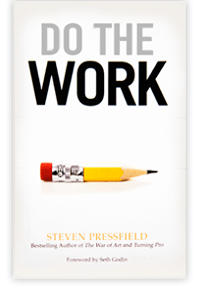
DO THE WORK
Steve shows you the predictable Resistance points that every writer hits in a work-in-progress and then shows you how to deal with each one of these sticking points. This book shows you how to keep going with your work.

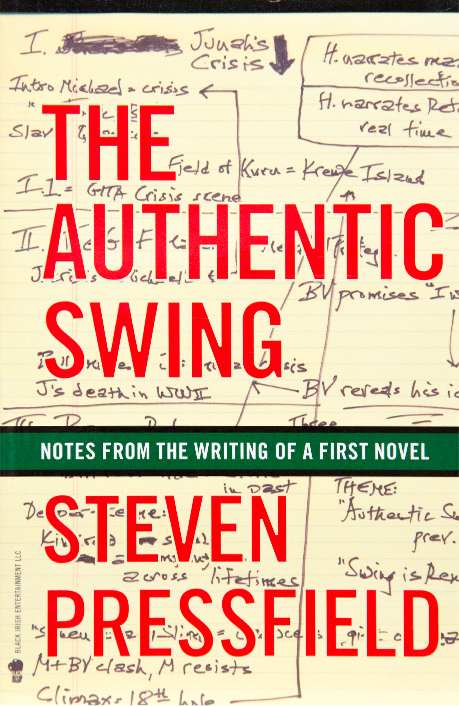
THE AUTHENTIC SWING
A short book about the writing of a first novel: for Steve, The Legend of Bagger Vance. Having failed with three earlier attempts at novels, here's how Steve finally succeeded.
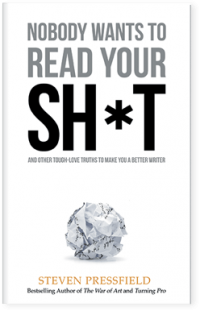
NOBODY WANTS TO READ YOUR SH*T
Steve shares his "lessons learned" from the trenches of the five different writing careers—advertising, screenwriting, fiction, nonfiction, and self-help. This is tradecraft. An MFA in Writing in 197 pages.
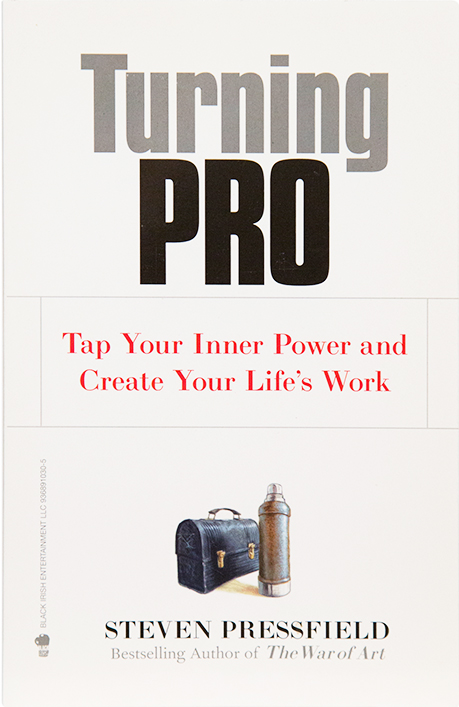
TURNING PRO
Amateurs have amateur habits. Pros have pro habits. When we turn pro, we give up the comfortable life but we find our power. Steve answers the question, "How do we overcome Resistance?"
Thanks for this post, Steven. As someone whose first professional writing job was, and still is, as a copywriter, I can really identify with what you have to say. In my non-advertising work I frequently find myself adopting the audience’s perspective – thinking about what would reach them; keep them engaged. Adopting an elitist attitude that you are writing for yourself and yourself alone – so screw everyone else – is a major mistake.
I apologize in advance for applying a political twist to this BUT … in my newly awakened civic consciouness inspired in no small way by Mr. Pressfield’s blog on Afghanistan, I decided to read all 615 PDF’d pages of the “Affordable Health Choices Act.” Case in point: nobody reads this ‘shit,’ not even the relative handful of our elected officials who ultimately make the choices for all 300 million of us. Our elected officials will vote on this bill — like they have so many others — without reading all the ‘shit’ that comes with it. As a result, we’ve replaced ‘equal opportunity’ with ‘equal outcome’ to the detriment of America. I plan to pass Mr. Pressfield’s lesson onto as many of those officials that I can. Bottom line: KISS.
Favorite quote / passage from: THE WAR OF ART
“The part we create from can’t be touched by anything our parents did, or society did.” pg. 48
Great advice, Steve, and very helpful. If this fledgling author and writer can add two follow-on comments: 1 – Don’t assume the audience knows what you know (or think you know), and 2 – Don’t be afraid to use the ‘delete’ key to remove that awkward paragraph instead of making it longer and even more awkward.
And how about that old Schaeffer Beer ad with Ed McMahon “Take Home 2 sixpacks tonight!” Fewer words = more beer; a great ad!
Thanks for the advice! I am prone to write everything I want to read, it does not mean that anybody else is interested on that.
Wow, this comment really struck me:
Aside from battling Resistance, I’ve found the hardest act in the writing process is reading your own work as an impartial reader. I’m working on this right now with my own WIP. I’ve found some darlings that must be chopped. Damn, it’s hard.
What makes it worse is when you are surrounded by loving, but uninformed, people who think everything you write is golden. It’s easy to slip into this lalaland, then blame the publishing industry when the work doesn’t get anywhere. This is a common mistake of the not-yet-professional writer, and sadly, I’ve done it.
Writing lesson #2: Proofread before you publish, e.g. “lession” in your header. 😉
Definitely: “Call it an overstatement but I’ll say it anyway: it was easier for Hitler to start World War II than it was for him to face a blank square of canvas.”
You know how many “wars” I’ve started with family/boyfriend/the coffee machine before I’ve sat down to write? Well, the number ain’t pretty.
My favourite quote, among many:
“A pro views her work as craft not art. Not because she believes art is devoid of mystical dimension. On the contrary. She understands that all creative endeavor is holy, but she doesn’t dwell on it. She knows if she thinks about that too much it will paralyze her. So she concentrates on technique. The professional masters how, and leaves what and why to the gods. Like Somerset Maugham she doesn’t wait for inspiration she acts in anticipation of its apparition. The professional is acutely aware of the intangibles that go into inspiration. Out of respect for them she lets them work. She grants them their sphere while she concentrates on hers.
The sign of the amateur is the overglorification of, and preoccupation with, the mystery.
The professional shuts up. She doesn’t talk about it. She does her work.”
Fantastic insight into the play between work and inspiration. O for a muse of fire? Get to work, you’ll find her there.
Thanks again for this book, Steven.
“Eternity is in love with the creations of time.” – William Blake
Steve – Love the blog. I was always hoping you’d start one. And I really like “writing Wednesdays.” I’m trying to writing a book and advice from a master is invaluable. Now, let me go back and re-read my shit…
I picked up your book today to read for the third time, and decided to look for you here in cyberspace. I just got here so I missed your offer by one day, but I couldn’t resist. My favorite is “The Marine Corps teaches you how to be miserable. This is invaluable for an artist.”
Dang! Missed this one. Next time, sir.
Whenever I solve a difficult engineering problem this WOA quote always pops up in my mind: ‘Rest in peace, motherfucker.’
Another great WOA quote (in the ‘A professional does not show of’ chapter): ‘This doesn’t mean that the professional doesn’t throw down a 360 tomahawk jam from time to time, just to let the boys know he’s still in business.’
Oh, and what about this one: ‘In the hierarchy, the artist looks up and looks down. The one place he can’t look is that place he must: within.’
There are a lot more great quotes in WOA, but these specific quotes pop up in my mind regularly.
Favorite quote from The War of Art:
“If you find yourself asking yourself (and your friends), “Am I really a writer? Am I really an artist?” chances are you are. The counterfeit innovator is wildly self-confident. The real one is scared to death.”
My favorite quote was what you write on the title page when you signed it: “For Mike, …who doesn’t need this book at all. I salute you!” Boy were you wrong….I needed your wisdom more than anyone you’ve ever met. So thanks for sharing and caring. And especially for caring about our troops. Mike
Here is one of my favorite quotes from the WOA:
“…she doesn’t wait for inspiration; she acts in the anticipation of its apparition. The professional is acutely aware of the intangibles that go into inspiration. Out of respect for them, she lets them work. She grants them their sphere while she concentrates on hers…”
It reminded me of Pablo Picasso’s response every time people asked what did he do to make his muse or inspiration come:
“Que la inspiración llegue no depende de mi. Lo único que yo puedo hacer es ocuparme de que me encuentre trabajando.” (“It’s not up to me whether inspiration comes. The only thing I can do is to make sure that when it comes it finds me working”)
“Call it overstatement but I’ll say it anyway: it was easier for Hitler to start World War II than it was for him to face a blank square of canvas.” I thought of this quote on Sunday Sept 6th, as I watched a scary documentary on Fiorsceal (Irish for True Story) on TnaG (Irish language TV station). The documentary investigated the very real current rise of fascism in Europe. As I watched I thought of all those people too scared to face themselves, who instead compensate by vehemently and violently projecting their fear and self-blame onto others.
pg # for resend of below quote that I posted on Twitter — p. 12 – Resistance is infallible
Submitted by: @kmayn13
“The more important a call or action is to our soul’s evolution, the more Resistance we feel toward pursuing it.”
This was an epiphany for me because of the part of this statement that seems to contradict the notion that we’re writing solely for the love of it. You discuss that too, but you also acknowledge that writing can make you miserable. (or rather, it is the resistance that produces the misery, but that can be the more common feeling during the process)
In our society, we associate doing something we love as something that should be enjoyable, even easy — or else why would we do it? So for years I thought that the degree of resistance I felt toward writing was an indication that perhaps I Wasn’t meant to do it. However I never understand why, of all the things in life that I couldn’t do or didn’t do and couldn’t care less about — so why was did this one thing keep coming back to haunt me. There has never been anything I have resisted more. And in heavy resistance, it is not fun, or enjoyable and I can’t truly say I’m doing it for the love of it. But this quote reminded me that resistance points the way — the true compass you reference. Thank you for that.
my apologies for all the typos and grammars errors above…..didn’t edit before I hit send
This is an amazing article and great advice.. I say this as I proofread a marketing piece with 8 bullets and 2 disclaimers.
Awesome article, it really applies to online marketing too. Keep it short simply to the point, but give the reader what they want.
Steven, great post. After reading it I’ve decided I just might be interested in reading your shit….might have to drop by Chapters and pick up a copy of the War of Art.
Cheers
HI,
Hey Steven, what a prolific article. I’ll be sending it to all my pals. Thanks.
Great points in that post. I sometimes have to give away free copies of my book to people to read, just to get them to admit, publicly, that my shit IS worth reading. And then other people, occasionally, buy my book.
But in general, you’re right. We’re bombarded with media, now more than ever, so you have to make people want your stuff, pique their curiosity … and then come across with something worth reading.
“Nobody wants to read your shit.”
That is such great advice. So very true. Nobody, certainly not one’s wife or the people you love and admire the most in the whole world, want to read you. I spent years getting my feelings hurt being a writer because I didn’t know that. Nothing against people, like you say, they’re just busy.
It should be on a sign over every creative writing class & workshop in the world: Nobody wants to read your shit.
Get over it. Write because you want to, and because you have to, and because you love it, because nobody wants to read your shit, not even you. Writing is not about boosting one’s ego, darn the luck. If you want an ego boost, get into something easy and non-competitive, like washing dishes.
Nicely written. Short, sweet and to the point, just like how all of us in the writing world need to do it.
I have to admit, I barely read this article. I read it enough to figure out what your point was, and that was because it was at the top of the links on Hacker News, which means a bunch of other busy people had already said this was worth reading.
That being said, if nobody wants to read your shit (myself included), they’re even less likely to read the comments way down at the end of the page. Go figure.
So…I’m applying this model to my classroom. Basically, I’m thinking that “none of my students want to know this shit”.
I’d comment but I’m too busy to read your shit 🙂
(Nice piece).
Posting “Nobody wants to read your shit” above my desk at work would be a career limiting move.
So I’ve changed it to “NOW TRYS” as an acronym for “No One Wants To Read Your Shit”. I’ve posted it in my cubicle with a small picture of Gollum from the Lord of the Rings, since that’s the way he talks 🙂 Am I cool, or what?
Rock solid advice! Best I’ve heard in a very long time, perhaps ever.
Ha, I enjoyed the humor in this post. Great information.
Excellent advice. I would apply it to other things, too. For instance, website design. Nobody wants to look at your shit – so you’d better make sure their initial impression of your site makes them want to look at it!
Well, that seemed interesting. Hoewever, I just didn’t feel like reading your shit.
😉
Love it! Now back to cleaning up the pile of dung on my site :))
Excellent article, I believe that the same theories generally apply to teaching in these sensory-overcharged times. After all, different lessons are just products that effective teachers have to market to their students. Unless students can understand why a lesson is particularly important, or have their interest in a subject piqued, their minds will never gravitate away from things they value, like videogames, sports, beer and sex. While completing my teaching practicum this winter, I’ll try to follow your advice with my approach to teaching. Now how to focus on sexyifying without opening the sexual harassment floodgates…
“The awareness that nobody wants to read/hear/see/buy what we’re writing/singing/filming/selling is the Plymouth Rock upon which all successful artists and entrepreneurs base their public communications.”
Really appreciate the advice. We do at times have diarrhea of the mouth and end up puking on people. Not a good practice when you are trying to keep people on your site!
Sincere advice, probably hurting people suffering of auto-compassion (which is useful, by the way, since in this offence/hurt/reaction is hidden the truth about their creative block: it hurts for it is true).
My favourite quote from The war of art comes from Resistance and procrastination, page 21:
<>
My favourite quote from The war of art comes from Resistance and procrastination, page 21:
<>
My favourite quote from The war of art comes from Resistance and procrastination, page 21:
“We don’t say to ourselves “I’m never going to write my simphony”. Instead we say “I’m going to write my simphony; I’m just going to start tomorrow”
Favorite quote, page 37:
“The paradox seems to be, as Socrates demonstrated long ago, that the truly free individual is free only to the extent of his own self-mastery. While those who will not govern themselves are condemned to find masters to govern over them.”
There are 2 books to live by as a writer in my opinion. The War of Art and Three uses of the Knife by Dave Mamet. Thanks again Steve.
“Get in late and get out early” the first thing I leaned about Playwriting.
I have just mounted a new website, tweeted on Twitter to feed my facebook page and I have heard less from people out there than before. So I can testify to the basic truth here: “It isn’t that people are mean or cruel. They’re just busy. Nobody wants to read your shit.”
I agree that this must be met as a challenge to empathize with others. It is about learning to shape your own thoughts into the world and it is about the art of marketing. Even blogging is a means to allow the evidence of order out of chaos to emerge, to allow shapes of thought to appear, to allow an identity and purpose to be visible.
I think that the resistance to honest blogging is when we fight with ourselves about being ready to be seen.
I think people web surf the way they channel surf, job surf, or people surf, for the same reason. They are looking for direction in their lives, and listening to voices they find appealing. Humanity is going through a major change. By 2012, we are supposed to change from fear-based to love-based, and even though that sounds good, a lot of us don’t know where we’re going or how to get there, so they plant their feet and refuse to change. But change is growth. If a living organism isn’t growing, it’s dying. So refusing to change will actually kill you, way sooner than those who manage to adapt to a changing world and move with it. It’s what Darwin called “the survival of the fittest.” Those who don’t believe in
Darwin, who won’t evolve, who refuse to grow, are rapidly making themselves extinct.
Dear Steven, I think your Writing Wednesdays –and the rest of your blog–are a fascinating read. I’ve always wanted a mentor and never had one in any of my paid jobs or volunteering assignments. I am being mentored by reading your blog. By the way, I never worked in advertising but was always subconsiously aware of the Client Disease. Thats is why I am happy to get at least a couple of comments to my blog posts each week 🙂
[…] to Steven Pressfield’s blog writing lesson (”Rule #1: Nobody wants to read your shit”) Ben Casnocha notes: In school anything you […]
That’s wonderful! Totally agree with you — one of my creative writing instructors used to compare writers to plumbers. People are eager for the plumber to fix the leak. No one is holding his breath waiting for my next poem.
I’m going to link to this post on my Creative Instigation blog if that’s OK with you — I do a Site Seeing feature where I point readers toward great posts, sites, etc.
[…] Although I have been registered with Redstate for over three years, I don’t normally post here because I am afflicted with nigh terminal cases of laziness and procrastination; and I have a great regard for Steven Pressfield’s admonition that “no one wants to read your s***”.” […]
[…] Although I have been registered with Redstate for over three years, I don’t normally post here because I am afflicted with nigh terminal cases of laziness and procrastination; and I have a great regard for Steven Pressfield’s admonition that “no one wants to read your s***”.” […]
[…] and historian Steven Pressfield (@SPressfield) has an excellent post on his site called “The Most Important Writing Lesson I Ever Learned.” If you’re wondering what this lesson is, it’s this: “nobody wants to read […]
This blog post is a Fount of Wisdom. This is what I’ve been struggling to capture in discussions, the one unifying principle that informs good writing, the bl**dy Grand Unified Theory of writing. And it only took six words.
[…] to get more people to read your shit 2010 February 24 by Jay L. Steven Pressfield wrote a great blog post a while back on a profound idea – nobody wants to read your shit. Don’t take it […]
nicaragua…
Writing Wednesdays: The Most Important Writing Lesson I Ever Learned…