“The First Five Pages”

Trust me, this is not just for beginners
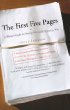
I had been writing professionally for 30 years when I read Noah Lukeman’s The First Five Pages, a Writer’s Guide to Staying Out of the Rejection Pile–and I still learned a ton of valuable stuff. Get this book. If you’re an aspiring writer, it’ll save you from the agony of unnecessary rejection. (You may still get rejected, but at least it won’t be unnecessarily.) Even if you’re a grizzled pro, Mr. Lukeman’s short, smart book is worth reading just to re-bone on the basics.
He can tell if it’s crap in the first five pages
Noah Lukeman was a literary agent. He knows all about going home on the weekend with stacks of manuscripts, 99.9% of which will turn out to be useful only as liners for the bottoms of canary cages. How did he save himself from slogging through yet another 1200-page epic on the fall of the Moghul empire? Short cuts. Tricks of the trade. Out of sheer self-preservation, Mr. Lukeman learned how to recognize the signs of amateurism and ineptitude. He learned to spot a lousy submission within the first five pages.
It is a shame that small–and easily preventable–surface errors can be determinants for an entire book, can prematurely prevent you from being taken seriously. On the other hand, these smaller signs may be indicative of a certain broader sensibility: they may signal carelessness, sloppiness, ignorance or defiance of the industry’s standards; that the writer doesn’t care enough to do the minimum amount of research to make a manuscript industry presentable. Often when a writer’s presentation is careless, his writing is too.
In The First Five Pages, Mr. Lukeman shares with us the red flags of formatting and presentation. Wrong typeface, incorrect spacing, weird paper or mailing boxes. He illustrates the blunders that not-ready-for-prime-time writers make–so that we can catch them in our own stuff and get rid of them.
There’s a lot more to The First Five Pages (not the least of the book’s virtues is the insider’s view it shares with us of what it’s like to be on the other side of the transom, as the editor or agent who has to read our romance novel or YA or diet book). But its delineation of the deadly sins of manuscript submission is alone worth the price of admission.
Signs of an amateur submission
I confess I’m guilty of this one myself: excessive use of adjectives and adverbs.
After its presentation, the quickest and easiest way [for an agent or editor] to reject a manuscript is to look for the overuse, or misuse, of adjectives and adverbs. Cut back … amazingly, you can improve your prose simply by going through your manuscript and reducing the sheer number of adjectives and adverbs.
This is elementary, I know. But mastery of the basics (and constant re-mastery) is the hallmark of a professional.
Here’s another from Mr. Lukeman’s primer: misuse of punctuation.
It is my experience that most people know how to use the period and most people know how to use the comma, most of the time. But you would be amazed at how many people use the comma poorly at least some of the time … and more amazed at how few people really know how to use the semi-colon, colon, dash and parentheses for optimal effect.
Writing for the reader
Robert Louis Stevenson once said (I’m paraphrasing), “It is not enough to write to be understood; one must write in such a way that it is impossible to be misunderstood.”
The First Five Pages may embarrass you. You may recognize yourself (as I did) as a maker of the most boneheaded, amateur-night mistakes. But the book inflicts its pain in a good cause–the cause of getting us to see our work the way others see it.
That’s the agent and editor’s job too. When she evaluates our submission, she’s projecting it in her imagination into the hands of the gimlet-eyed, real-world reader. Is it worthy of his time? Will he respond to it? Is our work up to the standards of literacy and professionalism that the reader demands when he shells out $24.95?
We as writers may not be able to deliver Nabokov-level prose or Dostoevskian insights into the Nature of Man and the Riddle of the Cosmos. But at least we can get our commas right and not mail in to Publisher Z the same recycled, thumbprint-besmirched manuscript that got shot down last week at Publisher Q.
Noah Lukeman’s First Five Pages walks us through the minefield of Manuscript Submission. He points out the booby traps and trip-wires that even the best of us can carelessly or unwittingly stumble onto. We emerge with a fresh appreciation for what our stuff looks like in the eye of the real-world reader–and we come out better for it. Get this book.
DO THE WORK
Steve shows you the predictable Resistance points that every writer hits in a work-in-progress and then shows you how to deal with each one of these sticking points. This book shows you how to keep going with your work.

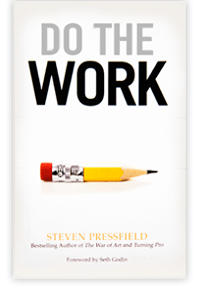
THE AUTHENTIC SWING
A short book about the writing of a first novel: for Steve, The Legend of Bagger Vance. Having failed with three earlier attempts at novels, here's how Steve finally succeeded.
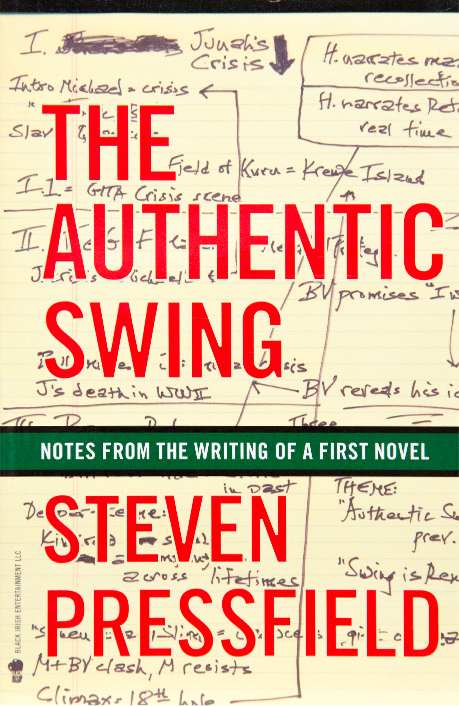
NOBODY WANTS TO READ YOUR SH*T
Steve shares his "lessons learned" from the trenches of the five different writing careers—advertising, screenwriting, fiction, nonfiction, and self-help. This is tradecraft. An MFA in Writing in 197 pages.
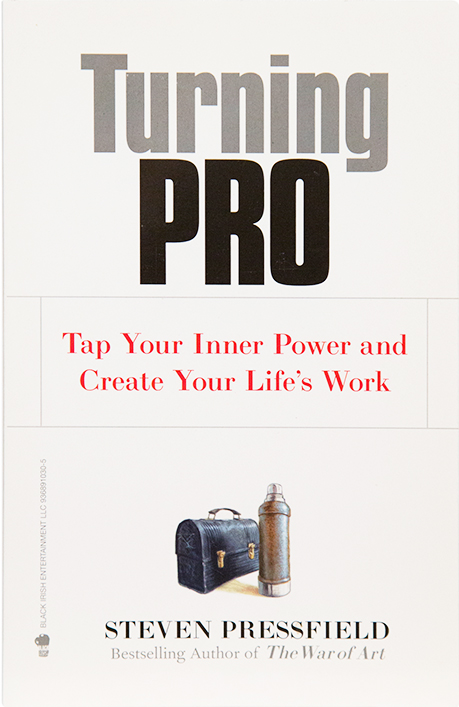
TURNING PRO
Amateurs have amateur habits. Pros have pro habits. When we turn pro, we give up the comfortable life but we find our power. Steve answers the question, "How do we overcome Resistance?"
Typical crap book. I’ve read ’em. Enough of them, anyway. Agents and editors are major POS’s. They don’t know s**t from shinola but they know a typo and will reject a great MS on the basis of a few errors because, hey, a few amateur mistake here and there has to mean the book sucks entirely. Right?
A**holes. Every last one of them.
Shakespeare couldn’t spell worth a damn. Not even his own name. Throw the bum out of the office.
Yeah, presentation matters, but if you’re such a turd that you can’t see a diamond in the rough, see talent in spite of some flaws, then you’re a real piece of crap.
How do you like them apples, Pressman?
By the way, keep spitting on Van Gogh, Blake, and Bach with that dumb, American suck up to a**holes attitude.
We were just talking about this book in my writing group last night! Contrary to your other commenter, I think it sounds like it could be really helpful. And in defense of agents, I think any of them would forgive some of these more technical errors if they could see that the story was amazing.
Sounds like another great resource. Another great resource and good read is William Zinsser’s “On Writing Well: The Classic Guide to Writing Non-fiction.”
I own at least a hundred books on craft. These are the best three…
(1) Story – by Robert McKee
(2) The War Of Art – Steven Pressfield
(3) Techniques Of The Selling Writer – Dwight V. Swain
None of the craft books on the market even come close these three.
I own Lukeman’s book too. But it wouldn’t even make my top 20.
I love the premise of this book as it reminds me of Walker Percy’s forward to A Confederacy of Dunces. John Kennedy Toole killed himself before ever getting his manuscript published and it sat in his closet for close to 10 years or so until his mother started tirelessly shopping it around. Finally, John’s mother brought it to Walker Percy when he was teaching at Tulane or LSU or some such university. And according to Percy, his highest wish was to be able to dismiss both the crazy woman and her son’s manuscript by finding it to be crap within the first few pages. And then the worst thing in the world happened: the manuscript was better than good; it was great!
Few of us have a crazy mother who can shop our script around for years on end until she finds a literary giant capable of seeing its merit. Even fewer can create characters as brilliant as Ignatius J. Reilly. But even if we are so lucky to have both factors in our corner, we still have to keep from being rejected within the first 5 pages.
Thanks for the head’s-up on this book, Steve. Just went on my Amazon wish list for the holidays.
– Jeff
Haven’t read “The First Five Pages”, though I’ll endeavor to at least skim it next time I’m in a bookstore as it sounds like it may be quite valuable.
While not having read this book, I’ve seen a lot of negative reactions to advice from agents/editors before. I find the discredit given to lit. agents and editors by writers to be amusing, if not a little sad. While they may not know “feces from shoe polish”, they know what they know which is what sells.
Right now, no matter how much a lot of literary writers or would-be literary writers screech about it, fiction isn’t selling much at all. Literary fiction even less. A lot of good work may never get published, because its simply not saleable. If you’re a writer who wants to sell, knowing how an agent or editor is going to approach your work is invaluable. You don’t like it – You just have to do it.
Even breaking out of conventional publishing, I see value for this perspective. In the modern age where more and more fiction is being published online and in unique, shorter, formats suited for the internet wired-brain, and writers are depending more and more on the fans directly (vice through a publisher) for support and income, bringing this level of professionalism to the work isn’t going to hurt anything.
There is a problem of not being taken seriously as a writer who is published online, or who publishes emerging formats such as “twitter fiction”, and is making direct pleas to the fans for support. If you’re that sort of a writer, you can afford less to throw away professionalism in your work and attitudes, than many who are being conventionally published or seeking it.
Not saying to sacrifice your art to meet some artificial standards – Learn how to sell your art through the standards is more like it. Plenty of writers have done this – I’ll draw on my favorite author Cormac McCarthy. He uses punctuation sparingly, to include never using quotation marks (even in dialogue rich work). When he does use it though, he uses it precisely. His writing is strong, very powerful and, while eccentric, professional in structure and usage. There are others as well.
I’d say the value of this type of advice is not so much about conforming to the system, if you’re a literary writer, as learning the system so you can work despite it.
You can write the best darn book in the world and still will be rejected. Prove to an agent that you will make him or her money, then you’ll get published no matter how crappy you write’ or spend $100 K on the Iowa Writer’s Conference or some other academic program, suck up to the author/teachers and they will pave the way for your literary novel that no one reads to get published and awarded.
Cormac McCarthy sells 5000 copies of his novels until they get made into a film. Brad Thor sells hundreds of thousands. Both are crap writers but on opposite ends of the spectrum.
Here’s a deal for ya, Steve. I’ll put up the first five pages of one of my books against the first five pages of any of your books (go ahead and put them online if others want to judge), and bet you $50 or $100 that mine is better. And you get to be the judge.
You get to judge your own work against mine. That’s how great my confidence is that I am a vastly superior artist than you. I am so good, so fine, that even as a biased judge, you can’t help but acknowledge the truth to your own detriment, you being a reasonably honest and conscientious person and such.
How about it? game on?
Judging two books against each other, based on “quality,” is impossible. The problem is reader slant.
My wife reads romance novels, which I consider lame hackwork. I read technothrillers, which my wife finds boring and unemotional. We both agree that Literature is worthless crap. We have severe genre fiction slants.
Same with movies. Same with video games. I’m plaing a PS3 game called Dragon Age, which I consider the greatest work of video game writing of all time. On Metacritic is averages an 87 rating. I’ve played most PS3 games that have scored between 80 and 100. But I like this 87 game better than most of the 90+ games. So even the concensus of a collection of professional critics, judging a work based on “quality,” is mostly meaningless. “Quality” doesn’t affect audience enjoyment.
And “quality” doesn’t affect sales. Twilight. Harry Potter. The Star Wars prequeals. What could we compare them to? The Lord Of The Rings? My wife’s friend Jen, a rabid Literature fan, can’t bring herself to finish the LOTR books because she finds them hollow boring generic crap. And she loves the HP series. I have an uncle who refues to watch any movies with exposed nipples. That’s his slant.
Who of us is qualified to judge? Should we create a Secret Committee Of Pretencious Fucks to sit in judgement of all artistic works, to hand out gold stars only to The Truly Worthy? Or would it be easier to just give the job to Oprah? I don’t know. The ecosystem is so complex. Publishers publish, agents represent, authors write, readers read, life is short, time is limited, and people make all their decisions based on pleasure.
Personally, Steven Pressfield’s “The Virtues Of War” is my favorite work of art of all time. I would put it against any book, movie, game, painting, song, or creative sexual position. To me, it’s pure pleasure.
I bought this book during my lunch break, and while I am certain it will be very useful, as a humor writer, I cannot help but point out that there is a typo on page four. Am I supposed to continue reading? Or take it back to the store.
“Home” instead of “Hone”.. in case the author frequents the comment section of reviews on his book.
A friend from Brown just corrected me. “Home in” is appropriate. Who the hell says “home in”? Seriously.
Bought ‘T’he First Five Pages’ last night.
Great stuff. Thanks for the tip.
Being a professional writer and a mainstream Indian journalist myself, I find Mr Pressfield’s observations not only timely but very relevant. Experienced wordsmiths can trip badly without knowing how and why they went wrong. I think ‘The Frist Five Pages’ will be a boon to both the budding and experienced writers. It will help them negotiate the way to literary success, beset with pitfalls and treacherous minefields. Being a die hard fan of Field Marshal Erwin Rommel, perhaps the most masterly military commander in history, I happily stumbled on ‘Killing Rommel’ recently, which I intend to read as soon as I can lay my hands on a copy.