“You Gotta Be Great!”

There’s a theme to all of these Writing Wednesdays posts, and the theme is Resistance: what it is, how it attacks us, how we can beat it. Here’s an insight that struck me with blamm-o impact last week:
I was in Washington, D.C., with Maj. Jim Gant of the U.S. Army Special Forces and Chief Ajmal Khan Zazai, a tribal chief from Paktia province in Afghanistan. We were speaking on the subject of “tribal engagement”—a new military/cultural strategy for Afghanistan—at the Naval Academy, Marine Corps University and several think tanks. (If you’re at all curious about this, click on “One Tribe At A Time” in the header of this page or scan through the “Interview w/Tribal Chief” posts.)
What “tribal engagement” entails, at least the way our threesome was positioning it, is that a small team of U.S. troopers embeds itself with an Afghan tribe and becomes part of the community, living with the tribe, working with it, supporting it, fighting and dying alongside it. It’s a bottom-up strategy for producing security, justice and good governance. Maj. Gant had achieved success using this strategy with his Special Forces team on a prior tour in Afghanistan. That was what he was speaking about to the Marines and midshipmen last week. Onstage, he was trying to be cool and objective, presenting the concept in an impartial, professional manner. But his passion kept getting the best of him.

Maj. Gant at the girls' school in Mangwel, Konar province, Afghanistan
Midway through each speech, Maj. Gant started recruiting. He started firing up the troops. His eyes got big and the veins popped out on his neck. “You gotta be great! You have to be great every day or you’re dead and so am I. Don’t lie. Don’t ever lie, because they [the Afghan tribesmen] will see right through you. They know you better than you know yourself. If you promise something, deliver—because if you don’t you will lose everything including your life.”
Maj. Gant’s mission wasn’t to enlist anybody. The Tribal Engagement program isn’t even in place yet. But he couldn’t help himself. “I want three years from you. That’s your commitment. Not seven months, not twelve months. I’ll send you home for thirty days a year and then you’re back with me in the shit.”
It won’t surprise you, I’m sure, to hear that, each day, as soon as Maj. Gant finished, he was swamped by Marines and midshipmen. “I’m in, Major.” Sign me up, sir!” At night, when he got home to his quarters, his inbox was overflowing with e-mail addresses. “Take me, sir.” “Here’s where you can reach me.”
Now: what does all this have to do with writing or art or entrepreneurship?
Attitude. Attitude in the face of Resistance.
Each day, when we stateside warriors confront our fears of failure (or success), of exposure, of loss or humiliation, of all the outcomes that terrify us in our art and our lives, why not call on Maj. Gant’s attitude?
“You gotta be great! You can’t settle for mediocre, or almost-good or half-assed. Every day you have to be great or people are gonna die.”
Watching those Marines and midshipmen jump out of their seats and swarm around Maj. Gant, it was clear to me that young men and women’s hearts today (and some of us who are not so young) are starving for challenges worthy of their secret, limitless capacities. They’re ravenous for a call to greatness—even in something as obscure and potentially thankless in terms of public recognition as being part of a team of infantrymen slogging into the back of beyond to help people who may in the end only hate us and even murder us.
Who’s going to be your Maj. Gant? Who’s mine? There’s only one inspirational leader for either of us, and he or she is staring back every morning from the mirror.
One definition of leadership is the capacity to recognize the aspiration for exceptionalness in the souls of our troopers—and then put words and deeds to that imperative. Summon it. Call it forth by action and exhortation. Maj. Gant did that last week for those young Marines and midshipmen—and each of us needs to do it too, for ourselves. Inspire ourselves. Call ourselves out. Self-initiate, self-motivate, self-validate.
“We gotta be great!”
Sign me up, Jim (no, wait … make that Steve). I’m ready to go.
DO THE WORK
Steve shows you the predictable Resistance points that every writer hits in a work-in-progress and then shows you how to deal with each one of these sticking points. This book shows you how to keep going with your work.


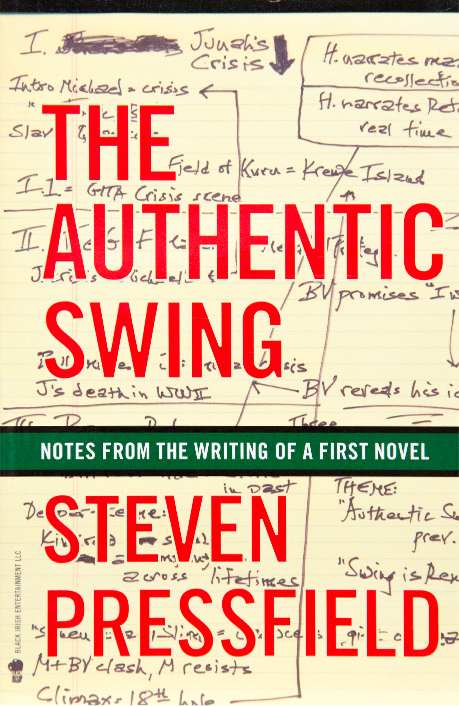
THE AUTHENTIC SWING
A short book about the writing of a first novel: for Steve, The Legend of Bagger Vance. Having failed with three earlier attempts at novels, here's how Steve finally succeeded.
NOBODY WANTS TO READ YOUR SH*T
Steve shares his "lessons learned" from the trenches of the five different writing careers—advertising, screenwriting, fiction, nonfiction, and self-help. This is tradecraft. An MFA in Writing in 197 pages.

TURNING PRO
Amateurs have amateur habits. Pros have pro habits. When we turn pro, we give up the comfortable life but we find our power. Steve answers the question, "How do we overcome Resistance?"

There appears to be an entire MOVEMENT which is viscerally against Maj Gant, everything he does and says and how he does and says it. They appear to be otherwise rational people, well-educated on the war effort at all levels. Is this Conventional Army against Special Forces? Please tell me it’s not that trite. Or is it making someone else look bad and apparently being fired or at least well pushed to the side – hard. I’m referring here to TRADOC’s own Human Terrain Systems whose own paper made the entire argument appear to be one of semantics. We all know what a quawm is; the term was used when Afghanistan was without a doubt crawling with tribes and it didn’t mean the tribes didn’t exist or were changing into something else, it was just a slightly broader term, inclusive even. I would love to hear some thoughts on what this fight is really about and send a hoo-ah Jim Gant’s way.
GAU8,
I heartily second Paul Anderson’s comment below. Turf defense, professional jealousy, academic-style back-biting and competitiveness. The semantic quiblling over “qawn” versus “tribe” takes it to the level of utter absurdity: “qawn” is just the word for “tribe” in Pashto (or Dari, I forget which.)
If I say I stepped in “merde,” how can it possibly make a difference? It’s still shit and it’s still all over my shoes.
Sign me up, Steve! I am ready to be great!
I thought I’d share this inspiring video of JK Rowlings giving the commencement address to the Harvard U. Class of 2008. She speaks about Failure and Imagination.
Great post written with great insight.
The days I get the best out of myself at my desk job are those in which I work as if lives literally depended on my ability to get paper moved off my desk.
Many thanks for posting.
Stephen, my mid-girl was there in the audience! I had heard your exended interviews on H.Hewitt’s show last year, bookmarked your site and made sure my girl saw them as well. She and the Major have exchanged emails. Interestingly enough, this past sunday our parish priest in his weekly bulletin newsletter wrote: we need people willing to challenge themselves…service that requires heroic efforts….the possibility is you won’t be noticed or even thanked…but the reward of knowing you contributed….” Sounded to me EXACTLY like the pitch she reported Major Gant said. Personally, can’t decide whether I should be excited or terrifed by these ideas of yours/Gants. Oh, yeah, BOTH! 🙂 Seriously, thanks for sharing your vision with passion and expertise.
Major Gant’s attitude, if you will, reflects in its finest the “to be or to do” charge of the late Col John Boyd. In particular note these defintions from his brief – “Organic Design for Command and Control”
-Understanding – means to comprehend or apprehend the import or
meaning of something.
• Command – refers to the ability to direct, order, compel with or without
authority or power.
• Control – means to have power or authority to regulate, restrain, verify,
(usually against some standard) direct or command. Comes from medieval
Latin contrarotulus, a “counter roll” or checklist (contra, against plus rotulus,
list).
• Monitoring – refers to the process that permits one to oversee, listen,
observe, or keep track of as well as to advise, warn, or admonish.
• Appreciation – refers to the recognition of worth or value, clear perception,
understanding, comprehension, discernment, etc.
• Leadership – implies the art of inspiring people to enthusiastically take
action toward the achievement of uncommon goals.
Boyd concluded that a more appropriate title would be “Appreciation and Leadership”
For those interested specifically see slides 30 -40 here: http://www.projectwhitehorse.com/pdfs/boyd/organic_design.pdf
and for more on the work of Col Boyd here: http://www.projectwhitehorse.com/boydsarchive.htm
God bless Writing Wednesdays…. always must-read stuff!
Steve, Great post! Writing Wednesday is a regular destination.
GAU8,
There are anti-Gants in every walk of life. People like Gant take heat because their very excellence, commitment and effectriveness puts the mediocre horde to shame, so they are shushed, hushed and crushed (of course it would take a few real men to crush Gant).
Even once you’re past this lizard-brain response, there’s the vested interest cadre to deal with – vested in money, power, and so on.
The world is full of mediocre people (over 50% of people are mediocre. Corporations (while not as risky as the world Gant inhabits and is working in) the world over (personal experience across the globe) are top-heavy with mediocrity . Mediocre silence is the way to thrive wherever you go – military, corporate, you name it.
I would argue that the primary reason Major Gant faces such hostility to his ideas is because of the ‘budget wars’ that take place every year within the pentagon. The course of action that Major Gant suggests would mean these large deployments of conventional based forces are largely irrelevant in future irregular conflicts (I disagree with this line of thought somewhat but I digress). The near future will see no end to conflicts like Afghanistan. So if Major Gants model proves to be a success, Congress will be asking some very tough questions as to the level of funding conventional military needs. This will be akin to the Clinton years of defense department belt tightening. Hopefully however their will be more oversight so we don’t get mismanaged programs like the Commanche or the OICW, etc. Most of the senior military officials are promoted precisely because they are great budget fighters, able to secure some shiny new platform or funding (F22, DDG1000 anyone?). Against this Major Gant has very little real option for success unless these people finally look towards their duty to their country and do the right thing.
I took from this post something that I am seeing at home on the business front lines. It saddens me when I have more faith and see the possibilities for success stronger than the person who possesses it.
What has happened to our people that they can no longer recognize their internal brilliance?
What has happened to our people that they feel like failures before they even put in any effort?
I trust that more leaders step up in our business arena before we lose that battle to fellow business people in other countries.
We are full of promise and yet our people look at what they DON’T have instead of creating what they WANT like some of our fore fathers did when they came here. Focus on where you want to go not where you are not.
I made only one mistake this week…that I know of;-)
I failed to leave a dinner early enough only two blocks away from seeing you and Seth Godin at Border’s in Columbus Circle. Kick, kick, kicking myself!
PS I live for Writing Wednesdays!!!
Praise continues to ring out on the logic of Major Gant’s message.
http://thomaspmbarnett.com/weblog/2010/02/really_working_with_tribes_in.html
Mr. Pressfield,
Please do not EVER stop writing.
I watched Bagger Vance, and it was great, but I felt that I was missing something, so I borrowed the book. If I hadn’t read the War of Art, I probably would not have watched the movie. If I hadn’t watched the movie, I probably would never have borrowed the book. Each step a victory over resistance.
Please do not EVER stop writing.
Jet
Strange. I too watched the movie Bagger Vance, after I had read the War of Art. Both have inspired me to be the best I am, and then share that with the world. I agree Self-initiate, self-motivate, self-validate.
“We gotta be great!”
Jesus, I’m pumped! Thanks, Steve.
All the best to the guys and gals that ask to be taken by Maj Gant. Wish I could go with you.
Rod Roth, Cpl. USMC 1957-60 (1st Force Recon Co.)
I’ve decided to be in love with you. I should probably just stop there.
Read “War of Art” because it was recommended by several different authors (the final hit was from Seth Godin). Here’s expecting that it has changed me.
I didn’t intend to be unable to put “Gates of Fire” down because I’ve never been interested in the retelling of war and I knew that it would be highly detailed and my imagination would fill in the rest. I expected to read a portion and set it aside, maybe to return another day.
But, I can’t stop reading it nor have I been able to stop telling everyone that will listen to me about what I’m learning from you.
I found your blog and have scanned many of the entries so as to mark those that I want to reread and process more deeply.
This last year has been a year in which I have taken up extreme challenges to make the next half of my life quite different from the first half. I recognize the Resistance (love that you practically anthropomorphized it) coming from within and without.
So … sign me up, Diane. I’m ready to go! (And yes … I still plan to just be in love with you … sorry!)
I saw you speak at Borders with Seth Godin last week – thought you were great !! Bought War of Art – just finished it and feel SO inspired by it.
Thank you.
Keeping writing please.
Nice words, nice article, nice people.
Thank you for this inspiration. It was forwarded by a friend on a day I couldn’t have needed it more. The empowerment will surely give me the strength I need to conquer today! I’ll let you know!
Laura
of course infidels would be welcome to change Afghanistan.