Downrange: An Informal Report of a trip to Afghanistan with Marine Gen. James N. Mattis

[Part Four of Four]
COIN doctrine, counter-insurgency theory, says “protect the people” comes before “kill the enemy.” In meeting after meeting we heard all the right things from officers and civilian leaders who were earnest, brave, well-intentioned, smart, sincere, hard-working and absolutely decent and ethical. We heard about construction projects and rules of engagement and mitigating civilian casualties, about liaising with tribal elders and managing escalation of force and irrigation and extracting resources and using local people, defeating the corruption of the Karzai regime, delivering good governance, etc. But I didn’t see any Afghans in the rooms. I didn’t see any in the PRT sessions (the meetings with the Provincial Reconstruction Teams.)
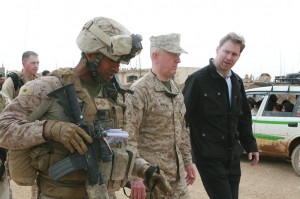
Maj. Cal Worth, foreground, with Gen. Mattis and MP Tobias Elwood in Marjah
Maybe that observation is unfair. Maybe it was in the nature of this trip—that its task was to investigate other areas. In Marjah and Lashkar Gah, we heard about the construction contracts that would start soon and the “government in a box” that would be set up immediately. Certainly the new Afghan flag fluttering over the police station looks hopeful. But Marjah has been a Taliban stronghold for the past five years and those boys aren’t going away. Will development efforts stick? Will the tribal people accept police and administration from the government in the capital? In meetings in Kabul, we heard experienced, honest U.S. generals declare with full confidence that today’s Afghans possess a sense of national identity. “Ask a man who he is and he won’t name his tribe; he’ll tell you he’s an Afghan.”
Will he? I wish I believed it. Searching the eyes of the men and boys in Marjah, the best I could see was wariness and skepticism, the worst enmity and hostility. Who can blame them? I’d be half-Taliban and hedging my bets too. Yeah, the Americans are strong and brave and they’ve got jets and armor. Some of them even speak a bit of Pashto. But how long are they going to stick around?
Can the Machine make the stretch? In Kabul we drove past rows of Arabian Nights mansions behind fifteen-foot walls topped with razor wire and security cameras. Drugs lords and corrupt officials who have raked millions from construction contracts and international aid. To truly reach the people (and that is, after all, the be-all and end-all of COIN strategy), the Machine has to get around that—and around a culture of family, clan and tribal loyalty and patronage that goes back five thousand years, not to mention bonds and rivalries, blood feuds and grievances of honor among warlords who are now cabinet ministers and sub-commanders and ex-mujahideen who are fighting on three sides at the same time and whose codes and secret ways are as impenetrable to our Machine as the squiggles in Farsi and Dari (or is it Arabic?) on the walls of the mechanics’ shops and the ad billboards for cell phones.
11. We meet with ISAF commander, Gen. Stanley McChrystal, in a conference area adjacent to his “war room.” Without exception, the American and Coalition commanders we spend time with are A+++ leaders, and Gen. McChrystal impresses me as the best of the best. Clearly he understands (far better than any of us reporting on it) the maddening complexity of the conflict, and he and his team are working as hard and as smartly as they can to do their job and accomplish their mission. Gen. McChrystal is the only U.S. commander with no budget. What he needs, he gets. He can cherry-pick any individual from any unit and get him sent wherever he wants. At least that’s the theory. But even the Machine can grind slowly sometimes. I ask him if he feels he is getting enough support from up the chain of command. He answers sincerely, I believe, that he feels backed up fully by the White House, the SecDef and all hands in the Capitol and the Pentagon.
I know he means it, and I know that generals don’t get four stars because they don’t relish handling an adult portion. But this chore is a real bastard. I wish I felt that the Prez and the American people were in it with both feet.
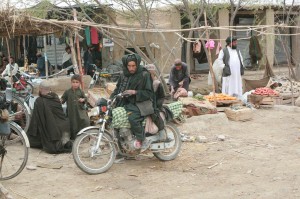
Market scene in Marjah
12. Maybe Vietnam is the culprit–the U.S.’s last unhappy experience with a conscripted army. Maybe blame can be localized to whatever forces or events turned the U.S. electorate off to the idea that every citizen owes service to his country–and decreed that 100% of the burden for defending our nation be borne by 5% of its citizenry. The all-volunteer military is probably the most highly functioning sector in American society and the only one in which the public still places full faith. But our troops are out here alone in space. They can hack it. In their own way they relish it. But that’s a lot of weight on their shoulders–and lot on Gen. McChrystal’s. “Today in America,” says Navy Capt. Kevin Sweeney, Gen. Mattis’ executive assistant, “if you don’t have a son or husband or a neighbor who’s in the military, you don’t even know there’s a war on. You see film on the news but the fight seems a million miles away, and you don’t want to hear about it anyway. It’s someone else’s problem. I don’t blame people. Who wants to ruin their dinner, hearing about civilian casualties and suicide bombers? But it’s happening. We’re here and this is a real fight and somebody ought to know about it.”
What’s my final takeaway from all this?
13. I went into this trip with an axe to grind (the name of this blog is, after all, “It’s The Tribes, Stupid”) and I came home carrying that same axe.
To me, the tribes are the X factor. They and the boots-on-the-ground troopers who work with them are the link between the Machine and the People. We were meeting with Gen. Scaparotti, commander of Combined Joint Task Force – 82, whose area of responsibility is the 14 provinces of Regional Command East, where the Pashtun tribes dominate and where enemy supplies and fighting men roll in and out across the Pakistani border. Gen. Scap told us of the Shinwari tribe, 400,000-strong, who had on their own concluded an internal treaty to resist the Taliban and work with Coalition forces. Tribal elders signed and planted their thumb prints, agreeing to fine any member who supported the insurgency and to burn down that person’s house. I asked the general how he placed this development in context of the overall fight. Was it an aberration or a potential game-changer? “The tribes signing up was huge,” he said. In the cities it’s different because tribal influences are less, but in the country (and 95% of Afghanistan is country) this is exactly the kind of turnaround we need and we must support it any way we can.
Gen. Scap worried though that such self-generated, bottom-up movements can be messy and difficult to control. I told him about my own friend, Chief Ajmal Khan Zazai (you know him if you’ve followed this blog), and the Tribal Police Force he has raised in his district in Paktia province. Though the chief speaks better English than I do and is passionately pro-Western, he has had to move heaven and earth to get the U.S. units in his district to work with him–and as recently as a month ago, American elements were trying to arrest his chief of police. I heard this same skepticism voiced at a recent think tank meeting in Washington, D.C. “Won’t empowering the tribes,” one of the Senior Fellows asked, “inevitably conflict with supporting the central government, which is, after all, our mission in Afghanistan?”
We missed the tribes on this trip. The agenda was to meet with American and Afghan commanders. But in the meetings and the walkarounds and on the plane flights, I couldn’t help thinking about Special Forces Maj. Jim Gant (you know him too from these pages) and the Marine infantry battalions and Special Forces teams and the officers and men of army and allied units who have been, and are today, out there with the real Afghan people. I still don’t know how many of these men (and women too) there are—or where this fits into the enterprise of the overall Machine. I hope we’ve got somebody with the Shinwari. I hope more are coming, to that tribe and to others <em>as tribes</em>. And I hope those officers who are doing this work, in whatever form it takes, are getting support and not just lip service.
14. What makes us Americans different from the Russians or the Brits who came to Afghanistan before us? For one thing, we’re not there to conquer the place. We’re not out to destroy the tribal system, as the Russians tried to do, and we’re not here unilaterally. Our mandate derives from the U.N. and our support comes from troops of more than forty countries. We’re the good guys, and the more up close and personal our soldiers and Marines and PRT teams can get with the village and tribal Afghans, the clearer that truth will become to them and the more impact it will have. The Machine is doing fine in its sphere. The Afghan people are the same as they’ve always been. Where the twain meet, if indeed they do, is and will be face-to-face, person-to-person, man-to-man.
Can we do that? Does the Machine have that gear? I don’t know.
The Senior Fellow at the think tank raised another excellent question. He was expressing skepticism about the feasibility of a policy that reaches out to the tribes and banks on the people-skills of American and Coalition team members to produce bonds and build trust across cultures so disparate and so far apart. “How can the United States bet on a policy,” the Fellow asked, “that relies on geniuses?”
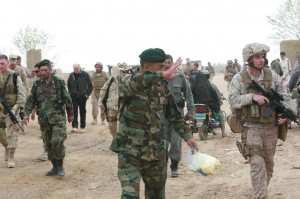
The ANA commander in Marjah. Pressfield is back left, in civvies.
That question shut me up. I didn’t have an answer in the moment. But I think now that such a policy doesn’t need geniuses. It doesn’t need anything that our Marines and soldiers don’t already have and aren’t already doing. It needs smart and brave young captains and lieutenants and sergeants and lance corporals who can connect across the cultural divide. It needs civilians like Greg Mortenson of <em>Three Cups of Tea</em> and <em>Stones Into Schools.</em> It needs money to back these individuals, political will to protect them and patience to keep them in place until they have time to do their job. I hope Marjah works. I hope it’s the start of something.
Afghanistan is ancient; it’s not coming into the modern world any time soon. Afghanistan is tribal. We’re not going to turn it into New Jersey in the next eighteen months. The Machine can’t overcome those realities by itself, and it can’t connect across the gulf between East and West, ancient and modern, unless it can bring to bear a dedicated element whose task is to do just that. I’m not a believer yet. I want to be. When I see that dedicated component–and see it in the field, being supported by our unbeatable Machine–maybe I will be.
[Photos by 1LT Joshua Diddams, MEB-A Media Officer.]
DO THE WORK
Steve shows you the predictable Resistance points that every writer hits in a work-in-progress and then shows you how to deal with each one of these sticking points. This book shows you how to keep going with your work.

THE AUTHENTIC SWING
A short book about the writing of a first novel: for Steve, The Legend of Bagger Vance. Having failed with three earlier attempts at novels, here's how Steve finally succeeded.
NOBODY WANTS TO READ YOUR SH*T
Steve shares his "lessons learned" from the trenches of the five different writing careers—advertising, screenwriting, fiction, nonfiction, and self-help. This is tradecraft. An MFA in Writing in 197 pages.

TURNING PRO
Amateurs have amateur habits. Pros have pro habits. When we turn pro, we give up the comfortable life but we find our power. Steve answers the question, "How do we overcome Resistance?"

Steve,
Thoughtful article. I’m wondering what you mean in your designated point, “11”, by writing, ” I wish I felt the Prez and the American people were in it with both feet.” In what, with both feet? Most Americans I engage with regarding the why/for of AF/PAK, have no idea “what” we’re in. Tell US more beyond the ‘US against them’ extension argument that doesn’t quite map in 2010.
Thanks for putting pen to paper in the eloquent ways you do.
Respectfully,
Herby Bell
I read the line ““How can the United States bet on a policy,” the Fellow asked, “that relies on geniuses?” and immediately thought of “Linchpin.” The Senior Fellow is thinking old school, old Army (in the bad sense), and industrial revolution. ‘The way to do this is to make a policy so easy that even Cogs can run it.’ Well that’s great and all, but you don’t pick your fight – the enemy has a vote. And this is not a war for Cogs. It’s a war for Linchpins. If you ask for Soldiers to be Linchpins and not Cogs, to really bring everything that they learned growing up in America, not just in Basic but back on their block and neighborhood and school, bring that and all of themselves into the fight, we can execute. We can win. Don’t pretend there’s another way though, a cheaper, easier, Cog-centric way to win COIN. There is not, and trying to find that way only wastes time and lives.
Thanks for the great report.
– Bill
I suggest you read Charles Chenevix Trench’s excellent book The Frontier Scouts. It is about the British officered Pashtun scout units on the Indian NW Frontier (now Pakistan’s FATA etc) of the late 19th and early 20th Centurys. Bascially the Brit officers did it similiar to Maj Gant’s approach in One Tribe at a Time, by showing respect and develeoping personal and enduring friendships with the Pashtun soldiers that they led. Steven is right you don’t need geniuses- “again and again, personal liking, trust, affection, overcame differences of religion and culture.” (p. xv) and “The wonderful thing about Scouts; … is that when they get to know you, you make such friends.” (p. 61)
I agree with Bill – it is about linchpins. Seth Godin in his book, Linchpin, mentions Kurlak’s law – it applies here. The closer to the front the more power the person has over the message. If we let the linchpins do their thing we can do this. As Jim Gant said ” I need you to be great!!”
What Scaparotti refuses to understand is that this same “self-generated, bottom-up movement that might be messy and difficult to control” is what the Marines used to ‘turn’ Ramadi and Anbar Province a full year before the Army even had all it’s “Surge” troops out of the US. It’s democracy – it’s messy – get used to it.
Afghanistan belongs to the Afghans. It needs an Afghan solution – perhaps guided, taught, and financed by us – but nevertheless an Afghan solution. That’s successful COIN, as demonstrated by the Marine results in Nawa and other Helmand River Valley villages, the locals moving back into Now Zad, and the first news trickling out of Marjah.
It’s when the Army hunkers down on big FOBs and avoids working with the locals that enables the Taliban to claim that we’re invaders. This SOP didn’t work in Iraq and it’s not working here. The Shinwari’s could be to Afghanistan what Sheikh Sattar was to Ramadi and Anbar – except Scaparotti and his fellow ISAF beaurocrats will spend more time saying ‘no’ to these brave souls than actually trying to assist them.
A great series Steve ! Welcome back and thanks for sharing you visit with us. One question: when are you returning ???
What Scaparotti refuses to understand is that this same “self-generated, bottom-up movement that might be messy and difficult to control” is what the Marines used to ‘turn’ Ramadi and Anbar Province a full year before the Army even had all it’s “Surge” troops out of the US. It’s democracy – it’s messy – get used to it.
Afghanistan belongs to the Afghans. It needs an Afghan solution – perhaps guided, taught, and financed by us – but nevertheless an Afghan solution. That’s successful COIN, as demonstrated by the Marine results in Nawa and other Helmand River Valley villages, the locals moving back into Now Zad, and the first news trickling out of Marjah.
It’s when the Army hunkers down on big FOBs and avoids working with the locals that enables the Taliban to claim that we’re invaders. This SOP didn’t work in Iraq and it’s not working here. The Shinwari’s could be to Afghanistan what Sheikh Sattar was to Ramadi and Anbar – except Scaparotti and his fellow ISAF beaurocrats will spend more time saying ‘no’ to these brave souls than actually trying to assist them.
A great series Steve ! Welcome back and thanks for sharing you visit with us. One question: when are you returning ???
((PS -sorry about the previous anonymous comment; I hit ‘post comment’ too soon))
Mr. Pressfield,
It took me a while to consider a response to this, because I think your “Machine” paradigm is important in the context of some pretty horrible goings-on; namely the disaster of the battle of Wanat.
I view the battle as a tragedy in three parts. First came the string of errors and actions that placed the American base so close to the village with nothing but hills all around it. Next was the battle itself. And finally there is the Army’s responses to the battle in which the Machine denies systemic failures and hangs the men who fought it out to dry.
The Army’s answers to congressional questioning is, to me, unconscionable. Over and again, the high command flatly denies that the local battalion and brigade leadership had become complacent, fatigued, or decisively engaged with upcoming relief operations with the incoming unit instead of keeping their eye on the ball in Wanat. Meanwhile, the Army’s own investigations have produced reprimands for the Brigade and Battalion commanders involved, as well as the Company Commander who lost nine men that day and, as indicated by reports, obeyed his orders to go into the village reluctantly.
Meanwhile, the highest commanders in the military argue that doing away with the “don’t ask, don’t tell” policy could jeopardize unit cohesion because “we just don’t know what the policy change will do to units that are fatigued after nearly ten years of war.” So apparently we are fatigued. The Machine is confused. The cog on the left doesn’t know what the piston on the right is doing. The whole assembly can seize up.
And that’s exactly what is happening. The Machine is in denial that it’s got some squeaky wheels and loose drive belts. Of course that unit chain of command was tired. They’d been in country over twelve months. Anyone would be tired after humping up and down those mountains for that long. The Army Center for Health Promotion and Preventive Medicine is already performing a study on the differences in physical toll taken on troops by Iraq and Afghanistan. What they’re finding is your average trooper loses about 10 pounds in the course of a deployment to Afghanistan. Higher-level staffs get strung-out working 20-hour days trying to keep up with the battlefield. I assure you, the Army is drinking its own Kool-Aid at times. This is one of them.
And here is my point– you showcased my letter to Major Jim Gant in which I questioned some of the aspects of his plan. In that letter, I asserted that the Army would never go for a plan in which eight bubbas went into tribal villages all on their lonesome. Major Gant responded that we’ve got to become less risk-averse if we want to win. What Company or Battalion Commander out in the field right now isn’t risk-averse? Look at what we’re telling people. “Boys, never you mind this is a battlefield. You can’t shoot the enemy unless you can absolutely swear in a court of law that he has a weapon. However, you also can’t go take any casualties.”
Somehow, the Machine has bought into the philosophy that we should fight a war without letting anyone get hurt.
On the front-end of the battle, it’s obvious there were some intelligence errors. That members of the offending tribe had suffered losses in an errant drone strike the previous week should have at least come up on the radar of the S2 and the Civil Affairs Staff. There’s where “Stupid” comes into play with regard to the tribes. However, I know I only attended the Infantry Officer Basic course, but I did stay the night at a Holiday Inn Express once and I’m more than confident reading a map and sattelite imagery. I’m not a smart man, but I know a really bad place to set up a tactical position when I see it. Someone else should have, as well. The 15-6 investigation into the battle is too heavily redacted to know just how vehemently the Company Commander protested, but it’s obvious that he was told to put his position there. The battalion haggled with the tribe for land-use rights for some time. Apparently no one considered that meant they were sending smoke signals to the enemy to let him know they were coming. Regardless, the Machine has sent a poor message to its Company grade officers.
That’s a big part of the reason I got out. I’ll be honest– the Machine caught me up in its gears and mangled my sense of justice and common sense. I also once made the analogy to Major Gant that his tribal policy needs guys that NASA could shoot into space. That doesn’t necessarily mean that your strategy requires “geniuses”, but it definitely needs guy who have “the right stuff”. I didn’t have the right stuff to be able to put up with the Machine.
I was watching “In the Shadow of the Moon” a few nights ago, about the Apollo program. One of the astronauts talked about how he’d been trained to override the Saturn V guidance system and fly the rocket manually if something went wrong. He talked about how, during the actual launch, he thought about the fact that he could, with the flip of a switch, take control of more raw power than any man had ever commanded before in history. He said “and just for a moment, I almost dared her to quit on me.” Almost, but he didn’t. Mentioning that he could literally feel the rocket motors gimballing underneath him, he decided that he didn’t want to dare the rocket or tempt fate. He had the right stuff to go to the moon, but he wasn’t going to tempt the machine.
I wonder how our fielded commanders feel now, out there in a place that’s often described as looking like the surface of the moon. I don’t think it’s a question of whether the Machine is equipped to fight the war. After all, it’s the troops that do that. Our boys have the right stuff to handle the environment and the enemy, but do they feel like they can overwhelm the Machine?
General Mattis is a national treasure. I had hoped that he would become the new Commandant after General Conway retires.
An excellent series of posts. I respect that Mattis has the insight to seek out unfiltered responses and feedback. That is not always the case in my experience with military commanders, but is a clear indication of an effective leader. I’m glad that he asked you to accompany him.
One of the key comments you made is this: “Maybe blame can be localized to whatever forces or events turned the U.S. electorate off to the idea that every citizen owes service to his country–and decreed that 100% of the burden for defending our nation be borne by 5% of its citizenry.” I believe the conditions this statement reflects point toward a fundamental obstacle to accomplishing our strategic goals in Afghanistan.
Every American shares a social commons that shapes the national expression and experience in the world. But when such a small percentage of the population has any direct experience of (or sense of personal responsibility toward) the requirements and consequences of national action, there is a deterioration of the will and fortitude required for any sustained effort. This is the other side of the picture your posts illustrate.
You spoke about the Machine, the Line and the locals as the three aspects of engagement that have to work correctly to achieve success. You then expressed confidence in the Line and questioned whether the Machine can provide the necessary support and guidance. I agree with all of your assessments. I also believe, however, that there is another critical component that is often overlooked and that the quote above points to. That is the level of national engagement in executing and sustaining the mission in Afghanistan.
Our military forces in Afghanistan are the head and point of the spear, but the supporting shaft does not end in Washington D.C. or the Pentagon, it rests in the hands of every American citizen whether they feel its weight or not. As a former Marine who served in Iraq I feel very strongly about national service. If I had my way we would have universal conscription in this country so that every young man and woman served in some capacity and felt a sense of personal accountability (instead of the pervasive sense of entitlement that currently reigns supreme).
Creating a sustainable outcome in Afghanistan requires a generational timeline and long-term commitment. It doesn’t matter how good the Machine or the warriors of the Line, if the national commitment is missing we will not achieve success. And I’m not talking about blind commitment; I’m talking about deeply engaged, eyes-open, hands-in-the-dirt, gripping-the-spear, and fully aware commitment. The kind of commitment you have when you recognize that your personal strength, honor and security depend on the outcome of your actions.
The domestic enemy of success is not liberal or conservative; the enemy is complacent, distracted, self-absorbed and unaware. How we as a nation deal with the enemy at home will define our success in Afghanistan and our future role in the world.
Dear Mr. Taslitz,
You certainly write well , and clearly express your opinions,, and I quote you;
““Maybe blame can be localized to whatever forces or events turned the U.S. electorate off to the idea that every citizen owes service to his country–and decreed that 100% of the burden for defending our nation be borne by 5% of its citizenry.” I believe the conditions this statement reflects point toward a fundamental obstacle to accomplishing our strategic goals in Afghanistan.”
And I quote you again;
“How we as a nation deal with the enemy at home will define our success in Afghanistan and our future role in the world.”
So,, let me get this straight,,, you believe we should bring back the draft,, and you feel like people back in the United States who do not want the draft brought back are your enemies ? Or are your enemies the people at home who do not share your definition of success in Afghanistan?
And , I would like to send a couple of my ideas your way for your consideration.
There are a considerable number of ex military and ex intelligence employees in the U.S. who know very well that our invasion of Iraq, and our current military occupation of Afghanistan, have both been quite unnecessary.
While you do not at all question the nature of our mission in Afghanistan,, you see as your enemy, the citizens who would question the role of our military.
I suggest you read a little about Matthew Ho,, an ex soldier who went to the State Dept,, was assigned to Afghanistan,, and resigned.
While the real experts,, whose salaries and benefits do not depend on following orders,, will tell you that there will never be a military solution to what is going on in Afghanistan,, and while other experts and committees are reporting on how we are actually paying insurgents not to attack our supply convoys in Afghanistan,, you see your enemy as the U.S. citizen who has the nerve to question our mission and role in Afghanistan.
Please look up fascism in any dictionary. There are many here who consider your types an enemy of sorts. Keep killing,, let the war profiteers make all the money,, keep loading your guns,, and let me know in about ten years how that has all worked out for you. It’s all about the money for the “complex” and all about the money in the heroin. And they both depend on brave blind fellows like yourself for their success. I suggest you take a long walk through Arlington National Cemetery,, and a slow walk by the Wall,, and then read the “Politics of Heroin” by Alfred W. McCoy,, and then study just a little bit about the political failures and the corporate greed that are the causes of all armed conflicts.
Yes,, we are a country that is slowly learning to question authority,, on so many levels. Good luck to you on your journey to fix this world with soldiers.
So true. If the Afghan or Iraqi people had expressed an overwhelming desire for our help I could understand investing so much (not as much as we have though). I believe in a strong military but here in the US our elders and poor children are getting squeezed to fund these conflicts. When do we cut our losses?
Amazingly mind-picture creating writing. I hope, in the future, that you have the opportunity to embed with a ground-level platoon.
I understand what you mean by moving in the bubble. As a photographer, I have often felt the same working in Pakistan. The bubble sometimes keeps me from photographing what I want. But you seem to have been able to easily look through yours and give us rich insight. Thanks.
Steve, an educational series once again. Thank you.
Semper Fi.
“Gen. McChrystal is the only U.S. commander with no budget. What he needs, he gets. He can cherry-pick any individual from any unit and get him sent wherever he wants. At least that’s the theory. But even the Machine can grind slowly sometimes. I ask him if he feels he is getting enough support from up the chain of command. He answers sincerely, I believe, that he feels backed up fully by the White House, the SecDef and all hands in the Capitol and the Pentagon.”
Interesting comment now.The American People will never be for this war with”both feet” Obama is harder to read. A lot can happen between now and July 2011. He will keep to his word and begin to back down the surge. How much depends on what Afghanistan looks like then.
Outstanding piece. As a South African, I have some understanding of tribes. It was our belief that what was going to prevent a black government from ever taking hold was tribal argument. It did not come to pass. A greater good was somehow entertained and the tribal clamor subsided. Elections were held. An entirely different third world issue looms now, the specter of a second Zimbabwe. So the true trouble ahead is seldom clear. Thanks for a very enlightening and well written report.
A great series mr.Steve,thank you.
I have learned much more about the war in Afgaistan ( Middle-East).
Gen,J.Mattis is a hero to me.
loved the post. I’m gonna show this to my (future) bf heh. Hope you’re having a good Sunday. – Danielle
A lot of of what you mention happens to be supprisingly accurate and that makes me wonder why I hadn’t looked at this in this light before. This article truly did turn the light on for me personally as far as this particular subject matter goes. Nonetheless there is just one factor I am not necessarily too cozy with so while I attempt to reconcile that with the actual main theme of the issue, let me see just what all the rest of the readers have to say.Nicely done.