Depth of Work, Part Two

You have to be a little crazy to be a writer or an artist or an entrepreneur. A certain breed of insanity is required to chase a dream or to seek to bring into manifestation something that only you see or hear. I’ve gotten to know, over the years, a few genuine warriors (I mean real fighting men, multi-tour Special Forces guys and Marines, Rangers and Airborne and Navy SEALS and plain old hardcore Army foot-sloggers) and you’ve gotta be crazy to do that too.
How do you know how crazy you are? By how genuinely nuts you get when you’re NOT doing (or not being allowed to do) what being crazy makes you want to do in the first place.
But this state of mind isn’t really crazy. It comes from the gods. It’s a species of divine madness. Socrates called the poetic variety of this condition “possession by the Muses” (and rated it superior to technical mastery), though he could have referred with equal accuracy to seizure by any Olympian deity. When this kind of nuttiness grabs us, we are possessed by forces we can’t name and can’t see, can’t measure or quantify, and whose very existence is doubted by much of the conventional world.
But this state of possession is real, as anyone who has experienced it will testify–and so are the forces that inflict it on us. What do these forces demand? First and foremost, they want depth. They require of us passion, authenticity, courage, stubbornness and commitment over time. They want us. They want everything we’ve got.
In return, these forces grant us peace of mind (at least for a few minutes), a modicum of honor; they gift us with self-respect and integrity, and they endow us with gravity. Most important of all, they ground us in a source, which may be mysterious and ineffable but that grants meaning and significance to our lives and work.
None of us asks for this. There’s no chain of intention or rational choice. The thing grabs us. We can run as far as we like, like Jonah did into the belly of the whale, but in the end we either surrender to this force or it kills us. I am not employing hyperbole.
What specifically is depth of work? We know it when we see it, don’t we? Julia Child had it, and so does Meryl Streep. Sam Maloof had it; Steve Jobs does and so does Elmore Leonard. So do thousands of writers and artists and entrepreneurs whom nobody but their own friends and fans have ever heard of.
Tweeting is the opposite of depth of work; so is gossip and reality TV and Facebook and 99.9% of blogging. Mainstream TV news is the definition of shallowness of work; if a journalist at NBC or CBS ever dared to go deep, she’d be fired on the spot. The Daily Show does go deep, and so does the Colbert Report.
Depth of work comes from immersion. A thousand physicists worked on the same problems that Einstein did. There’s something unbalanced about going that deep. It isn’t normal; it isn’t regular. But that’s what we’re looking for. That’s why we have to find within ourselves.
The guts to get to that place.
When actors work on a scene in rehearsal with a director, the first pass is always the shallowest. Why? Because it’s easy to stay on the surface. It doesn’t hurt. There’s no risk and no exposure. But the fun begins when the actors start digging. They’ve got this cryptic map–the playwright’s words and stage directions. But what does he really mean? What does the writer intend that even he didn’t know? What is this freakin’ piece about anyway? Why is each of us here? How do these character beats advance the story? What is the story anyway?
So the actors start at eight and work till eleven, and they come back the next night and keep digging into the same words and the same stage directions. It’s like therapy. It’s like bench pressing. It’s like training in short-track speed skating.
What’s the difference between being in shape and being out? A trainer once told me it was all in the capillaries. When we train hard, day after day, we force blood deep into our muscles; this “push” compels the circulatory system to create new capillaries, so that oxygen and nutrients can be carried to every tiny mitochondria of muscle and so that waste products can be borne away. When we’re out of shape, our network of capillaries is small and constricted; when we’re in shape, those little creeks and runnels are branching out everywhere. You can tell when someone’s in shape by the aliveness of their skin. Capillaries close to the surface give it that healthy glow.
Depth of work is like that. Pain is involved, and will and effort and motivation. But so is joy and strength and stamina and self-empowerment.
Have you ever seen those software programs that help writers flesh out their stories? The formulaicness sounds robot-like, I know, but in fact the concept has tremendous power. The programs compel you, the writer, to answer the hump-busting questions: What is your story about? What does the protagonist want? What does this mean? These are the privately-experienced, gloryless, bone-crunching, capillary-expanders that, when you confront them successfully, produce depth of work.
How deep can you go? If we’re Francis Ford Coppolla and we’re writing the screenplay of The Godfather from Mario Puzo’s novel, we have to go as deep as Mr. Puzo did and keep drilling even after that. What is this story about? Family? A code of honor? Crime? Evil? An oppressed and despised tribe within a greater and even more corrupt society? How do we get to these answers? Instinct, inspiration, head-banging rationality? All of the above? But if we can drill down deep—to answers that are universal and that address not just the parochial dilemmas of the Corleone family and the society that surrounds it, but that speak to universal human themes … then we’ve got something. Then we have achieved depth of work. And then we really reach the audience, even if they don’t know why or how.
This is killer work and you gotta be nuts to do it. You have to want it for reasons a lot of people are not going to understand. There aren’t many Francis Ford Coppollas and this is why. It’s hard to go deep. It hurts. There’s a price to pay and maybe most people don’t want to pay it or even think about. Are we willing to pay that price? Am I? Are you?
DO THE WORK
Steve shows you the predictable Resistance points that every writer hits in a work-in-progress and then shows you how to deal with each one of these sticking points. This book shows you how to keep going with your work.


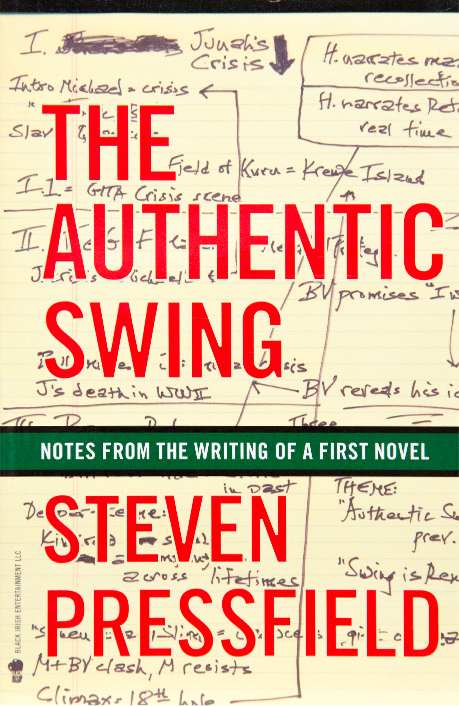
THE AUTHENTIC SWING
A short book about the writing of a first novel: for Steve, The Legend of Bagger Vance. Having failed with three earlier attempts at novels, here's how Steve finally succeeded.
NOBODY WANTS TO READ YOUR SH*T
Steve shares his "lessons learned" from the trenches of the five different writing careers—advertising, screenwriting, fiction, nonfiction, and self-help. This is tradecraft. An MFA in Writing in 197 pages.

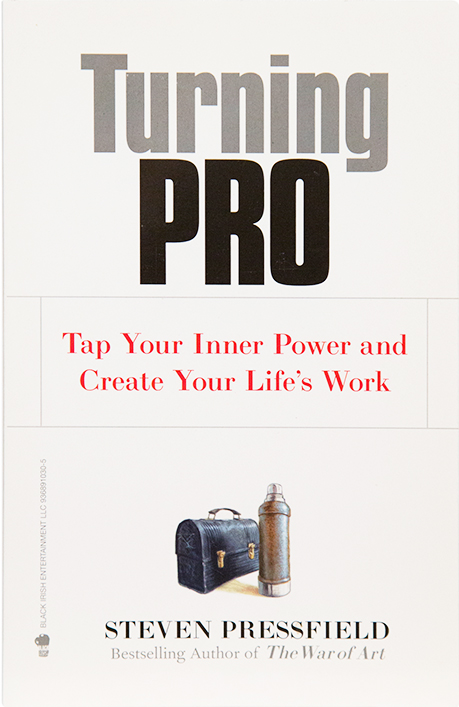
TURNING PRO
Amateurs have amateur habits. Pros have pro habits. When we turn pro, we give up the comfortable life but we find our power. Steve answers the question, "How do we overcome Resistance?"
Just a minor correction – Jonah got snapped up by the whale, Noah built a giant boat in the middle of a desert.
You got that too? otherwise great article
This is really beautiful and hard-hitting. I love the way you’re continuing to trawl the idea of muse-based creativity by drawing out its various tangential implications. Many thanks; you have me firmly hooked.
I’m being forced to new depths these days. Some days the price feels exorbitant. I question whether I can go on, but there is something, or someone, that keeps driving me on. It can’t be explained to those who’ve never felt it. I’ve known for a long time that I’m a bit crazy, but at least now I know it’s ‘divine madness.’ Thanks Steven. Great post.
I recently watched to a video interview of Michael Bungay Stanier and he made a comment about having a singular, universal guiding motive. People often poke fun of artsy-fartsy actors who say “What’s my motivation?” but it really is a crucial question.
Because if you can answer it, it will drive and dictate all your other decisions for you, sometimes effortlessly. Stanier has a goal to share his vision with a billion people. All of his day-to-day activities either support or detract from that end game. And so he simply has to ask himself, “Will this activity I’m thinking of doing take me closer to my goal or further away?”
As I’m sure you already know, if a writer takes the time to really get inside a characters head, really learn their motivations, then everything that character thinks, says, and does kind of works itself out automatically.
Love your posts Steven–you’re the man!
I read this great book once where the author claimed that something called Resistance could never be beaten. You had to fight the same battle every time you came to the page. You might come away victorious, once or twice or many times in a row, but the same battle would be waiting for you the very next morning.
Why would anyone choose to participate in such a process. Because it feels worse not to. Who was that guy, I wonder….
Great post, Steven. It reminds me to look up every once in while and check on where I’m headed.
Genius Steven,
You’ve done it again. H C Anderson once said: you’ve got to go in the gutter to find the pearls. I agree. It hurts, you don’t know how much deeper you still have to go, you keep going and then when you got it, its such a beautiful feeling. That’s why I keep doing it. It helps to be nuts though.
Thanks again,
annette
I was over at Betsy Lerner’s blog, and someone quoted John Irving, “you have to get obsessed, and stay obsessed”. I think you need to be in this state to go deep, but staying obsessed circles back to resistance.
Going deep about going deep. I like this.
Thank you!
I’ve been going deep on what started out as a general idea for over a month now. People don’t understand how I can sit around chasing through blogs and taking notes and not “doing something”. It is crazy. It is divine madness. But as long as I keep finding those little bits of ore down there I will keep digging.
Thanks for being one of the major veins in my goldmine.
Steve:
You’ve got it. It’s what makes the writer re-read, re-edit, and scrap those last 30 pages and start fresh, or when the runner does yet another 440 repeat, and the Marine hauls his buddy out of the line of fire. How hard does the really good writer work? Harder than all the others.
Hi, I have read your book on writing, and I specifically remember you writing something about Resistance upping the level of drama in your life. I am having a full blown attack of Resistance right now; no sooner have I fixed (or survived) one episode, another episode of high drama begins. Can you please help me here? I’d like to place the blame on a certain individual here, but I know that if I could do away with the Resistance, I could probably rediscover life as a source for happiness.
ON “Depth of Work”, Part 2 . Your take on acheiving “depth of work” is very accurate and its true that very few humans ever get close to reaching this point in their profession due to the pain it takes to get to this place! I am a retired Army Ranger of 21 years and reaching my goals of becoming a warrior was the hardest thing I had never imagined! Spin on words but so true. Alas, anything of that value(being a Ranger in my case) is worth every second of effort and can only be achieved by the most insane! By the way, Noah didnt get eaten by a whale, Jonah did!
Could Mr. Pressfield subconsciously have meant “Junah” in the whale? (I prefer to think that is so, even if it isn’t.) For those who haven’t read The Legend of Bagger Vance, Junah is the character who got inhaled into the belly of his particular whale, World War I, and subsequently was expunged and redeemed with the help of his mystical caddie, Bagger Vance. Of course, Junah’s counterpart is Arjuna and Bagger’s is Bhagvan Krishna, principal characters of the Bhagavad Gita who engaged in similar transitions. And Noah, another key figure in another mysterious tradition with an “ah” suffix to his name, is somewhere in between. All in the family, but so many significant kindred names can be hard to keep track of sometimes.
I’m trying really hard to understand this because I feel it’s so important. Immersion, possession by the Muses, craziness. I get that.
Writing makes me crazy, and yet I am more crazy if I don’t get to do it. It becomes the thing that is often even more important to me than spending time with people I care about. I feel obsessed, possessed and driven towards this goal that I’ve cherished since I was a child. To write. It doesn’t make sense at times but here I am, still writing, still trying to go deeper into the art–never satisfied.
But the paradoxes of blogging really make me question whether to continue with this kind of writing on the web. I can’t keep myself out of the tangle of writing for popularity, of looking for validation through comments and feedback and checking my stats. Yet I want my writing to be above the shallow seeking of applause.
So much blogging is just empty words. Style without content, or reams of advice about using Twitter to increase your authority, Search Engine Optimization, and all that. It’s completely depressing. It seems no one cares about going deep and writing something that really matters. Something that can change people’s lives one day.
How can I pursue depth of work on the web without getting affected by all the dross? Or would I be better to quit blogging now and work towards publication in other ways?