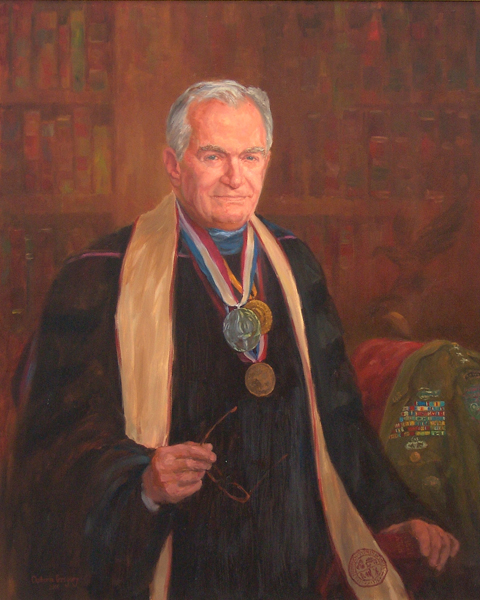
General Sam V. Wilson

I’m in awe of everything General Sam Wilson has done. His is a name that everyone should know. He’s accomplished more in his lifetime than many of us dare to dream about. He served as a reconnaissance officer with Merrill’s Marauders in Burma, during WWII; as a CIA spy-ring operator in Berlin, uncovering Soviet secrets; as a director of instruction at the U.S. Army Special Warfare School; as a civilian working with USAID in Vietnam and then in the personal rank of minister at the U.S. Embassy in Saigon; and then back in the military, as a Special Forces Group Commander, followed by an assignment as the Assistant Commandant at the U.S. Army’s JFK Institute for Military Assistance (now the U.S. Army John F. Kennedy Special Warfare School); then Assistant Division Commander for Operations in the 82nd Airborne Division; as chief defense attaché at the U.S. Embassy in Moscow; as a director of the Defense Intelligence Agency; as Deputy to the Director Central Intelligence for the Intelligence Community; as one of the founders of the U.S. Special Operations forces and one of the creators of the Army’s Delta Force; and as a teacher and ultimately president of Hampden-Sydney College.
 SP: One of the questions that I’ve been asked as a writer, and which I’ve asked others is: Where do your ideas come from? Often, people say that their ideas come via experiences leading them to a certain point, or a Muse or other source. When I read about your career—that you joined the military at 16, and that you were teaching counter-insurgency by 19, I wondered about where your ideas came from. A hallmark of your career, indeed your life, is outside-the-box thinking. How did a 16 year-old, three years later, find himself creating and teaching strategies with which today’s senior leaders still struggle?
SW: The most important influence on my thinking processes came from my parents during my growing up period. I was born and raised on a 150 acre farm—tobacco, corn, wheat—in Southside Virginia (hard by the Saylers Creek Battleground, where the Army of Northern fought its last fight.) My parents were readers, and they imbued us Wilson children with a deep love of books. My mother had been a public school teacher, and she saw to it that I—along with my older sister and three brothers—took the business of learning seriously, including what we learned in Sunday school and church, where she was my first Sunday school teacher. She taught us Wilson children discipline, self-control and how to think logically.
My father, on the other hand, fired our imaginations with his stories, songs and poetry, and helped us see things in life and in our environment in general that we otherwise would surely have missed. From an early age, we worked with him in the fields and woods, and around the farmyard, and he kept our morale up and our spirits high with his jingles and stories, many of them made up on the spot right out of the thin air. In a draft for my memoirs, titled Galahad II: A Country Boy Goes to War, I wrote:
“His mastery of ad-lib storytelling was legendary around the community. Boys from the neighborhood would frequently drop in for free haircuts—he was an expert barber. As often as not, they would be accompanied by buddies who had come along for the tale telling that came with the shearing. The whole group would sit there open-mouthed, mesmerized by the colorful nature tales of foxes, ‘possums, coon dogs, stories of hunting and fishing, of goblins and ‘hants, watermelon heists, red-tailed hawks, and river owls calling at night along the Appomattox. He gave distinct personalities to birds and animals and made them come alive. He could create more tension and drama than anyone I have ever listened to out of such subjects as a creaking door in an abandoned old farm house or strange footprints on a river sandbar in the pre-dawn mist. We would sit entranced for hours on the front porch on moonlit summer nights or by a glowing fireside during the cold of winter, listening as he spun yarn after yarn, making up his stories as he went along…”
There is no question but that my own ability, such as it is, to see things that are not there and then picture them for others to see is greatly aided by the heritage of my father.
SP: I watched the introduction you did for the film Merrill’s Marauders. At one point, in the trailer, you say:
“This was a job they said we couldn’t do. They called it impossible.”
Later, there’s a scene in the trailer, where “Stock” says:
“My man can’t make it. It’s not that they don’t want to fight, it’s that they can’t fight. They just can’t physically fight anymore.”
What inspired you and kept you motivated through your almost 40 years in the Army—much of which required accomplishing the impossible, and stretching your physical and mental limits?
SW: On motivation:
In addition to their providing a sound moral and philosophical foundation on the things that count—including love of country, I also had some appreciation from my parents—and from my own reading—for what was going on in the world of the 1930’s, and had some glimmer as to what the stakes were for the United States in the arena of U.S. foreign policy and national security. By the time I was 16, I was fired up and ready to go slay dragons. In my 1994 commencement speech at Hampden-Sydney College, I said:
“And so, let an old soldier of 3 1/2 wars, and over fifty years of public service, who has seen many men die—some, unfortunately, at his own hand, who has roamed the five continents and the seven seas, strolled in the market places from Marrakech to Baghdad to Samarkand and Ulan Bator, browsed in the book stalls of Paris, Berlin, Moscow, Peking and Tokyo, watched the sun rise out of the South China Sea and set in the Indian Ocean, the moon come up over the snows of the Himalayas and the lightning play in the peaks of the Andes, who has missed setting foot in or at least seeing only two places—Albania and the South Pole—tell you this:
“It is now your world, it is not mine anymore. And it’s a beautiful, blue jewel . . . a shining sphere. Love it, cherish it, protect it and keep it.”
And from my 1997 commencement speech at Hampden-Sydney College:
“I reach for language these old oaks have heard before and know very well. Let an old soldier who has run with the wolves and flown with the eagles tell you this: ‘Love your country. Don’t ever, ever stop loving your country. In the whole wide world we’ve got the best system there is for a man to work out his own destiny. But the system is not on automatic pilot. We have to work to make it work. Don’t forget that . . . We count on you as young men of awesome promise to do what is necessary and what is right to keep us strong and keep us free.”
On hanging in there when the going gets tough:
I felt that I could never falter or let up in front of the troops. I would sooner perish.
All my life (until now) I have always been the youngest and the least formally educated in whatever outfit I belonged to. Result: I was almost always running scared (even when I may have lapped the field—without really knowing it.) For me failure was never an option. In the draft of my memoirs, I also wrote:
“What calls forward this little vignette I have no idea. I haven’t thought of it in years. For some reason I was musing at breakfast this morning, almost in my subconscious mind, about the midnight ride to Merrill. That led to memories of Pride-and-Joy, which led in turn to recollections of Big Red.
“I recall that Big Red was almost as fast as Pride-and-Joy. When we raced the horses in the corral back in India, in the fall of 1943, to pick out the fastest one, Big Red came in second. (Lt Col Still never knew his horse placed third; Sergeant Knapp never told him, thank goodness, or Still would have taken Pride-and-Joy away from me.)
“Pride-and-Joy had a smooth, fluid motion when he ran; the sensation was one of floating along, even in full stride. But Big Red seemed to exert himself mightily, thundering along with great wheezing gasps, almost jarring the ground with the impact of his hooves. The ride was so rough that at times it was hard to stay in the saddle, especially since Big Red would go kind of crazy when you let him run full out. It would become almost impossible to rein him in.
“We were about midway of the march from Assam into North Burma over the Ledo Road. It was a mid-morning in January 1944, pushing on towards noon. The column had fallen out for a rest break, and as usual I was taking advantage of the chance to unlimber the horses a bit. This time it was Big Red’s turn, and as he began to gallop down the road along the column of resting soldiers, I decided to let him have his head.
“And he ran away with me.
“I guess nobody but me knew that I was in trouble, barely hanging on and about to be tossed at any second. We came careening around a bend in the road, and right in front of me was the command group with General Merrill, standing there with his clipboard. I can still see the pleased grin on his face as he took off his helmet and waved it as I came thundering by. Little did he know that I was running scared, not knowing how the thing was going to turn out.
“Running scared. That’s an ironic and typical commentary on the life of one SVW, hanging grimly on with a silly grin disguising his terror and wondering how he got himself into such mess.
“Running scared…Big Red becomes a metaphor for my entire life.”
In almost all my varied assignments (the majority of which I volunteered for), I was blessed with a mission, a goal that I could believe in deeply. And more often than not I had this funny feeling that I had something to offer. That made it easier, sometimes even fun, to hang on and work very hard for a successful outcome.
SP: I read the following quote from you and was reminded of the many of us who think they need to be James Bond to accomplish something special:
“Ninety percent of intelligence comes from open sources. The other ten percent, the clandestine work, is just the more dramatic. The real intelligence hero is Sherlock Holmes not James Bond.”
And in an interview with Dr. J.W. Partin, when speaking about your time training with Major General Wingate in India, you said:
” . . . we began to pick up some things from the British and their way of doing things. They were much leaner, more conservative in what they carried and in what kinds of external support they expected. In fact, we were sort of, by nature, a little spoiled. They tried to do more with less, so that was a good lesson for us.”
As you rose within the military and then became a leader helping those coming up in the ranks, how did you drive home the notion that more can be done with less—Sherlock Holmes v. James Bond—whether related to clandestine work or freshman studies in college? What did you do yourself, and what did you encourage other to do, to live the importance of being able to do more with less?
SW: Growing up on a Southside Virginia farm where we lived on things that came out of the soil, directly or indirectly, I learned early on that one not only can survive but actually thrive on very little. This lesson was confirmed emphatically in the North Burma campaign of 1944, when I came to realize that I could get by if three simple needs or conditions could be met: if I had enough to eat to keep going, if I could have a place and a chance to rest and recoup my energy, and if I could gain respite from enemy guns, especially artillery fire. I figured that if I had these three things, I could make it the rest of the way on my own. Later, I had occasion to check these observations with some of Wingate’s Chindits, and I found them in full agreement.
From another angle, as a soldier starting out in a rifle company in 1940, I was almost amazed at how little in the way of trappings and paraphernalia I really had to have in order to do my job effectively, how relatively easy it was to simplify things and get down to basics. When we would break camp in the early mornings while on maneuvers, and I would sling my pack and march away, all I owned or needed was on my back, and there was nothing left behind to show where I had slept the night before. A wonderful liberating feeling.
That conviction, arrived at early on, has been with me ever since. You can do more with less, and you really don’t need most of the things you think you do. Seeing how the British-Indian Army put this principle into practice was a revelation… And you get these points across to the troops by personal example.
The primary lesson in the Holmes-Bond analogy is not so much “doing more with less” as it is knowing in depth what your intelligence priorities are and then knowing what (and how) to look for the answers. Sometimes the critical key to unlock the whole conundrum is right there under your nose. Remember Poe’s The Purloined Letter? You have to know what to look for and how to recognize it when you see it.
SP: Two weeks ago, I did an interview with General Hal Moore. I asked him the following, and wanted to ask the same of you:
As a writer, I’ve found myself doing the same, but on an individual basis. For me, it might be that an idea comes along, and I don’t think about it or analyze it. I just act. I often attribute this to the Muse, who inspires writers. But in the military, lives are at stake. While a writer might battle over a main character’s actions, you battle in real time, pulling everything together while you are in the moment. From where do you pull this strength? And how would you advise today’s service members in particular about acting in the moment, and not overthinking and analyzing—just doing?
SW: If you have studied and trained and know your job and its requirements thoroughly, then in a fast-moving crisis when you don’t have time to think, your instincts take over and you act practically without conscious thought.
You are going along a jungle trail in North Burma when suddenly a voice in your head says, “Duck Sam, Duck Sam, Duck!” And a Jap Nambu light machine gun cuts the empty air where you had been standing. Premonition? Hardly. The almost unnoticed odor of fish heads and rice and the slight discoloration in the leaves of the branches camouflaging the enemy machine gun telegraphed danger to you without your being fully conscious of it. Trust your instincts.
SP: I asked Joe Galloway the following questions last week:
You’ve been a leader within the journalism and military community, and you’ve known legendary leaders in the military community as they’ve risen—such as General Norman Schwarzkopf, whom you met in Vietnam, and then went on to cover, and embed with during Desert Storm. Most recently, General McChrystal has been in the news, with people questioning his leadership skills. What’s your advice to our next generation of leaders, both civilian and military? What is it that has worked for you and for others?
You have a tradition of outstanding leadership yourself, and you’ve worked with, and have helped nurture future leaders. What’s your advice for military leaders in particular today?
SW: It is not easy for me to answer this question. I have been giving lectures on leadership and teaching leadership courses off and on ever since the fall of 1945, when I was involved in establishing a post-war course on the subject at Fort Benning’s infantry school. In this light, I have great difficulty responding to you in a couple of short paragraphs. Among the suggestions I might offer would be included the following:
Always strive to develop and communicate a clear-cut statement of the mission.
Stress the sharing of information, especially down the chain of command, as well as laterally.
Once you are satisfied that your subordinates know their jobs, give them their marching orders and get out of the way, while supporting them in every way you can.
Remember, take care of the troops and the troops will take care of you.
Don’t let your superiors get caught by surprise.
Study the lives of successful leaders, but at the same time don’t neglect to learn from the mistakes of those who failed.
There is so much more to be said, but this gets us started.
SP: We’ve all seen our ideas adapted by others for their own use. And during that process, our definitions are dropped/altered by those handling them. You coined the term “counter-insurgency.” I read a column that Joe Galloway wrote about you in 2004, in which he recalled:
“Samuel Vaughan Wilson stares intently at the television news from Iraq. American infantrymen are kicking in a Sunni Muslim family’s front door, yelling and screaming and manhandling the father. Wilson grimaces. “This isn’t counter-insurgency,” he says. “This is not the right way to do this.”
And in the summary of Rand’s 1962 Counterinsurgency Symposium, there is a point where it states:
“Col. Wilson emphasized the distinction—thus far inadequately stressed in our service schools—between two entirely different situations in which the Communists initiate guerilla war. In the first they will seize on existing resentment (people’s hatred of an oppressor, or their desire to recover lost privileges or property) and capture an independent movement already under way. The second is the culmination of years of communist planning an organization, as in the case of Central Vietnam . . .”
You wrote the Army’s first manual on how to do counterinsurgency. How have you felt about how something you worked on for so many years has evolved, and has been changed by others? Do you think counterinsurgency is being done right today? Or is what we’re seeing today something different, which should be titled with a different term?
SW: While serving as the director of instruction of the U.S. Army Special Warfare School (Fort Bragg), during 1959-61, and with the capable assistance of several bright, forward-looking officers, I worked to develop a program of instruction (not a manual) on counter-insurgency operations. As the subject was relatively new, this in a sense was a foundational effort, which attracted unusual attention at the time from policy levels in Washington. While trying to figure out what to call our undertaking, we settled on counter-insurgency (coin, for short), as noted above. Three years later, in the summer of 1964, I was assigned to South Vietnam where I had the opportunity to try putting into practice some of the principles we had identified at Fort Bragg. In a word, they worked. Others have been applying lessons learned since then to update, modify and improve basic coin doctrine. In this sense, General Petraeus and his warrior intellectuals have taken COIN to new levels, and I have no doubt that someone else will carry it further along in the future. To your question as to my feelings on how a subject into which I poured so much time and energy continues to evolve, I have no sense of proprietorship; this process simply reflects the dynamic nature of doctrinal development in the military world.
DO THE WORK
Steve shows you the predictable Resistance points that every writer hits in a work-in-progress and then shows you how to deal with each one of these sticking points. This book shows you how to keep going with your work.


THE AUTHENTIC SWING
A short book about the writing of a first novel: for Steve, The Legend of Bagger Vance. Having failed with three earlier attempts at novels, here's how Steve finally succeeded.
NOBODY WANTS TO READ YOUR SH*T
Steve shares his "lessons learned" from the trenches of the five different writing careers—advertising, screenwriting, fiction, nonfiction, and self-help. This is tradecraft. An MFA in Writing in 197 pages.

TURNING PRO
Amateurs have amateur habits. Pros have pro habits. When we turn pro, we give up the comfortable life but we find our power. Steve answers the question, "How do we overcome Resistance?"

General Sam a quarter century or so ago began tutoring me about interfaces between DoD’s special operations and those that belong to CIA. I hope he never stops.
JOHN COLLINS
Steven,
Thank you for doing these interviews. Gen. Wilson is an amazing man. I love the intro to his speeches! If he would tell more about his experiences, can you imagine how much of a wuss James Bond would be in comparison?
I appreciate this post so very much. My father, who died unexpectedly in 1990, was a “Merrill’s Marauder”. Though he found decades later a CBI group to join, he only rarely ever spoke of his experiences in the war, though he did intimate he had no liking of Stillwell. Dad was a Tex Sgt., a machine gunner with the group. He gave away all his medals. He’s buried in Arlington Cemetery, which makes me proud. My greatest regret is my failure to ask him for an interview, difficult as I know it might have been for him, though I can’t help but think that exorcising the demons from the hell that CBI was then might have made him a changed man.
I would like to thank Maureen for her thoughtful posting and offer to exchange emails with her about Merrill’s Marauders and the North Burma Campaign of 1944.
I would be delighted, General.
Maureen,
My Dad was a Marauder as well. We are having the reunion this year in Minneapolis over the Labor Day weekend. My Dad was in Logan Weston’s I&R Plt/Orange Combat Team. Logan was my mentor and I spoke at this funeral. Logan often spoke of Sammy Wilson. LTG Wilson will be our speaker. They are the “Greatest Generation”.
Great interview by LTG Wilson.
Hello, I have heard that your father played the guitar..what can tell me about that part of his life..thank you!
Thanx! It was with mixed feelings that I presided over Sam’s retirement at Ft. Bragg. We shared a soldierly moment on the parade ground there with band playing, soldiers marching and flags unfurled. It was impossible to encapsulate his extraordinary career in a few words, but then soldiers know another soldier when they see one.
Essence precedes being. Values precede action. That is the core truth of my father’s reflections on the origins of his gifts, talents, and efforts. As an offspring who also resides in Southside Virginia, I can testify how deeply the quiet ethos of faith and service run in this region. It is largely unspoken but quietly evident in the casual but warm way we greet friend and stranger alike; the stoicism with which disappointment and loss are greeted; the deflection of attention to oneself; the absolute determination to fulfill an obligation; the upholding of the standard “do it right.” Here, we all, in one way or the other, attempt to “Mean, Speak, and Do Well.” My father is a patriarch in that tradition.
I found your musings on your father and living in Southside Virginia very much like the Sam Wilson I knew a long time ago 😉 I have a connection of my own to that region, having graduated from Longwood and then having a daughter who did the same. I am a retired US History teacher and she is teaching the 4th grade. A noble profession, to be sure! Hope this finds you well and the same for your family. Please give your father my best regards. My dad passed on in 1994, but my mother is now almost 92. Our home is your home if you are ever in the Gainesville, Virginia, area. God Bless!!
Gen. Sam is one of the finest soldiers and leaders it has ever been my privilege to meet. I only wish there was room in this format to hear even a tenth of the stories he can tell. Those he still can’t tell are even better!
He’s truly a Renaissance Man: Fluent in nine languages. Accomplished musician/guitarist. Solid moral values drawn from the bedrock of his people and his place in Southside Virginia. Always a teacher; always a giver. He defines the term selfless service, and for him service is for a lifetime. So too friendship.
Am I neutral when it comes to Gen. Sam? Hell no. I love the man. I’ve known him a long time and only wish we had met many years before that.
This spring I spent two weeks with Gen. Sam and his equally talented and wonderful wife Susie on his farm–surrounded by the farms of his brothers and the home place where they all worked the tobacco crops.
We sat for hours in big old rocking chairs on the porch overlooking Frog Hollow Pond talking about places we had both been–Moscow for instance–and the usual suspects in all those places. Rain on the tin roof overhead provided fine background music. A glass or two of yellow whiskey lubricated the conversation.
Bless you, Samuel Vaughn Wilson. Sadly, they broke the mold after they made you, and now we need some leaders who would hew to standards even half as high as yours.
Joe Galloway
Were men just as talented and determined as General Sam Wilson more in charge of preventing conflict,, than in cleaning up the messes of inexperienced politicians and corporate led thieves and deceivers, what a wonderful world this might be.
Do the ends ever justify the means ? Perhaps only truly brave and experienced soldiers and spies should be able to testify to that debate.
Politicians and soldiers will forever be on two opposite pages,, reading and acting from two very different scripts.
Can there ever be any justification for over one million Iraqi citizens who have died through violence since 2003,, or any valid justification for those civilians killed in Afghanistan since 2001 ?
Any truly thoughtful consideration of any of our leaders to whom we bestow the title of hero,, should also include the failures of our society that made their exceptional sacrifice necessary in the first place.
Yes,, how much would I love to enjoy a couple glasses of yellow whiskey with General Sam,, and how very much would I love to hear him speak about how there ever might be true conflict prevention.
How very much would I love to hear him say out loud jut one time,, that peace,, is indeed possible.
I love my grandfather and respect his counsel.
However Shea Brown your statement about civilian casualties is either misdirected or ill-informed.. The dynamics of these civilians deaths needs to be clarified or put in proper perspective. During the Afghan Civil War it is estimated by the UN over 400,000 Afghans lost their lives in comparison to the recent total by the UN of 19,000 afghan civilian deaths after 9 years of US/NATO operations. Also the recent reports have concluded the total Iraqi deaths have been close to 100,000… not the millions you are quoted in saying. That very figure is often quoted for propaganda and recruitment purposes by ACM forces both in Europe and in South Asia.
Having served in the OEF VI myself I can agree with the statement about the political and military objectives need to be clarified. It is muddied by political hamstringing and conflicting rules of engagement which operational demands mad it a mad house then unless it was a “clean shoot” to use police jargon.
I first met “COL Sam” as a young SGT in 1968, when he was G2 at the Special Warfare Center. I had just read “The Maruders”, and had some questions, I got the courage to walk up to him in the parking lot, and asked if I could he could clear up some events in the book. We sat down on a bench and he spent nearly an hour answering all my queries and clarifying salient points.ok. As a newly promoted COL I had the opportunity to chat with him at a SF branch meeting and recounted our previous meeting. He laughed and said I was glad I had taken his advice, he told me on that day so many years before, that when I had had my fun on the “Teams” for a few years, to get commissioned, and teach the troops not to forget our past, as it is also our future.”
A fine officer, a brilliant man, and one of the truly great soldiers of our age
John N. Tobin
COL (R) SF
Steven,
You interview with General Wilson is awe-inspiring and instructive.
Thanks to you and good General for recording these important recollections and thoughts!
Cordially, J. Scott Shipman
During my forty years of serving in senior staff position in higher education I have had the privilege of serving eight distinguished presidents at four institutions. For eight of those years, I had the honor and privilege of serving with President Wilson during his entire tenure as President of Hampden-Sydney College. Understandably most of what is written about President Wilson concerns his service in the military and national security arenas. However, no profile of him would be complete without properly recognizing his service as President of Hampden-Sydney College. At a period in their lives when most are enjoying their retirement Sam Wilson responded again to the call to serve – this time as President of Hampden Sydney College.
Sam Wilson has occasionally likened himself to a fire horse – “Ring the bell and I respond.” Sam Wilson did respond once again and for eight years President Wilson served with great distinction as the leader of H-SC. During his tenure he brought much needed stability, recognition, and success to our College. Our endowment doubled, enrollment grew, a daunting deferred maintenance problem was eliminated and numerous buildings were constructed or renovated. All this occurred while substantially improving the academic quality of the College. Throughout his tenure President Wilson somehow found time to teach leadership, national security and world affairs. Needless to say his classes were always heavily oversubscribed with our best students. In recognition of his contributions to the College the Wilson Center for Leadership in the Public Interest, located on the beautiful Hampden-Sydney College campus was dedicated in his honor. This center serves as a monument to him and continues its mission of instilling in our students those values of virtue, honor, and service to which Sam Wilson dedicated his life.
Mr. Krueger,
Thank you for your additions. One of my greatest academic regrets is that I didn’t fail a few classes my senior year so that I would have been a student under The General. 😉
It was a very good school during my tenure; but General Sam made it a GREAT one. I think one of the best examples is that, due to his leadership, Anders Fogh Rasmussen, the then-sitting PM of Denmark, sent his sons there. As a head of government, his sons would have been welcome at any Ivy League school they wanted, but apparently they wanted an actual Education instead.
Thank you, General Wilson. For everything.
Dear Steven Pressfield,
Thank you for the extraordinary interview, with Lt. Gen. Samuel Vaughan Wilson. The interview covered a considerable amount of information that I was not aware of, and yet I wasn’t a bit surprised. For, during the Merrill’s Marauders, North Burma Campaign in World War Two, I served as the radio repairman in the same Combat Team as Lt. Sammy (Lt. Sammy is what he preferred to be called). Wilson was an outstanding innovative Intelligence and Reconnaissance Platoon (I & R) leader. His judgment and ability as a Platoon Leader, is reflected in the fact that his men would follow him anywhere. Among its other duties, the I & R Platoon, was required to scout the area surrounding the Battalion’s main body preventing it from surprise enemy attacks. The I & R Platoon, was involved in many skirmishes with the enemy and usually engaged the enemy first.
Dear Steven Pressfield,
I would like permission to make copies of the Wilson interview, to distribute at our upcoming reunion, where Samual V. Wilson will be our guest speaker.
I can fully understand if you refues this second request, but I would like to add it to my webpage, along with a link to your page and full credit.
This very informative story about Gen. Wilson was forwarded to me by Merrill’s Marauder historian Bob Passanisi. My Merrill’s Marauder and Korean War – 5th RCT Dad, Vincent Melillo, who will be 92 on Friday, was with the 2nd BN, I & R Platoon, Blue Combat Team under Lt. Grissom. Dad is now the only surviving person of the five-man patrol where the first Marauder, PVT Landis, was killed. Although Dad joined the Army in 1940 and served in the old 33rd Infantry in Panama and Trinidad with many of the men who later made up the 2nd battalion, that firefight was his first time in combat. He vividly remembers it — he was scared. Like Maureen’s Dad, my Dad didn’t know about the Merrill’s Marauders Association for many years because he was busy fighting another war and serving as a career NCO. And like Richard Avery, I’d like to encourage Maureen to please join the Merrill’s Marauders Proud Descendants by contacting Lorrie Carpenter at [email protected] and to sign up to attend our Minneapolis reunion — where she can hear Gen. Wilson speak in person — by contacting MM Proud Descendants treasurer Jerrie Daley at [email protected], who’s planning the reunion for our fathers. For another timely story on the Marauders, please go to the National Ranger Memorial Foundation website and read yesterday’s email news announcement, “ANET 213 – Seven MIAs missing since May 1944 buried July 15 at Arlington.” Bob Passanisi identified three of these men as Marauders and provided most of the information and photos for this story, which as ANET editor I put together for the NRMF. Many Marauders have bricks at Ft. Benning’s National Ranger Monument. My Dad and another Marauder, Phil Piazza, also in his 90s, and the person who started the Merrill’s Marauder Association more than 63 years ago, will be at the 3rd Battalion, 75th Ranger Regiment change of command ceremony today at Ft. Benning — in the sweltering heat. The Merrill’s Marauders Association has evolved into the Proud Descendants organization, similar to the Sons and Daughters of the WW II Rangers organization. The oldest Marauder, who lives in the state of Washington, is 97-year-old Nisei warrior and Ranger Hall of Fame inductee Roy Matsumoto. Many of these men in their 90s are still active in military events and living history projects.
As a student of General Sam’s, I find myself reading this article and re-living the famed discussions in class. General Sam is to me, and multiple generations of Hampden-Sydney men, more than a mentor. He is another grandfather, a sage with the best advice, a hero that can pull down the moon, and a standard bearer for our personal lives. His wise counsel has guided me far in my life, and always will. I can here him now quoting Pericles’ Funeral Oration–a speech that all Americans should read until it is familiar–“the secret to happiness is freedom and the secret to freedom is a brave-heart.” To those happy souls living in the United States now, and those yet to come, our freedom was supported by this gentlemen his entire life. From the battles in Burma, to his major role as the President of America’s 10th Oldest College–Hampden-Sydney, General Sam has made a life out of giving and sacrifice. He truly reflects a life of public service and dedication to country. I am proud to call him my grandfather–adopted it may be–but I am proud and thank God in Heaven that I had the fortune to be around him then . . . and now! Cheers to General Sam! The Greek word for brotherly love is philos–and your students have this kind of love for the General!
Thank you for this interview, and for all of the comments. I have had the privilege of calling General Wilson “friend” for more than a quarter-century, and like many commenting here, am the better for knowing him. I proudly call myself a “student of Sam Wilson,” having taken his National Security Policy course in the early Eighties, and the first session of the course that has become known as “Spying 101.” He is a national asset and the only one of the three great men I have known in my life to still be with us.
I, for one, can’t wait to read the memoirs!
I was fortunate to have had the opportunity to study under General Wilson during my time at Hampden-Sydney College. On an educational level, I have rarely had a teacher who was so able to identify with his students on a personal level, and personalize his approach to them in such a manner as to have the greatest possible impact on that particular student.
On a personal level, I’ve had the honor of experiencing General Sam’s hospitality both on campu and at his home. Mr. Pressfield’s interview with General Sam brought many memories back to me, including times where I was graced with many of the same stories quoted here. In that I am sure that I am not alone. It goes to demonstrate that General Wilson does not treat any one person differently than the next – each is given the utmost respect and consideration by this great man.
I share Mr Pressfield’s awe of this American hero (though I know the General is loathe to have the term applied to himself), and I’d like to express publicly in this forum my gratitude to General Samuel V Wilson for the time he devoted to me and my education.
Please tell me someone is helping General Sam Wilson to write his memoirs.
Having recently retired from DIA I fondly recall
Gen Wilson stopping by the National Military Intelligence Center when he was DR of DIA. He was
held in great esteem by all of us in the center. No
one ever filled his shoes, he was a giant. It was
never about the General bu the mission.
Ron Krueger DIA 1973-2008
Having recently retired from DIA I fondly recall
Gen Wilson stopping by the National Military Intelligence Center when he was DR of DIA. He was
held in great esteem by all of us in the center. No
one ever filled his shoes, he was a giant. It was
never about the General but the mission.
Ron Krueger DIA 1973-2008
Loved the article!!! The only part I don’t understand is this inference that Gen. Sam has retired! What??? Never! Sam still inspires the lads at our Society of ’91 leadership conference every year, and remains my best advisor on all issues international. If the General says, “go”- we go! If he says, “think about it first,” we try- but in all things he reminds us to, “keep your head down and call me when you get back!” So far, w’ve followed orders!
God bless you Sam- you remain my hero!
Hello, Gen. Wilson and Sam. Remember me? I grew to have my own attachment to Southside Va., as I graduated from Longwood (College) University in ’68 and have a daughter who graduated from same in 2001. We are a family of school teachers, too. I am a retired Fairfax County teacher and our daughter is presently teaching elementary school in Prince William County. I have fond memories of your family and enjoyed reading about your career after losing touch. Please give my best regards to all of the Wilsons!
Dear General Sam (and All):
It has been my honor and pleasure to have looked into your past history as a sometime biographer and part-time student of U.S. Intellgence history and leadership — and I am and will always remain both impressed and blessed to have known you, to have served in your proximity, and to have glimpsed your remarkable life from the vantage point of shared experiences and privleged information. You — General Sam — are one of a kind! Thank God for soldier-citizens like you.
With great good wishes for you and yours…
Lieutenant General Patrick M. Hughes, U.S. Army (Retired), 13th Director of the Defense Intelligence Agency, at one time — soldier of the line
An excellent article. I had the privilege of taking four semesters of independent study with General Sam during my undergraduate experience at Hampden-Sydney College (I’m class of ’08). I would arrive at his office once a week with my laptop and take copious notes while he recounted adventures from throughout his life. This article struck me as following a similar format to those sessions. Conversations with General Sam always confirm my suspicion that he speaks eloquent prose without much need for editing.
Although he occasionally told me to “put the computer down for this one” before some of the most exciting stories, I was still able to compile over 300 pages of chronologically organized biography of General Sam. I’m still in the process of preparing the document for publication, so I very much enjoyed reading this article. Thank you Mr. Pressfield, and thank you General Sam.
Gen. Wilson is one hell of an inspirational soldier. I was a REMF in W. Germany in the early 60s in flight operations when Vietnam was heating up. I left active duty in early ’65 when LBJ ordered ground troops in. How crazy it was to have Gen. Westmoreland and then Gen. Abrams in charge-an artilleryman and then a tanker amidst a guerilla war. Then to be overrun by N Vietnamese troops with artillery and tanks in Apr ’75!
I enjoyed the interview greatly and hope there may be a part 2. Gen’l Sam is the most extraordinary man I’ll ever meet. In addition to the long list of his virtues offered here, I would add graciousness and humility. Who more than he has cause to be arrogant, yet there’s not a trace. And despite the many luminaries he knows and can call friend, he finds time to have lunch with a lowly postman who has little to offer but the love and admiration of a son for his dad.
meet the famous
I am a brand new fan of both the general and the author. Just regret it took so long…but I’ll make up for lost time. Thank you.
I had the honor to interview General Wilson when doing research on “low intensity conflict” at the army staff college in the 1980s. He spoke at class I taught in 1992. Sir, are you near to finishing your memoirs. I would love to read it and hopefully review it for Military Review or The Journal of Military History.
One of the most treasured pieces of paper in my posession, and I can count amongst the flattened and smoothed pieces of wood pulp I have saved and which have been passed down to me letters from a Great Uncle to his family while serving overseas during WWI, and a collection of correspondence between my Great Grandfather (who was a foreman) and a Railroad Company owner in the 1910s and 20s, is a very simple one, couple of sentences really. I had recently ETS’d from the Army and General Sam and BG Alan Farrell had recruited a few of us former soldiers to give Hampden-Sydney a try.
The letter is from General Sam to the Resident Advisor board suring my sophomore year stating that I was one of the young men he worked hard to get to HS-C from the military and though “it would be inappropriate for me to reach over your shoulder and appoint him” he strongly urged the RA committee to consider me for the position.
That simple recommendation from General Sam means more to me than most any other accolade or award I have achieved in life.
Michael Garrett
Naval Special Warfare Command
HSC 1995-1998