Icons and Iconization

This is a subject I’ve been thinking about a lot lately. Iconization as an issue in real life–and as a form of Resistance. Here’s what I’ve come up with so far.

On their way to iconhood?
First, what is an icon? The dictionary says it’s “an object of worship.” An icon originally was an actual physical artifact—a splinter of the original Cross, say, or an article of apparel once worn by a martyr or a saint. Worship could be directed at this object, as a stand-in or intermediary for some higher embodiment of the divine.
(Some would call this idolatry, but let’s leave that alone for the moment.)
People can be icons
Human beings can be icons too. We make them into icons by worshipping them. Movie stars are icons. (Interestingly, character actors or minor stars are not.) What makes stars into icons is some vivid power or gift that they seem to possess. Angelina Jolie’s ass-kicking sexiness. Jennifer Aniston’s girl-next-door vulnerability. Bette Davis’ eyes.

There already.
When we make a human being into an icon, we endow them in our imagination with a power or gift that we in fact possess ourselves, but are either afraid, or not yet ready to, embrace.
Clint Eastwood is an icon. His movie image, in films like Dirty Harry or Unforgiven and on to Gran Torino, is of a man of suppressed and explosive rage. We, watching him onscreen, endow his character with the power of violent, even fatal payback. We iconize him.
Einstein is an icon. So are Marilyn Monroe, Elvis, Gandhi. Today, Robert Pattinson and Kristen Stewart are becoming icons.
Real people can be icons too
When we fall in love, we can iconize our beloved. We imagine that they possess powers that we don’t. We love them, at least in part, for those powers. If only we had them! By being with our beloved, maybe some of those powers will rub off on us. But just being with them is often enough.
Iconization and Resistance
Making others into icons is a form of Resistance.
We endow others with powers because we’re afraid to claim those powers for ourselves.
Iconization cuts both ways
When someone falls in love with us, we can get iconized. Since the publication of The War of Art, readers have from time to time tried to iconize me. I’ll get long, soul-baring e-mails, invoking me as if I were Yoda or Obi wan Kenobi, seeking advice and counsel. It’s unnerving.
When you get a note like that, it’s impossible not to see the psychological mechanism behind it—and to be alarmed by it. Clearly the writer is giving away his power. Clearly fear is the motivation. It’s an insult, actually, to be iconized. Because the person doing the iconization is dehumanizing you. But the biggest danger is the harm you can do to the vulnerable individual who has (unconsciously) fallen prey to this very human tendency, which none of us, if we’re honest, can claim to be immune to.
Good mentors and bad mentors
Every good mentor I’ve ever had has deflected my attempts at iconizing them. They refuse to bite. Instead they turn my solicitations back onto me, which is where they belong. You, they remind me, have the power to make that decision, to see through that illusion, to take that action that you are so afraid of. Don’t give me that power, the honorable teacher/shrink/mentor says. It’s yours. Embrace it.
When the iconized person exploits the power that the iconizer has given him, that’s called abuse. Depending on how much he or she exploits it, it can become a crime.
But let’s get back to the bright side.
Catching ourselves in the act
When we catch ourselves iconizing somebody—in real life or in the sphere of celebrity—the smart move is to stop and take a seriously deep breath. What power or gift are we endowing this icon with? Do we ourselves possess that power or gift? What is keeping us from embracing it as our own?
When we take that power or gift for ourselves, we break the spell of the icon. We emancipate ourselves from self-imposed slavery. But this isn’t easy. For some reason, we are terrified of embracing that power or gift that is our birthright as our own.
That’s as far as I’ve gotten on this subject. I’ll be very interested to read the Comments this week. Please, friends, don’t be shy about offering insights. This is important—and interesting–stuff!
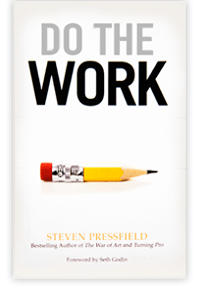
DO THE WORK
Steve shows you the predictable Resistance points that every writer hits in a work-in-progress and then shows you how to deal with each one of these sticking points. This book shows you how to keep going with your work.

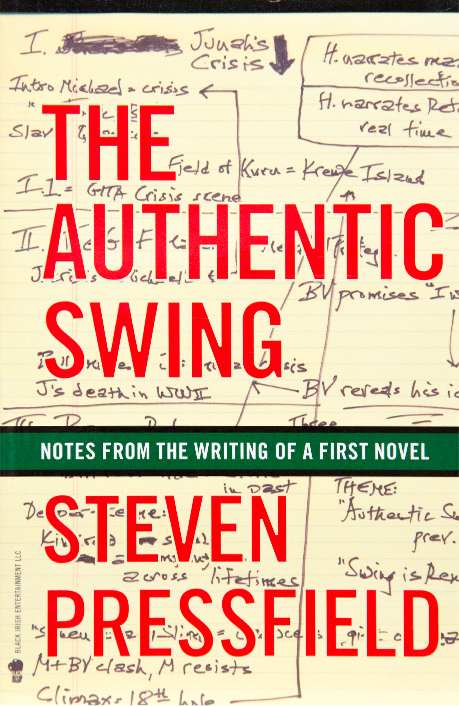
THE AUTHENTIC SWING
A short book about the writing of a first novel: for Steve, The Legend of Bagger Vance. Having failed with three earlier attempts at novels, here's how Steve finally succeeded.
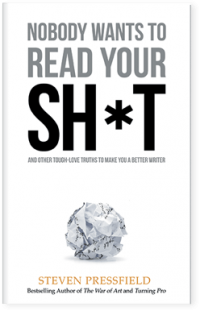
NOBODY WANTS TO READ YOUR SH*T
Steve shares his "lessons learned" from the trenches of the five different writing careers—advertising, screenwriting, fiction, nonfiction, and self-help. This is tradecraft. An MFA in Writing in 197 pages.
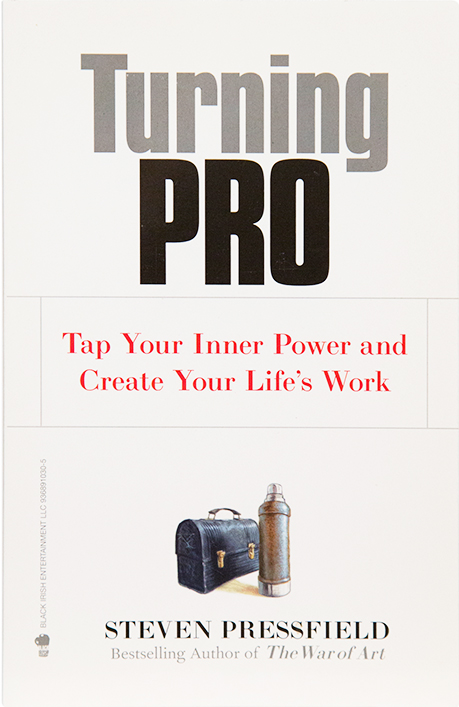
TURNING PRO
Amateurs have amateur habits. Pros have pro habits. When we turn pro, we give up the comfortable life but we find our power. Steve answers the question, "How do we overcome Resistance?"
I can remember several times where I have iconized someone. They all tend to be writers. The main thing is wanting to do what they have done, accomplish writing a book and taking it to the end.
The one thing I did find that putting writers on such a high horse made what I felt that I could do look like nothing. These people have finished writing books. Accomplished many great things and they did become iconized in my life; I admit it.
The biggest moment that happened was when I empowered myself. I knew that I could write a book and took that power and used it to fuel my passion of writing and it has worked out great.
I loved the post and agree that empowering others by iconizing them does nothing for us.
M.A Walstad
Very interesting Steven, I have been pondering myself these last couple weeks on ego and self-discipline and how any amount of flattery I get (while it seems to be nice) only harms my following the craft and accomplishing my goals.
You mention iconizing people and becoming a slave, but I’m also thinking about how much it feeds resistance to me when someone says how great I am and “I” let it go to my head.
Self-importance can be a killer.
Gran Torino was a great film, with a great song by Jamie Callum.
I think it would be important to think about the differences and relationships between the words: relic, icon, iconisation, idol and idolatry.
You say it’s unnerving to receive readers’ messages sometimes.Is always the motivation? Have you ever thought about writing a post or two on ‘The Responsibility of the Leader/Teacher’?
Sartre talked about people who go looking for advice always knowing subconsciously what advice they want to be given anyway but this perhaps ignores the essentially human nature of learning, teaching and growth. Does learning like this necessarily have to be such a harsh affair?
In a way, iconization can be good. I’m looking at it from a “this person has accomplished great things and I want to accomplish great things as well” perspective. In this way, iconizing someone helps us formulate a plan of action where we may not have had one before. Sometimes it’s good to be a follower as long as we’re not making ourselves to be clones of someone else.
That said, in person or even via e-mail (like the soul-baring e-mails you mentioned) iconization crosses the line a little bit. You state that it’s unnerving and that makes complete sense. A lot of people fail to realize how much power they have and they dig themselves into a hole by giving that power to others.
Thanks for always making me think. 🙂
I think there is a good distinction here worth noting: putting a person’s actions versus the person themselves on the pedestal. There are some studies showing that praising a child as “so smart” actually hinders them in the long run. They begin to think “Well if I’m so smart, and this thing I’m trying to do is so hard, then maybe I’m not as smart as people think I am.” On the other hand, if you praise a child’s effort towards achieving either success or failure, they learn that it’s not some innate attribute that leads them to achieve, but the quantity/quality of work they put into it.
The flip-side is demonization, which is I suppose more obviously destructive.
For example i found my self in a state of irrational fury this morning reading about Sarah Palin’s plstic t*ts.
I live on a different continent. Why do I care?
I often notice a level of devotion bordering on sycophancy in the comments on this blog that would unnerve me (despite that fact that they may be “deserved”).
As a budding writer myself I feel that this kind of unconditional praise can be worthless if not destructive.
heidi ( novartis )
Thanks for the thoughts on iconization, Mr. Pressfield. I have often sought in writing a master, someone who would be The Writer for me. But I think this has held me back from being the writer I was meant to be. There’s room for imitation of writers whose work you admire (Picasso said go ahead and imitate and the part that is original will be you anyway), but when it gets to wanting to be that person (emulation?) then it hurts you. My wife suggested instead of finding a master I just include all my favorite writers in a “Parthenon.”
Okay Steven, I promise to stop invoking you. The first thing I read online this morning was that Marilyn Monroe’s house was for sale. My first thought was, if I had the money, I would buy that house. Why? It must be the icon thing. I think icons are anchors for people in an overwhelming, ever-changing world. I don’t think an icon is a problem as long as you see it as existing apart from your identity. You cross to the dark side when you merge with that icon, when you no longer see it as a symbol representing something else but as a symbol representing who you are. Is this crazy? Absolutely. Do I still want Marilyn’s house? Yes I do.
Hi Steven,
As you know, I am not shy in sharing my thoughts. I love this post.
I was 15 when I became World Champion in Horse Vaulting. It changed my life completely. I had the opportunity to meet well-known people and celebrities when we were honoured. After talking to a few the novelty wore off pretty quickly. This “celebrity thing” is just something we project onto people. Inside they are normal people like you and me. Idolization is rather superficial too cause when you start digging you won’t find the “holy grail”.
On “every good mentor I’ve ever had has deflected my attempts at iconizing them….” – I call that humility.
When I don’t idolise or iconize someone who is well known and treat them with respect I wonder if they think I am being ignorant. I am just looking for substance not superficial stuff.
Maybe that’s why so many of the idolized celebrities end up in rehab or all sorts of other problems cause how can you possibly make sense of this phenomenon?
Great post – thank you so much. In my folder I have 45 “Writing Wednesdays” – 7 more to go and you will have completed a whole year (one for each week = 52 weeks = 1 year).
Much love,
Annette
I think having an icon can be useful in the regard of thinking “what would ________ do?” and then emulating that. In that way, someone could take on a role they wish to see within themselves. It is a safety net when ‘trying on’ a new position. It is only transitionary, if done properly. Eventually the prompt is no longer necessary because the habit or behavior has become their own.
I think in order to maintain proper perspective, the person would have to see that the icon isn’t, in fact, a person, but a concept. That way the person behind the iconic ideal doesn’t get put on a pedestal.
I agree so much with this. I’ve been fortunate (in a sense) to meet several of my ‘icon’ over the years, and they are never as I pictured them. Such is the way of humans! Where this has usually been disappointing at first, I’m later really grateful for the opportunity to “kill the Buddha” and realize that all of those great qualities I saw in them were really facets of myself reflecting back.
This is some I’ve always tried to resist. I recognise the power of Icons but I don’t want to empower them myself, if that makes sense.
I’ve never been impressed with celebrities or politicians. Just because someone is popular doesn’t make them wise or good.
I know actors, I’ve been one, though on an amateur level. There’s nothing inherently enlightening in acting that gives an actor’s opinions weight.
The same way with writers. Once I started writing novels myself, I had a revelation: Writers were just like me. They struggle with the same things I do. Now most published writers DO know more than I do about craft or the business side of things but they’re still just people. Flawed and possessing the same divine spark we all do. I’m grateful to every one who’s taken the time to encourage me or give me advice.
Not that I’m always successful at treating my heroes with egalitarian aplomb. I got to meet Guy Gavriel Kay and Walter Jon Williams this past month. I was stammering like a schoolboy. That’s my problem, not theirs.
Thanks for sharing these thoughts, Steven. I agree that icons often represent powers we are afraid to live up to ourselves. They can also be a source of strength and inspiration to a mentally healthy person who doesn’t confuse what the person/persona or character symbolizes for them with reality–a set of training wheels for learning to own those powers oneself.
I wouldn’t call it an insult to be iconized. It doesn’t come from the same intention as someone who dehumanizes a person or group of people in order to subjugate them. Idealizing/having a crush/hero worship doesn’t have to be a manifestation of resistance, it can just be fun, energizing and inspiring.
Are you making a distinction between iconizing and ordinary admiration or crushes? Is “iconizing” your word for how idealize the people we admire or is it the extreme version engaged in by mentally unbalanced people who think you are their best friend solely because of your work? Would you call what you feel for Hal Moore or Sam Wilson iconizing?
We are more likely to iconize traits that we possess but have not accepted. Like fear, we can use what we iconize as a compass to show us what we should develop in ourselves.
Unlike some of the commentators, I must say that I never think that it is okay to have an icon. Too often, people see the icon-the finished product (so to speak) and don’t give credit to the commitment and work ethic that goes into making the icon. Instead of focusing on the person, we should look underneath to the process. That is where the lessons can be learned for those aspiring to greatness. One of the things that The War of Art makes clear is that it is the work that matters. Certainly you bring your particular gifts to the table, but if you don’t work (which is something each of us has the capacity to do), then success cannot occur.
Others should also be mindful of just how difficult it is to be on the receiving end of such devotion. With respect to the emails that you mention, people may not feel the full tilt of what it is like for one person to be on the receiving end of hundreds, perhaps thousands of such correspondences. That is unfair to ask of anyone, especially when we all have the capacity to maximize our own potential.
Here’s an issue I don’t think anyone has mentioned so far: iconizing yourself.
Have you ever looked at a past success and thought: I wrote an amazing book that people love. I was at the top of my game. I was fabulous. But not anymore. I’ll never measure up to what I once was.
Major resistance.
“All who make idols are nothing, and the things they delight in do not profit; their witnesses neither see nor know. And so they will be put to shame. Who would fashion a god or cast an image that can do no good?” Isaiah 44:9-10 from The Holy Bible : New Revised Standard Version. 1989 (Is 44:9–10). Nashville: Thomas Nelson Publishers.
People and things become icons because they eventually stand for something specific (a sport, a talent, a character, a value, etc.). An icon might be a movie star, a house or even you Mr. Pressfield, as wonderful as these Wednesday posts are. Some icons are just “eye candy” and fun to watch. Therefore, icons are not bad in themselves. They represent what is important to our culture. In fact, it is wise to study current icons and the work of others so that we can learn from them about us and about our society.
However, when we “worship” icons we are being fools. We hurt ourselves and others. The desire to “worship” someone or something reveals the hole we have in our souls. In the deep we find a longing for relationship, unmet desires, unfulfilled dreams, and disappointments. I believe that we were created for worship and praise. Our worship belongs to GOD alone and the powers of darkness are against it. That is resistance at its best! Therefore, when we transfer our “worship” to icons we are giving into resistance. We are also revealing what is inside of us that dreams to do great things, desires to experience more and screams to express itself, but is too afraid and maybe lazy to try.
When I was a child, I would spend hours reading through the Encyclopedia, looking at pictures of people who accomplished much. I wanted, and still want, to make my life count, to leave a mark, to make a difference, and to be more than just dust. I believe it is a healthy desire, one I was designed to have. But I must be careful not to allow this desire or the powers of resistance to lure me into “worshiping” idols. Easier said than done.
I think you’re going for archetypes: Jolie as the goddess-warrior, Anniston as the princess/damsel to be saved. I believe that once they achieve that status, a crystallizing moment happens and we generally refuse to follow them in any other type of story. Around the (media) campfire, they are the characters we follow, if that’s the story we need to learn.
Which is why I think a Gary Cooper figure will make a comeback. That’s an icon/archetype we could use.
I’ve fallen into the icon trap more than once – “if only I could be like ….” Over the (many) years I learned to quit looking to be like someone else, but when I run into someone who has the qualities I like (and someone did tell me this once, so it’s not original) to seek what they are seeking. Makes the playing field more level.
Yay, excellent post Steven.
Indeed, as Karol said: thought provoking.
I have idols and I do consider my “idols” to be a source of inspiration for me to act and to create my art.
Expressing gratitude for their art is kind of a thank you (via note, email, blog etc.) to them for being a great example, which helped me to unleash my own talents within.
My first mentor, told me, when I asked him,”How will I pay you back for all your help?”
He said: “Just send the message forward and when you will meet “your old self”, then you will know what to do. That is all I want back.”
Steven, I totally agree with you, that no wise man would consider himself to be “the reason” for someone’s success.
Therefore, I do not follow “stars” from the magazine covers or TV shows, cause those who truly deserve to be pointed out, do not wish to be praised or celebrated. It is simply the way they are…Serving others unconditionally is so natural as breathing. What for all the sparkle and noise?
😉
cheers from Ivana, currently experiencing magical oriental adventure in Tehran.
😉
A good book on this topic by my ol’ teacher “If You Meet The Buddha On The Road; Kill Him”
I do this with really smart people and really got a lot of value from your post. I was brought up in a house of high achievers and I never felt my smarts or accomplishments measured up. It’s embarrrasing when I do this and your post has given me a lit of insight.
I suspect many relationships and marriages are formed based on one or both parties idealizing the other.
Good post. Cheers
Very astute, and as always you seem to be able to solidify something that tickles at the back of the mind.
Er…that’s just a compliment, not idolizing. (I think)
A few years ago when I and my writer friends first read War of Art we openly discussed idolizing you. That is, we recognized the urge we each felt to do so, and then agreed not to follow it. What you’ve said here we found pretty clearly implied in the book. You didn’t invent work or perseverance.
I don’t think celebrity is any kind of trend or novelty. Our obsession with forceful, well-defined personalities is no different than that of the Greeks who passed their time gossiping about the forceful, well-defined gods of Olympus. Or the Hindus who idolized the avatars of God, or the Chinese with their ancient adventure poems still echoed in their TV shows and commercials.
It’s basic personification. We idolize people who embody clear, singular qualities. Archetypes. Jolie is bold, Aniston is innocent, Clint doesn’t take any shit, Einstein is ingenious. These are qualities available to anyone. Present in everyone, to varying degrees. Often, like you say, we’re afraid to cultivate them in ourselves to a heroic degree. It’s safer to possess them vicariously. “I want to be righteous like Clint, but I could never stand up to a bully like that.”
A minor star or character actor is too versatile to back wholeheartedly. His resume of characteristics is long, confusing, contradictory. He’s not a safe bet. Anyone who does gain footing on Olympus probably does so by sheer force of skill, which then becomes their signature quality. (I’m thinking Olivier, Meryl Streep, Gary Oldman, that sort.)
You see a lot of those “What Would X Do?” t-shirts, slogans — it’s mentioned here in several comments as a positive effect of iconization. I say fuck that noise. It may be a helpful stepping stone but what good’s a stepping stone if you stop crossing the river halfway.
I want a t-shirt that says “What Would I Do?”
this is one of your best posts in a long time. you can apply this to anything, musicians, artists, the opposite sex. i love this, very versatile.
Another excellent post.
Every good mentor I’ve ever had has deflected my attempts at iconizing them. They refuse to bite.
So true. And I think that the reason the great mentors do this is because they realize that any great art that they create does not come from themselves — it’s a gift from the Muse, and it would be sacrilege to let yourself be placed upon the pedestal that rightly belongs to the Muse.
I was talking to a wise priest about this last week. I’m starting to get recognized when I attend events related to the areas in which I write, so I asked him: “How do I avoid the temptation to pride when people say extremely kind things about something I wrote?” He told me to just pass the compliment along (inwardly, if not outwardly) to Source of the inspiration, and remember that it was never about me to begin with.
Thank you again for this post, and everything else you write. It’s truly a gift.
A thought: One can unknowingly become identified with/attached to the process of “helping others” and in that sense unconsciously slip into/attract the dynamic of the “icon” projection, however pleasant/unpleasant.
My understanding is that once these dynamics are made conscious, one has the choice to engage (or not) in clear boundaries (and humility may
or may not be at the root of this choice).
Tricia
Iconization as Resistance? Feels pretty subtle, or at least further down the list of all the ways Resistance manifests within me.
As for putting Steven into that position, here’s one cure: listen to Steven read the W of A audiobook. The authenticity and humanity in his voice says don’t place me any higher than the same ground you’re standing on now. It a sound that always reminds me of a Rumi line: “Play for a difficult teacher.”
Question: If iconizing someone gives up our power, how much power are we giving up endlessly watching movies and TV shows, following the heroes’ exploits, to learn to do what we don’t yet dare. How many great movies/stories does it take to become sufficiently empowered to live a fulfilled life? And does watching 10 crappy movies to every 1 quality movie perhaps take you backwards on that journey?
Your post and the discussion reminded me of a spiritual teacher I had in my early twenties – whenever I would come to him with some “question” or report that was really just a need for validation or attention, he would look at me quietly and ask: “What do you want me to say?” Not in a cruel way, not in a kind way – just a completely neutral request that I examine what it is I’m hoping to get from “outside,” and take the responsibility for supplying it myself. He was more than happy to say whatever words I needed to hear, but only if I was honest enough to provide the script for my drama. 🙂
Thank you for jogging this memory tonight, and thank you for “The War of Art,” which has for many years now provided me with a similar reality check and kick in the butt when needed.
Ever wondered why the first commandment is like it is? For those who have forgotten…
“You shall have no other gods besides me. You shall not make for yourself an idol in the form of anything in heaven above or on the earth beneath or in the waters below. You shall not bow down to them or worship them;”
Why is this? Is this just the ranting of a vengeful deity or could there be a reason? It seems obvious to everyone except the evolutionary biologists that we were created to stand in relation to something / someone bigger than ourselves. That we have a built in “icon gap”, a tendency, indeed a need, to worship something. When people eliminate God from their world, this need does not go away, it just gets transferred to something less worthy – either themselves or another human.
I think God knew this (duh!) and hence his first commandment was designed for our mental and spiritual health.
Jesus too, later on, “Call no one Father except God alone”. Seems like anytime you make an icon out of another human (including yourself) it’s probably not good for you.
Steven, what can I say? You’re so right, once again.
Maybe turning movie stars into icons is the easiest way. Simply because we never – or very seldom – get to see the “real” person. Mostly it’s just a projection. Good lights, make-up, and the role the person is playing probably all help to lift him or her onto that pedestal.
I don’t mind people seeing others as a kind of leader or example so that they themselves – at least for a while – act according to the way they believe this person would behave. Much like with some kind of “role model”. I guess we all grow both by ourselves and through the influence of others and society/nature.
It becomes dangerous when people give up their own power or personality and start attaching themselves to others/depending on others to live their lives for them.
Sure, it takes courage to find and go your way. But it’s so rewarding. Hanging onto someone else won’t get you there, that’s for sure.
All best,
André
Steven,
I have been thinking about this topic since January when a contestant on the UK TV show Celebrity Big Brother, laughed as he said that his girlfriend Jordan(a glamour model/ex-porn star) had published 35 autobiographies. 35 of which were best-sellers.
What influence does iconization have on how we see the world and ourselves?
Just look at the language we use. The word celebrity has its origins in celebration. We call people stars…a metaphor which suggests that they are above us, operating from a different sphere, as though they are fundamentally different from the every-day people we know. Making it ok and logical for us to sit back evening after evening and relax in front of our telescopes. Be it twitter or celebrity gossip shows, it’s an excuse not to try.
It’s more than just another form of resistance. I believe iconization drives resistance, the way advertising drives sales. We overestimate others and when we don’t feel any comparable potential in ourselves, we give up on our dreams and pay to watch other live out theirs.
The irony is that everytime I pick up an autobiography I can see that success is a process of improvement. I’m with Taisha on this one. People dedicate their whole lives to one activity only to be christened an “overnight success”.
The way I see it, the choices and decisions you make each day boil down to two essential options. 1) to seek to improve yourself (and do your work) 2) to seek to escape yourself (and consume the work of others). The latter is instantly gratifying and is fuelled by iconization, but everyone reading this blog knows which option will produce satisfaction in the long-term.
Ralph Waldo Emerson nailed it when he said “The only escape in all the worlds of god is performance.”
Aside: My generation, those born in the 80’s and 90’s, were born onto a Merry-go-round of resistance. The belief in icons and habits of consumption are so engrained that we could lose ourselves completely online. Unless we’re woken up to the phenomenal opportunity to improve that has arrived with the internet. The power of choice has multiplied. I believe Steven is right…… this is important.
I have people I admire. But I never raise them to icon status because I don’t believe anyone is better than anyone else. They’re doing a job. Yes they’re great at their job. But so am I. Difference is no one sees me doing my job on a big screen. I work in a cubicle making sure people get paid.
An interesting side-effect of the internet is that there are more icons and that they are much more accessible.
Many bloggers edge into icon status for me, then I have a few exchanges with them and realize they are merely interesting humans that have put themselves out there.
As a result, I’ve begun to assume the same of other would-be icons like movie-stars.
–
The issue of icons as examples to learn from is also interesting, but here they’re serving more as role-models which is quite different, though often overlapping.
You don’t have to worship a rolemodel to learn from them.
Thanks for the interesting article and discussion!
-Nicky
Steven, great article! I can truly relate to what you’ve written, as I know it’s all true. I know of one icon that I and millions of others are “idolizing” right now.
The icon I’m referring to is Michael Jackson. Let me explain… that sad and shocking day that he passed awoke an urgency in a few of us (and I’m talking thousands from all over the world) to run to our computers and watch and listen to every video, read every interview, every newsworthy article, every authorized book, including looking past the tabloid lies and absurd media bias. I watched this “Michael movement” grow with my own eyes, as the internet was flooded with shock, sadness and sometimes rage. In short, doing our due diligence we learned just who this man really was.
Since then, we’ve naturally come to idolize him as our mentor, as well as worship (your word) and love him (ours). From our research, we found out that his sole purpose on earth was to help others, especially the children. His biggest wish was to share love, bring peace, and help heal this unhealthy planet.
So then, how could we not rightly take up his cause? Many of us banded together, formed groups, built forums as I’ve done (MJ’s Army), to continue his mission where he cannot. He has absolutely inspired us, and it is a beautiful thing to see. So I know firsthand, we are empowered to not only become more like him, but to see his vision through, and in so doing, we are changed for the better, forever, and all because of one man, an icon.
Thank you for this opportunity to share!
Oh, how I needed this. I am giving my icon yhe power to make and keep friends, the power to persist and work hard, and strong, affirmative, positive belief in himself, youth and good looks.
I am so glad you are discussing this topic and how to overcome it. MAJOR for me.
Steven,
This is called codependency – the impetus, many think the side effect of addiction. What you’ve written skims the surface. Most who have grown up in addicted /cross addicted housholds fall prey to this very easily. Most of us are artists.
So entralling to shoot a person up into your arm.
Pia Mellody, the clinician who founded the Meadows treatment center really has defined all of this better than anyone I’ve encountered.
In fact all of your writings about Resistance are really about codependency, at least in my experience. You use more literay language and she uses more clinical psychological language. You’re poetic about it – but essentially, I believe – it’s the same thing.
http://www.piamellody.com/articles.html
http://www.piamellody.com/pdf/CE_Summer2002_Pia.pdf
The 5 tentets with the representation of extremes in parentheses are :
Self Esteem – (one up / one down)
Boundaries (no boundaries / walls)
Reality (Perfect / Baddest of the bad)
Dependecy (Needless/Wantless / Totally dependent)
Moderation/Containment (Explosive / Shut down)
Cheers. Thanks for your writings and all the reminders to stay on course.
Victor Coppola