Sticking Points

[In keeping with last week’s “Writer’s Journal” and the idea that the Last Push on a project is always the hardest (with the possible exception of the First Push … or is it the Middle Push?), I thought it might make sense to bring back this earlier post entitled “Sticking Points.”

Why there'll always be an England
[Two facts that all artists and entrepreneurs can agree upon is that sticking points inevitably occur–and at thoroughly predictable times in the process. Part of being a professional is being mentally prepared for these rough patches. I did an interview earlier this year with Gen. Hal G. Moore, who knows a little about life-and-death combat, and he made the point that he always prepared himself and his soldiers mentally for all possible Worst Case Scenarios, so that his troopers “could stay in problem-solving mode and not go into panic mode.” Herewith some Sticking Points for us non-rifle-toters to be ready for–so we, too, can stay out of panic mode.]
Have you ever hit the wall? I have. Over and over. On any project–I don’t care how dazzlingly it starts out–inevitably the truck runs into a lake of goo.
Here’s what I’ve learned about sticking points.
First, though they feel like defeats, sticking points are actually good signs. A sticking point means we’ve arrived at a threshold. We’re on the brink of moving to a higher level. That’s the good news. The bad news is that when Resistance gets wind of our impending advancement, it races ahead of us and strews our path with Krazy Glue and thumbtacks.
Second, sticking points are real. There’s a reason why we’re stuck and it’s usually that we’re not good enough yet to get over the particular hump that’s facing us. We need to grow. We need to learn. We’re faced with a real problem and we really have to solve it.
Third, sticking points are about fear. Yes, we are struggling with a real problem in the real world–but what makes it worse is the multiplier effect of fear. What are we afraid of? We’re afraid of growth. We’re terrified of exposure. Remember, nothing scares the crap out of us more than advancing, because to advance is to move from the known to the unknown.
Fourth, sticking points do not respond well to emotion. Resistance wants us to take getting stuck personally; it wants us to blame ourselves, freak out and begin racing around madly revising, rehashing, second-guessing. The reason these knee-jerk, emotion-spawned responses don’t work is that we’ve become stuck for a real reason. What we need now is patience, objectivity and professionalism. Our jalopy has broken down by the side of the road; we won’t get it started again except by coolly assessing the situation, finding the problem, then fixing it.
Six sticking points
Here are six predictable sticking points for writers (these apply, by the way, to all other aspects of art, life–and love):
1) Before we begin. We’re afraid to launch, to commit.
2) An eighth of the way through. The honeymoon rush of enthusiasm wears off. We start having second thoughts. “What have I done? Where did I get the crazy idea that I could pull this thing off?”
3) In the thick of the action. We’ve committed so much that we can’t go back–but we can’t see the end either. Befuddlement strikes, the fog of war. Paralysis.
4) Nine-tenths of the way through. We suddenly discover our whole premise is faulty; we must scrap 65% and start over. Arrrggggh.
5) In sight of the end. Can we close the deal? Will we freeze? Will we choke?
6) When we’re actually done. Now we’ll be judged. We are struck by fear of failure, fear of success, “the full catastrophe,” as Zorba the Greek once said.
Keep calm and carry on
Have you seen the British poster above? It’s been reproduced on bumper stickers, T-shirts, you name it. According to Wikipedia, “Keep Calm and Carry On” was written by the Home Ministry for use in tube stations and other bomb shelters where Brits took shelter during the blitz in WWII. The poster was never actually used, alas. No matter; its philosophy is still brilliant for overcoming any kind of fear.
How to beat sticking points
We do it by keeping calm and carrying on.
Remember, sticking points are good; they mean we’re at the brink of a breakthrough. Resist the urge to respond with haste or emotion. Stay calm.
Then the critical part: carry on. Keep working. Don’t stop. In the Marine Corps, they have a phrase: “work the problem.” That’s our mantra now. Find what’s wrong. Remain cool. Fix it.
Beyond a sticking point
On the other side of every sticking point is blessed progress. We move to a higher level. We get better. One increment at a time, we learn our craft, we face our demons, we pocket some good juju for next time–the next sticking point.
Keep calm and carry on.
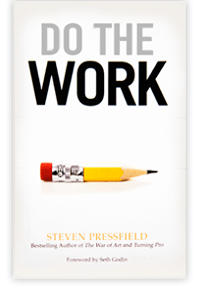
DO THE WORK
Steve shows you the predictable Resistance points that every writer hits in a work-in-progress and then shows you how to deal with each one of these sticking points. This book shows you how to keep going with your work.

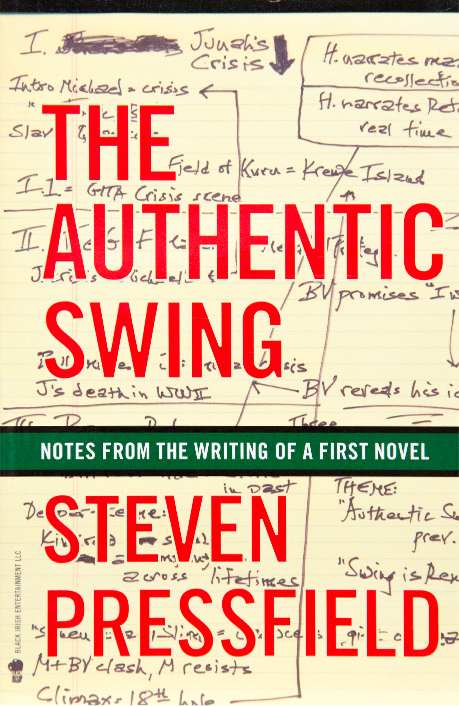
THE AUTHENTIC SWING
A short book about the writing of a first novel: for Steve, The Legend of Bagger Vance. Having failed with three earlier attempts at novels, here's how Steve finally succeeded.
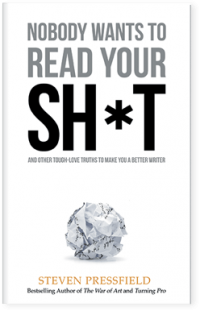
NOBODY WANTS TO READ YOUR SH*T
Steve shares his "lessons learned" from the trenches of the five different writing careers—advertising, screenwriting, fiction, nonfiction, and self-help. This is tradecraft. An MFA in Writing in 197 pages.
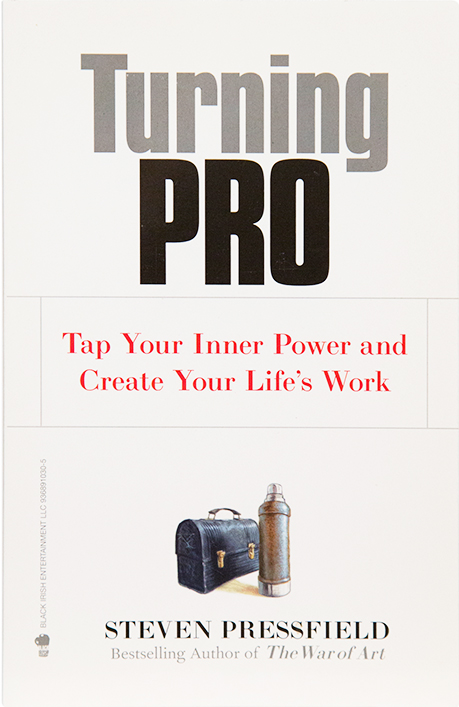
TURNING PRO
Amateurs have amateur habits. Pros have pro habits. When we turn pro, we give up the comfortable life but we find our power. Steve answers the question, "How do we overcome Resistance?"
Brilliant. Thank you!
Excellent post Steven. Like you say, the capacity to not get flustered and to summon one’s wits cooly is the most important lesson as we need to make forward motion and not get mired in the pit of anxiety.
Sticking points? Building walls? Sometimes is seems like they are both part of my home address. I carry walls around in my pockets, and THEN, if i misplace it, I energetically build a new one. Case in point – I am about a 100 pages in to a book. And then the bullshit starts –
What makes you think you’re qualified to write this?
Who’s going to care anyway?
Sure, it makes sense to you, but will it make sense to actual humans?
Where are you going with this; you keep repeating yourself.
And on and on. I keep writing, but the resistance wears me out.
Mike
Wonderful. Helpful.
At step #4, do you really start over? Aaarrggh!
This is very helpful. A perspective I needed to hear this morning after several days of putting off the launch of a business idea while watching the original energy dissipate . And a nice surprise since I didn’t expect a post today after the incredible writer’s journal you wrote this last week. Your courage and generosity never cease to amaze, thank you Steven!
Kathleen
Thanks for the reminder. It’s nice to be reminded that I’m not the only one who get’s high centered and stuck. We’re all in this together. Knowing that I’m not the only one makes me not beat myself up so much. I can say, “Look, everybody has these obstacles, not just you.” Makes getting unstuck an easier proposition when you know you’re not alone.
Thanks for great writing!
My fridge magnet says, KEEP CALM AND CARRY ON, but my brain screams, PANIC AND PETRIFY. My brain is dumber than my fridge magnet. That can’t be good.
Couldn’t find truer words. Reading this has helped me understand where I’m at with my art and why I feel like I have nothing left to give. It’s not that I don’t have anything more, I just have to find the next level.
Thanks Steven.
Writing a book is like working a puzzle. In the beginning when you are doing the hardest – nothing much seems to be happening. Pieces don’t seem to fit. Everything is so disjointed, thus who pass by are critical and skeptical. But once you get the structure in place, the characters and plot points sorted out it goes much smoother. But you must stick to it with an obsession that borders on lunacy. With the end in mind you can “work that particular piece on that particular day.” Brick by brick, piece by piece – my citizens of Rome.
I shall have to find a “keep calm and carry on” sign for my desk! This is something I learned the hard way, like most writers, I suppose. I used to try to force my way through those sticking points, but I finally realized they happen for a reason — a good reason, one that would benefit the project overall. Learning to take a breath and let go made working through those sticking points a productive experience rather than an exhausting nightmare, and taught me how to be more objective about my own work.
Great post!
Why is it so frightening to be known, seen, loved?
Thanks for your helpful “sticking points!” I am working on my PhD dissertation and get stuck often,
waiting for my psyche to catch up to my brain.
Your “sticking points” give me courage. Bravo…we all welcome any insights you would like to share with us as we try to “keep calm and carry on.”
This is a little gem. Excellent article Steven.
Excellent Steve. All the sticking points are so accurate but it was point four that brought back horrid memories. So true!
You’ve done it yet again! Provided me with the nudge I needed to get beyond what could have been an otherwise devastating conclusion….I am not on the wrong path. NO! Quite the contrary. I am very much on the RIGHT path to be experiencing so much self-imposed resistance. Whew! Saved again. Thanks.
Never a better description of what goes on inside the creative mind!! Thanks Steven for sharing your insights with us. I could relate as a Writer and as an Artist. Seems I want what I fear the most!
I am a sticking point place for sure. For the second day in a row, I’ve sat down to write the most important passage of my (first) book so far – and I’m terrified to do it. I don’t want to f- it up, you know? But I feel way out of my league to write the quality of passage I know I need at this point in the book (10 chapters in, 11,000 words).
Having read your “The War of Art,” I knew coming to your website would provide some good thoughts, and you nailed it with this post. Thanks for your insight and for your help. I love that I can come back to your words and get a fresh take on Resistance and professionalism in creativity. Thanks Steven!!
This helps a lot.
What if the sticking point has nothing to do with fear? I mean… Once you’ve accepted that fear of submitting a chapter that is at best incoherent subsides: You work on the chapter and work on it some more, but no matter how many times disassemble it and reassemble it, you still can’t make it all fit the way you know it should. The answer can’t be patience as I have a rapidly approaching deadline. 😀
Just submit the chapter as it stands and let my editor help me? Carry on even though my front is all over the place?
Wait… I just answered my own question. Doh!
Not only do I enjoy your the rhythym of your writing, the message in this is spot on. I deal with these things everyday and have recently come to square off with the part of me that “wants to take getting stuck personally” – doesn’t do a bit of good to spend much time in there, but I do find it’s necessary to name it before I move on. Thanks for this…
Thanks for the encouragement, Steve. I’m kind of at a ‘sticking point’ with only 1/4 chapter to go to the end. Every bit of advice helps!