The Ego and the Self

Where does Resistance come from? Seth Godin says it arises from the “lizard brain,” i.e. the primitive reptilian stem that knows only fight-or-flight and thus resists all attempts by the organism—you and me—to ascend to higher realms. There’s something to this, I think, but not, in my opinion, the way Seth sees it.
The source of Resistance, to my mind, is the clash between the ego and the Self.
A definition of the ego
What is the ego? The ego as I would define it is that identity-center that runs our lives in the here and now, the material dimension. When we say “I want,” “I need,” “I am,” the “I” we’re talking about is the ego.
(Significantly, when we say “I love,” we’re not talking about the ego.)
The ego runs the show in the real world. It’s the boss. It’s got an enormous stake in remaining the boss.
Now: what is the Self?
An “I” beyond the ego
The Self is a deeper “I,” a greater “I.” The Self, according to Jung, contains infinitely more than the ego. The unconscious (personal and collective) resides here. Dreams come from the Self, as do instinct and intuition. From the Self spring visions, myths, archetypes. The Self abuts the Divine Ground—neshama in Hebrew, the soul.
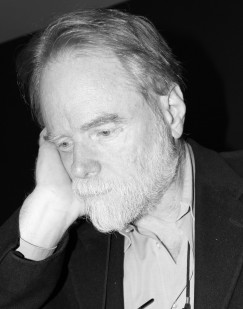
Rabbi Finley. It's a sobering business, contemplating the yetzer hara.
In the Kabbalistic view of the world, the soul, which is the source of all wisdom and goodness, is constantly seeking to communicate to us—to our consciousness on the physical plane, our ego. The soul is trying to guide us, sustain us, restore us. But there is a force operating against the neshama. This entity, called the yetzer hara by the great Kabbalistic teachers, is a self-contained and self-sustaining intelligence whose sole aim is to block us from accessing the neshama and to block the neshama from communicating to us.
My breakfast with Rabbi Finley
I was having breakfast a few weeks ago with my friend, Rabbi Mordecai Finley of Ohr HaTorah congregation in Los Angeles. I asked him about this very subject. Here’s part of what he said:
“There is a second self inside you–an inner, shadow Self. This self doesn’t care about you. It doesn’t love you. It has its own agenda, and it will kill you. It will kill you like cancer. It will kill you to achieve its agenda, which is to prevent you from actualizing your Self, from becoming who you really are. This shadow self is called, in the Kabbalistic lexicon, the yetzer hara. The yetzer hara, Steve, is what you would call Resistance.”
I’ve been publishing these Writing Wednesday posts for over a year now. Here, in a nutshell, is my artistic (and personal) philosophy:
Our job, as souls on this mortal journey, is to shift the seat of our identity from the ego to the Self. That’s it.
Art and the ego
Art (or, more exactly, the struggle to produce art) teaches us that. How? Because we start off, as neophytes, stuck in our egos. We’re trying by force of will, lust, ambition, greed etc. to come up with something that we can show to the world and be rewarded for. Ah, but it ain’t so easy. The process begins immediately to humble us. Like a stern but loving master, the struggle itself nudges us, shifts us, reroutes us. We’re seeking our true voice, our power, our authenticity as artists. We realize–through blood, sweat and tears–that betting on the ego is not going to get us there.
We have to go deeper. We have to surrender, give up the illusion of control, get out of our own way. We have to conquer our fears and jump off the cliff. Call it the Muse, call it “flow,” call it whatever you like. This is the Self—instinct, intuition, the unconscious. When we hit it, it’s like striking a vein of solid gold. We lose ourselves—that is, our egos—and we find something greater: our Selves.
The lover experiences the same exaltation in her perfect embrace of her beloved. She loses herself by giving unconditional love—and discovers a greater Self that is simultaneously her and not-her. So does the mother, the warrior, even the drunk and the drug addict. For an interval they all obliterate the little self and submerge themselves blissfully in the Big One.
Alas, this happy union vanishes the instant we resurface, just as a vision flees from the mystic emerging from his trance or a dream fades from the sleeper when he wakes. We have completed our miniature version of the hero’s journey and we’re back home. Now what? Try again tomorrow—and keep doing it till we get it right.
Resistance and the ego
The ego likes being in charge. It doesn’t want us to seat our identity within its rival, the Self. The ego produces the yetzer hara—Resistance—and strives with all its force and cunning to keep us bound to it and not to the Self.
The pursuit of art, originality, selflessness or excellence in any ethical form is, beyond all its other aspects, a discipline of the soul. It’s a practice. A means to and method for self-transformation.
If you ask me personally, Have I myself achieved anything like this … hell, no. I’ve still got both feet in the ego and they’re mired in mud and mucilage. But I’m trying. Like Rabbi Finley and those hard-thinking mystics from the sixteenth century, I’m shuttling back and forth to the Self as often and as mindfully as I can–and trying to hang on as long as I can when I re-merge to the earthly realm.
When you and I struggle against Resistance (or when we try to love or endure or give or sacrifice or face down an enemy), we are engaged in a contest not only on the material plane, but on the spiritual as well. It isn’t just about writing our symphony or taking care of our child or leading our team against the Taliban in Konar province. The clash is epic and internal, between the ego and Self, and the stakes are our lives.
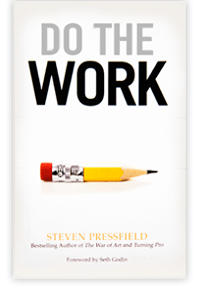
DO THE WORK
Steve shows you the predictable Resistance points that every writer hits in a work-in-progress and then shows you how to deal with each one of these sticking points. This book shows you how to keep going with your work.

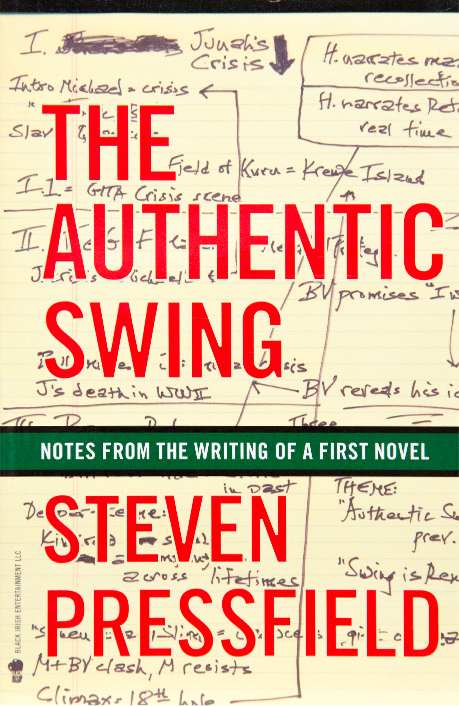
THE AUTHENTIC SWING
A short book about the writing of a first novel: for Steve, The Legend of Bagger Vance. Having failed with three earlier attempts at novels, here's how Steve finally succeeded.
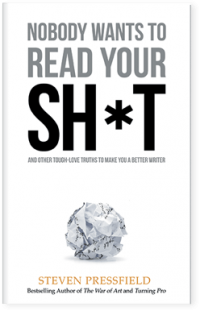
NOBODY WANTS TO READ YOUR SH*T
Steve shares his "lessons learned" from the trenches of the five different writing careers—advertising, screenwriting, fiction, nonfiction, and self-help. This is tradecraft. An MFA in Writing in 197 pages.
TURNING PRO
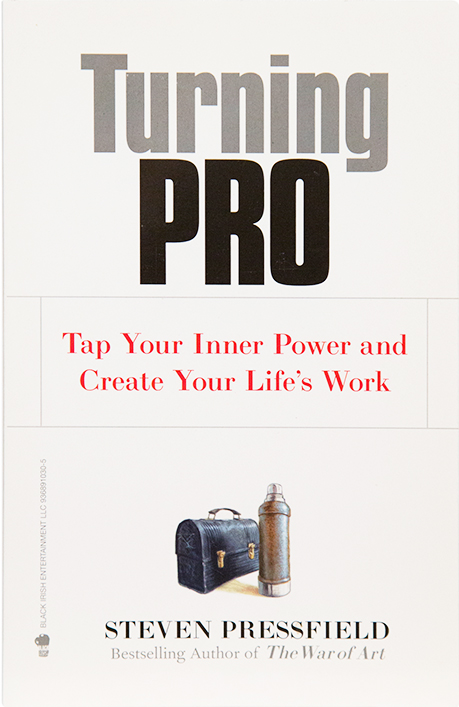
Amateurs have amateur habits. Pros have pro habits. When we turn pro, we give up the comfortable life but we find our power. Steve answers the question, "How do we overcome Resistance?"
Now why would it want to do a thing like that?
At first glance, the second self killing you to achieve its agenda is an odd concept. Looking deeper… when we let fear choose for us, (these are choices grounded in ego, that second self inside you) resistance always prevails.
I think the term “killing” is more metaphoric.
In a way, the ego does not want the self to live, to take over, so it is perhaps more of a blocking out than a killing.
in the larger context,
our individual selves might try to block out the unity consciousness, so that the individual can have the credit, acknowledgement, etc.
just a thought.
P
Wow, yet another breath-taking post, Steven!
Thank you!
I have came across nice quote recently, which said: “Success is not what are you hanging on to, it is what you can let go.” Letting go and surrendering to inner calling is indeed, an epic clash.
March on, warriors!
Wow!!! What an amazing but very true publishing. How often do we sit and allow ego to take control and gain the upper hand each and everyday of our lives. Understanding and knowing just what we are against is a great tool in this struggle. Continual fights with resistance is a constant battle but in order to achieve our true SELF, we must fight this war daily until we have won. Thank you Steven Pressfield!
“The process begins immediately to humble us. Like a stern but loving master, the struggle itself nudges us, shifts us, reroutes us. We’re seeking our true voice, our power, our authenticity as artists. We realize–through blood, sweat and tears–that betting on the ego is not going to get us there.”
This description really resonates with me. The pursuit of art is not only a calling, but a transformative process bringing us closer to our true selves.
This is a fantastic post and a great way of looking at Resistance from another perspective.
I keep encountering these chill-inducing synchronicities every time you publish a post like this. Last night I commented on an article by Mark McGuinness at Lateral Action about procrastination. Mark mentions you and your incisive concept of resistance in that post. My comment was all about the necessity of getting the ego and the unconscious mind, likened to the muse, into a harmonious working relationship. And now I wake up this morning to find this beautiful post by you about essentially, or exactly, the same thing. As always, thank you. You say these things so very, very well.
thank you so much for sharing your battle with resistance… yet another “to the target” hit on how profound your thinking is.
humbly i say thank you for sharing this Steven! your writing wednesdays are a total….
“dont miss it man!”
we all learn and share something with words like yours
sorry posting again so i can click on the updates box… best regards Ric
Alas, this happy union vanishes the instant we resurface, just as a vision flees from the mystic emerging from his trance or a dream fades from the sleeper when he wakes.
There’s nothing like being in that trance.
Sometimes I sit at the computer screen wondering how in the world I’m ever going to write another 60,000 word mystery novel. How did I do it those other times?
But then, somehow (I wish I knew exactly how) I go into that trance. And the words begin to flow. I can see the action on the screen of my mind. I can hear my characters speaking. I simply write it all down. Easy.
Oh, for the ability to go there at will. 😉
Along the same line, Caroline Myss talks about how we should be grateful that we were raised in an ego-based tribe, because it gave us a place to come from as we seek to free ourselves from its groupthink to get in touch with our Self. There can be no light without dark, no love without fear.
Further, if the ego was not there for us, we might never emerge from ecstatic meditation to forage for food and shelter, for instance. The ego allows us to survive in this world (the dark) so that we may experience the divine (the light).
“I” completely agree with your view of the need to “have” an Ego to survive in this World (virtual or real) and realize our True identity. I believe our “gut” feelings guide us more than wanting to destroy. Thank you for reading me.
“Our job, as souls on this mortal journey, is to shift the seat of our identity from the ego to the Self. That’s it.”
This morning, I am as depressed as Rabbi Finley looks. I am fighting against the yetzer hara, against Resistance. It is a powerful force and my energy is weak. I come here looking for a boost, but today, I am hit with reality. The battle is for me to fight. It’s time to get out of the safe zone. For goodness sake, even these Wednesday visits (which turn into Thursday, Friday and Sunday rechecks) are proving to be a distraction. Resistance is even using my learning about it to keep me from writing. This is crazy!
That’s it! I am shifting my seat.
I’m in the same zone Ines. You brought to mind that William James quote. “Nothing is so fatiguing as the eternal hanging on of an uncompleted task.”
Drat! I thought I was coming up with something more original when I realized this. Those 16th century mystics beat me to it 🙁
There is no new thing under the sun.
The only thing I’d add is it ain’t just art which allows for a persuit of the self and overcoming resistance. Everything does. I’m involved in weight lifting right now, and it’s taught me a lot about overcoming resistance for the sake of the self, which is kind of neat….
Hi Steven,
I emailed Seth Godin some time ago to share with him my thoughts about the Resistance, which is similar to what you’ve mentioned here.
However, I don’t see the conflict being between the ego and the Self, but between the Self and the self-image. The Self is who we are, and the self-image is our impression of who we are, based on the impressions people have about us, our past experiences, and our own thinking pattern.
We take every incident as an opportunity to reinforce our self-image. Whenever we do something (or fail to do something), we ask ourselves: “What does this say about me?” and use the answer to instill our self-image.
We spend most of our lives living through our self-image, and not our Self. We live according to our false impression of who we are and what we’re capable of, without realizing the enormous room for flexibility that the Self allows for. But because we see ourselves from the narrow confines of our self-image, it’s difficult to break out of that illusion, and embrace our true potential.
Many writers say that they are “terrible writers,” then behave accordingly. And because they’ve already concluded that they are terrible, they don’t realize the enormous reserves of creativity they have, yet refuse to acknowledge.
Resistance is our way of clinging to our self-image as the only truth we know, and the fear of discovering what the Self truly is, and capable of achieving.
Just finished reading Pema Chodron’s “When Things Fall Apart” Theres a great zen story in there about a young female warrior who asks to do battle with Fear. She asks “how can I defeat you?”.. Fear replies, “I get very close to your face, and I talk fast and very loud. You can listen to what I say, and even believe it, but as long as you don’t do what I say, you will defeat me.
Amazing post and Insight. Worth sharing, understanding and directing your conscious mind.
A pleasure to read this post.
Beautiful post! Being a yoga student, this especially sticks with me: “The pursuit of art, originality, selflessness or excellence in any ethical form is, beyond all its other aspects, a discipline of the soul. It’s a practice. A means to and method for self-transformation.”
Hi Steven,
In a word, this piece: ROCKED. I subscribe to Godin’s lizard brain theory, very much resonate with this Kabbalistic view as well. Perhaps the lizard brain (amygdyla) is the seat of the yetzer hara the same way yogis say the pineal gland is the physical window to the soul. In either case this is a big insight.
BTW I just finished Gates of Fire. Beautiful storytelling. Gritty and truthful. I searched for writing you’ve done on phobologica, but couldn’t find anything. Is phobologica a way of defeating yetzer hara?
It is exactly, Steve.
What about the embracing of opposites, holding the contradictions of life in our heart and mind? Can contradictions co-exist? Isn’t that what art is?
I think wisdom comes when contradictions co-exist. Holding the contradictions of life in our hearts and minds can push us to be empathetic beings like the wind in the anecdote that explains the conflict between the sun and the moon I represented on one of my masks I called, The Cave: The sun views people as active because it sees them move about during the day. The moon, on the other hand, sees people sleeping and views them as lazy. So long as the sun and the moon make no effort to understand the reality on the other side, conflicts between the sun and the moon will never end. We can’t be wise if we don’t transcend.
What a profoundly beautiful post, Mr. Pressfield. It brings tears to my eyes.
The buddhists call her Maya. The greatest enemy we will ever face. And make no mistake. She will hide everywhere even where we least expect to find her. Even in our hearts, even in love. Just when we have realized how proficient we are becoming in getting rid of fear and unconditionally loving our peers, we feel the joy and pride of having reached the goal: at last I have shed my ego and are resting in my Self. But who is this “I” that have performed such a magnificent feat?
Dear Steven. Thank you for writing your great posts about resistance, and thank you for mentioning the ego as the source of resistance – I agree this is the main thing. Seeing beyond the illusion of the world and letting go of the ego, of the “I”.
However unlike you I find “love” at least in it’s everyday use, is in no way separated from ego or Maya or yetzer hare. In fact I think is a place where the ego reigns supreme. How many times haven’t what we call love triggered exactly the contraction and fear based reaction that are the hallmark of the ego?
And while I like you find my ultimate purpose to see through the illusion, I don’t see “fighting resistance” as the solution. For let me ask you, who is doing the fighting? Who is taking pride in the results?
So what’s the solution. There is none – at least none that can be put into words. Personally I like the image of seeing Maya or yetzer hara as a trickster. And sometimes she will get you and then what’s left other than to smile, acknowledge that you fell for it once more and just keep walking doing what you have to do. Just like Arjuna.
So – have fun 🙂
Very interesting. However I am not sure that we need to battle that frightened, narcissistic part of ourselves that you are calling the ego. I think compassion and mindfulness is both a gentler and more effective approach. There is some lovely research on the benefits of self-compassion i.e. ‘being warm towards oneself when encountering pain and personal shortcomings, rather than ignoring them or hurting oneself with self-criticism.’ http://en.wikipedia.org/wiki/Self-compassion
It’s not a battle as much as it’s confrontation. To face the bear. We are looking for our truth so we have to unravel the mind that is playing out all these rational scenarios instead of jumping into the unknown. We can’t think our way through this, we have to feel our way through it to truly understand.
Scott Michael… brilliant perspective.
As I read this superb post and Scott’s comment, Maslow’s hierarchy of needs made perfect sense to me.
Good definitions. It helps to define how we see self-as-content (ego) as how we are what we think vs. self-as-context, simply the place where the thinking and feeling takes place, which helps us then observe resistance and catch it in the act!
Steven, what would it look like for you to pursue this concept further? I would love to see a series, a retreat, weekend, or online discussion about how to work out these principles. I really think you’ve hit on something here, and would like to explore it in a deeper way.
I knew something was there, something identifiable. I could feel it. The deeper I go into this work (sifting the Self from the Ego), the more surprised I become at the depth of my rage. I think, in the beginning, rage and resistance were a sword and a shield. They saved me. Now … well, now they try in both devious and forthright ways to defeat me, the world, the entire human race. Of the two, I think rage is actually more benign.
The fall of man! Expelled from Eden, filled with shame and cursed by God to ‘toil’, man is divided from his Creator (and against himself?!) and fallen into sin. Then see 2 Corinthians Ch. 5 “We are always confident, knowing that while we are home in the body we are absent from the Lord. For we walk by faith, not by sight.”
But what is a man? What is a man in Ego and what is a man in his divine masculine?
Beautiful article on the Divine Masculine
https://medium.com/illumination/what-is-the-divine-masculine-and-what-is-its-purpose-984102487bae
i like the photograph of the typewriter fonts
Thanks for this, I’m in the struggle as well. The “Art of War” is part of my morning routine and it helps me get back on track during the day when I let myself get sidetracked by resistance.
@Laura: The Art of War? Or The War of Art?
What a post!! Self and ego — yes indeed. You go straight to the heart — truth and lies, good and evil, and all the other forms duality takes in this double-minded world of ours. When you can get the false self, the ego, out of the way, that’s when the Muse or Self takes over, and in that wonderful transcendent state, art begins to flow. You really nailed it Steve and with such wonderful anecdotes and metaphors to bring the idea home –and for sure we all struggle with Resistance. It’s the human condition.
Soul discipline, I love that. In Christian Science, the expression is “to stand porter at the door of thought.”
Ironic how you can find yourself in a moment of ecstasy where you’ve made it home and “all is right with the world,” and then a tiny thought creeps in, an ego thought that says, “well, perhaps not ALL is right with the world” …and away you go down the rabbit hole again. Being aware enough to nip that little thought before its ugly blossom fully unfolds — ah…that’s the challenge. It’s a camel’s toe in the tent, and If you can nip it at the start, it’s so much easier than waiting to see what the ego will say or do next.
I think life is a gradual peeling away of unconscious moments along with glimmers of awareness that take us higher.
Rachel had a good point in her response. When we channel our attempts at soul discipline down to the level of a fight or force, then we’re on the ego’s ground. A simple recognition of its lies and turning away to embrace higher thoughts like love, compassion and understanding are more effective ways to deal with Resistance. Resistance is looking for a fight. In fact…it’s counting on it. It’s our attention and belief in Resistance that gives it its power. Of course, for our stories, we need Resistance for our protagonists whether external or internal, but in life? When sitting down to type our story? No…we don’t need Resistance,and stepping back to take an exterior view of it, and seeing it for what it is, enables us to get on with writing.
Brilliant! Brilliant! Brilliant! I’m sooooo grateful you wrote this post!! Thank you! Thank you!
I do believe ego and self will always counter balance each other, but as you pointed out somewhere along the way, we need to find a strategy that works well for us to break through the resistance. The brain’s primary effort is to keep us alive, so it makes sense – when we stretch outside of our comfort zone, the brain says, “oh no you don’t!” Change equals the unknown and doing something with an unknown outcome is perceived as RISK. Not something the brain wants to allow. So, if you feel the urge to turn and run (or clean, organize your sock drawer or paint the fence) instead of expand into the purpose that is calling to your heart, you can do some things to ease the resistance. One trick that works wonders is to imagine that you’ve already accomplished the goal you desire. Picture the outcome – all the rewards, and then run through the process you went through to achieve it (with ease!) This takes practice, but doing it even a few times can relieve some of the push-back from the brain. Sweet relief!
I understand this clearly. I don’t feel so foreign now. Steven, this is the first article I’ve read so far, yet I will certainly return for more.
This is a beautiful mesmerizing article and concept. Transformation work has been a struggle for me for years but I am not the same person I was last year. I wonder if I’ll ever get there. Oops…that was the ego, right? So those thoughts do not belong. We must move forward with two steps and back with one. Or perhaps only forward. We are spiritual beings have human experiences and the goal is to become our spiritual self as best we can.
Thank-you a lot for writing this, I felt it was looking for me, trough your words it has arrived!
A fellow singer/performer suggested your book and website to me, and the timing and messages are perfect, as I’ve been wrestling with focus, action, ideas and shoulds.
I’m getting the book, and just signed up for the 27 minutes course. By the way, how does one get to part 2, etc of the course? I was hoping to go through it tonight, have tried several things and can’t seem to figure it out. Thank you
Please disresgard my last Q; I found the blog’s search function, and searched for “War of Art course”
The ego does rule. I like to think I am on the path to self awareness and making art. Steve takes the struggle of the mystic, and applies that to the quest for making worthwhile art. I applaud his continuous prose on the subject. It is a leading by example. I put him in my circle of trust as an intelligent provider of insight. This article resonates with what I have learned in studying the subject. Although the ego needs conflict in order to survive, one must always ask how to see things differently to ease the suffering in the world. There is a prize at the end of the quest. Moments of happiness, creating and sharing a piece of work. While also, there is so much value in listening to other voices.
This is so well written but I’ve moved away from the ideas of divide within us. Carl Jung. Spiritual teachings. These ideas sound good but where there is separation there will be conflict adding to self doubt (which is more of the resistance. Battling one part vs the other. Labelling the animal vs spirit. Ego vs self. They are all one. The ego is us and is useful in protecting us. But yes, face the self doubt and constantly move forward.
To understand the Ego and the self, one first steps away from the self and the ego so they can see it. The Ego is like wearing a hat and we think we have a handle it on but we really cant see it when its on our head. It’s like this, the celestials refer to our death as a moment of separation. So, we are always attaching and separating. That is structure and chaos. We exist in unity, then create structure to focus and learn.
To find unity in ourselves, we can simply remove the belief in separation, but to identity each piece and then make them whole, well that seems to be the journey. Read the book The Ego And The Self, Erin Dinsmore, its fascinating. JeanLuc, you are in this beautiful 5d mind, unity, which is amazing, but find all your pieces and find their harmony, that is the art of transformation. To become fully self aware. That takes shadow work, relinquishing past beliefs, and letting your mind unravel. Hello Ego Death. What a ride. 🙂
What a beautiful article Steven! Wow. The Ego is the most misunderstood aspects of being human. I struggle with it all the time because I didn’t understand it. We went back in history all the way back to Mesopotamia, Akkadian Empires, Babylon Empires. We unpacked the emerald tablets, lost writings of Mary, and the depths of Siddhartha. They all say the same thing quite clearly: You must awaken your heart center to balance the system of the mind. The Ego. It is only one part of two. This is the great awakening thats begun. There is only one book that we know of on planet Earth that unravels this complex system on the path from Head to Heart, its called, haha, The Ego And The Self, by author Erin Dinsmore. He traveled the world and found our secretes. Wait till people see the Spectrum Of Self, you can find your own layer of Ego and start to understand your life with more depth. Anyway, thanks Steven, this was so very beautiful. Thank you!
Bravo! I sent a question to your site not 30 minutes before I read this, and this addressed it beautifully. Good timing.