Writing Characters Who Are Smarter Than We Are

There’s a great moment in the movie Tootsie, when Dustin Hoffman—in costume as “Dorothy Michaels” but speaking as himself, “Michael Dorsey”—says, out of respect for Dorothy, “I wish I was prettier.” In other words, the character he was portraying was better than he was. That’s an amazing thing if you think about it.
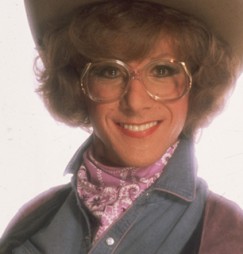
Dustin Hoffman as "Tootsie": He wanted to be prettier
Working above our game
As writers, can we write characters who are beyond us emotionally and intellectually? Can we work above and past our own personal limits? I’ve heard the opposite. I don’t believe it. How does Thomas Harris (who I’m sure is a very nice guy) conjure Hannibal Lecter? How did Arthur Golden pull off so brilliantly Memoirs of a Geisha? How did Dickens get inside the skin of any of his characters—or Shakespeare or Tolstoy or Sophocles?
The answer is that we as writers (and painters and filmmakers and every other kind of artist) work from a part of our beings that is far deeper and wiser than our mundane everyday selves.
There’s no great mystery to this. As kids we could pretend anything, couldn’t we? Be Flash Gordon, be Catwoman; we could walk like an Egyptian or mock our assistant principal’s accent; we could mimic flawlessly the way Sister Mary Catherine screwed up her nose when she whacked us over the knuckles with her yardstick.
Being brave in our work
When we are told to be brave in our work, what that means is “trust the source.” When I was working on The Legend of Bagger Vance, it became clear to me very early that my narrator—in whose voice I was speaking—was a much deeper character than I am. Was I daunted? Hell, yes. But it also became clear very fast that this character (a Southern physician in his seventies) was speaking in a true and authentic voice. How does this happen? I don’t know. It just does.
In Patricia Madsen’s wonderful book, Improv Wisdom, she tells of an exercise she used for years in her Improv classes at Stanford. Imagine a box. Now open it. What’s inside? Sometimes it’s a frog, sometimes a diamond. But the trick is: there’s always something in the box.
The ego and the Self
When we’re walking down the street as our everyday selves, our identity is seated in our ego. The ego is that fearful, hesitant, pain-in-the-ass persona who generates Resistance and in general holds us back and ties us down. But when we write or paint or compose and trust the source, our identity shifts over into the Self.
The Self beats the hell out of the ego any day. The Self, Jung tells us, abuts the Divine Ground. The Self is the Muse, the quantum soup, the unconscious, the soul. The Self knows the dark side and it understands the light. It can make fun of Sister Mary Catherine and it can channel Vishnu.
My first real adult job was as a junior copywriter at Benton & Bowles in New York. My boss was a terrific writer and novelist named Ed Hannibal. When I’d bring him ideas, he would grimace. “This idea is so small. It’s the size of a postage stamp! If this idea was any tinier, I’d need a microscope to see it. Go back to your cubicle and bring me something BIG.”
It ain’t easy being big
I was terrified. I didn’t want to be “wrong.” I didn’t want to reach for something and fall on my face. But it was so excruciating to see the scowl of disappointment on Ed’s face that I had to try. Advertising sucks; I won’t try to defend it. But an apprenticeship in a creative trade, be it journalism or software design or writing instruction manuals for submersible industrial water pumps (another gig on yours truly’s C.V.), can teach you stuff you don’t learn in the Iowa Writers’ Workshop.
Turn off the self-censor. Release all self-judgment. Type as fast as your fingers will let you and don’t even look at what you’ve done until ten days later. Do that—and keep doing that.
The well is deep. Trust it. Trust the source.
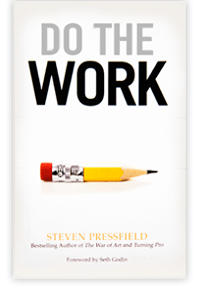
DO THE WORK
Steve shows you the predictable Resistance points that every writer hits in a work-in-progress and then shows you how to deal with each one of these sticking points. This book shows you how to keep going with your work.

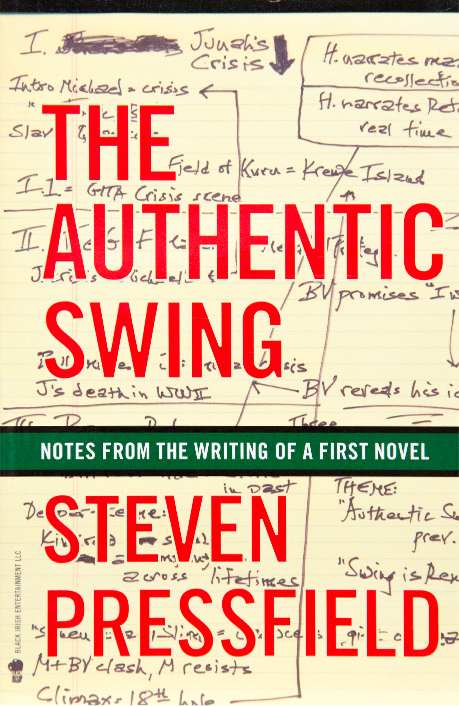
THE AUTHENTIC SWING
A short book about the writing of a first novel: for Steve, The Legend of Bagger Vance. Having failed with three earlier attempts at novels, here's how Steve finally succeeded.
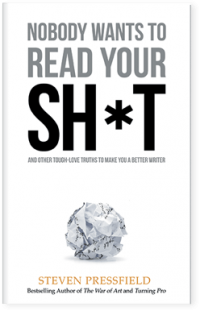
NOBODY WANTS TO READ YOUR SH*T
Steve shares his "lessons learned" from the trenches of the five different writing careers—advertising, screenwriting, fiction, nonfiction, and self-help. This is tradecraft. An MFA in Writing in 197 pages.
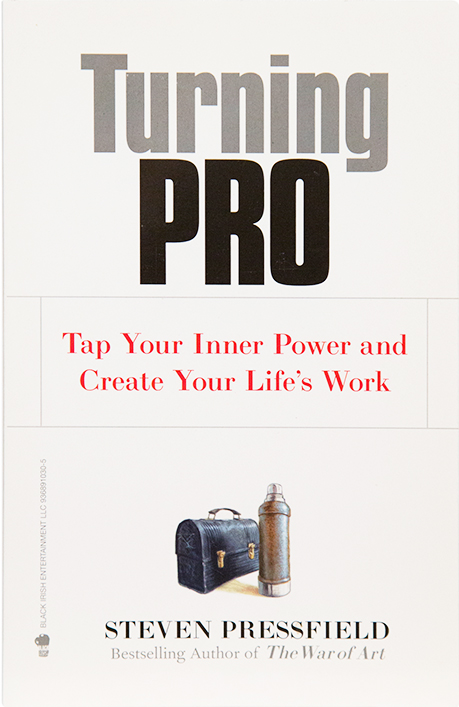
TURNING PRO
Amateurs have amateur habits. Pros have pro habits. When we turn pro, we give up the comfortable life but we find our power. Steve answers the question, "How do we overcome Resistance?"
I often think it is funny that our characters can be so much more that the writer that created it. I have first hand experience with this.
I’ve been writing the about the same characters for over a decade and as you can imagine they have taken on a life of their own. I can crack my husband up with some of their dialogue in ways I can never do as myself. He had often wondered how they can be so much funnier that I am, and it is something I often wonder myself…
I’ve had many a dream in which I am am observing someone speak on a subject and think- while still in the dream- I wish I was that deep and brilliant and could communicate so well.
We have to wake up from the dream of our perceived limitations.
This is a particularly timely post for me since I am trying to write a character who is going to turn out to be a masterful concert pianist whose emotional journey and character arc are built around the song Moonlight Sonata. Good luck with that right? I venture forth from this article with a surer step. Thanks so much Mr. Pressfield.
Yes, sometimes my characters are smarter than me. Other times they’re braver than me. Or cooler than me. And my bad guys are definitely badder than me. 🙂
In one of my suspense books, my main character, Greg, who is a mild-mannered kind of guy, does something he could never have imagined doing. His girlfriend is about to be shot in the head by a lunatic who is bleeding to death. So, Greg picks up a gun for the first time in his life and dives into the room, determined to save the woman he loves. He knows he will probably die. And the chances of his shot hitting the bad guy are close to zero. But he does it anyway.
When I created Greg, I had no idea he was capable of doing such a thing. Sometimes you don’t find out until the pressure is on.
But if I had thought it through carefully, maybe I wouldn’t have let Greg get into that situation. But I didn’t think. I just threw Greg off the cliff, not knowing where or how he would land.
And I’m glad I did. It’s one of my favorite scenes in the book.
A few weeks ago, I was writing a scene where my protagonist looks at an empty bedroom, remembering the death of his three-year-old daughter several years before. I don’t know where this came from. I have never been married and I have never had any kids, and yet, my character’s pain was as real as if it had really happened to me.
Back in Olden Times when I was in music college as a drummer, my grizzled old salt of a jazz teacher was trying to get my samba playing up to speed. Within a few bars the lactic acid would have my calves screaming and I’d seize up.
He told me to relax and “cop the nerve”, meaning, relax and let it out, almost ride it, instead of trying to push it.
When you get this idea, you stop overthinking and begin trusting and you get to enjoy the performance on it’s own merits – you just happen to be playing it too – and you stop sweating about ‘cutting the gig’.
You let your faculties do the job.
I’ve found that Copping the Nerve applies to writing and my art as well…a sort of Zen disconnected concentration…
and who doesn’t like tossing around vintage jazz-era phrases?
Steve, you have once again stuck a cord of both sense and magic for the writer/creator. Why is it, I wonder, we forget that there really are no limits? I am not bound by my personality, my preferences, even my values. When we open that “box” there is no telling who/what might show up. The key thing, as you point out, is to trust the source and to accept whatever crazy things show up. Your blog inspires. I continue to be in your debt for quoting Improv Wisdom. I hope you are well. I send happy greetings from the Bay Area.
I had to laugh at your memories of “writing instruction manuals for submersible industrial water pumps.”
Reminds me of B2B copy I once wrote for “The Auto Parts After Market.”
I agree imagination is key to writing characters—or about characters—who are bigger or deeper than ourselves.
Compassion is also helpful.
I write a lot of marketing copy for subspecialized physicians–genius healers far more intelligent than me. I’ll never be able to grok their subject matter. But if I can get inside their heads—and hearts—I find I can convey their curiosity, keen intelligence, passion and compassion.
“The well is deep. Trust it. Trust the source.”
Thank you for writing this. It feels so real and so true and I hope I never forget it.
What an inspiring article. You almost have convinced me to try out Fiction and be that person that I have always wanted to be but never had the courage to explore.
Ooooo lala Pressfield, this is very nice….
So very timely as well. Thanks for the musings…
I love this article, I’ve often thought how lucky I am to be able to take time just to spin fantasies and make them feel real. Often, when I create a totally made up world, I go back and read it later and meet my real self there.
http://echo-echosvoice.blogspot.com/2010/07/storyteller-for-duffy-barkley.html
I’ve written characters who are much wiser and deeper than I have been in life, and probably will be for the near future, because I mostly act from ego instead of Self. In the (too few) times I’ve been aligned with my Self in life, responding instead of reacting, wisdom came forth like water from a happy spring.
The Muse struck again – I’ve never heard of a happy spring until now, and I’ll take it!
That was a good article. Referencing “Tootsie”…. The writers’ movie and in a surprising way. I know we’ve all felt that feeling of yours in the agency, of wanting to be better but not understanding what better is out of fear.
The box exercise and metaphor are both lovely, thank you.
We all have our things to warm us up. I write these little things I call “compassion loops”. There’s not a hard and fast definition, no feet a lariat could sweep from a compassion loop. It’s just a way to feel things (it works for me) for people you can’t see. An aside: that’s a thing the brain does, mixing imagination with memory like some stalwart and semi-demented mixologist; it (the brain) often doesn’t know if the mix is syrup or sour.
A compassion loop is (por moi) an economical way to get to the heart of characters, to what they want.
So an easy compassion loop:
The character who is smarter than me has been hated for his smarts, maybe he disdains other people… thinks of them as pests, and that’s why I…
but that’s pretty easy. Are you with me?
A harder compassion loop.
The character who is smarter than me… Can’t quite keep friends as I rise through the ranks. Spend a lot of time alone, not lonely. I keep busy. The Economist. The Utne Reader. Poker. Drinks Yoo-hoo on the drives home from the Center, those days he gets to fill the tank on his way home, pops inside, the a/c cold in his chest as John, the shorter of the two Indian brothers who own the station, cheerfully subservient, sings out his greetings.
Once you get to what the character wants, it doesn’t matter. Follow your outline.
My old theater professor, a tiny little man, Stan something, used to call out “I don’t see a reason in your eye!”.
It’s the same thing in such a real way that we even have the same word for two totally different things. A Character in a Film is not, will not, and could not ever be experienced in the same way as a written character. Film captures everything and leaves the visual part of your brain (the part that imagines) with nought to do but sleep for 90 minutes. That same part of your brain (that remembers what that photo you’re looking for looks like) comes back to life when life slows past frames per second and reverts to page-by-page.
But characters are characters and written or acted, their wants must be revealed in all their actions. That’s what Stan wanted for us.
Kudos to that!
There was nothing in the box when I opened it…. What does that mean? I think outside the box? 🙂