Rosanne Cash’s Dream

[The following excerpt from Rosanne Cash‘s Composed hit me like a two-by-four between the eyes. Thanks to Ms. Cash for permission to run it. The book is brand-new and it’s keeping me up nights. It should be required reading, in my opinion, for all serious writers, artists and musicians, particularly women. But judge for yourself. I’m giving over the whole of today’s post to this passage from Rosanne Cash’s Composed.
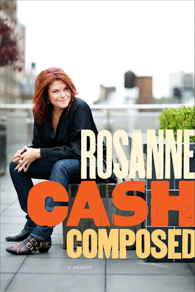
If you want to know about the Artist's Journey, particularly from a female point of view, read this
[Note: “King’s” is King’s Record Shop, the 1987 album that produced four #1 singles. And now: over to you, Rosanne …]
It was late in the making of King’s that I had a dream that changed my life.
I had met Linda Ronstadt a few times–in Los Angeles, while I was recording at Lania Lane; when I opened for Bonnie Raitt at the Greek Theater and Linda had come to see the show; and on a number of other occasions, as we traveled in the same circles and worked with many of the same musicians. Her record Heart Like a Wheel had profoundly affected me as a young girl, and I had studied it assiduously as a great example of a feminine point of view concept record, the best one since Joni Mitchell’s Blue, I thought, and equally important in the template I was creating for what I might do in my life. I especially admired her thoughtful song selection, which resulted in a very well-balanced album, and I wanted to make a record with a similarly unified concept, but as a songwriter.
Just as I was beginning to record King’s, I had read an interview with her in which she said that in committing to artistic growth, you had to “refine your skills to support your instincts.” This made such a deep impression on me that I clipped the article to save it. A short time after that, I dreamed I was at a party, sitting on a sofa with Linda and an elderly man who was between us. His name, I somehow knew, was Art. He and Linda were talking animatedly, deeply engrossed in their conversation. I tried to enter the discussion and made a comment to the old man. He turned his head slowly from Linda to me and looked me up and down with obvious disdain and an undisguised lack of interest. “We don’t respect dilletantes,” he spat out, and turned back to Linda. I felt utterly humiliated and woke from this dream, shaken to the core. I had been growing uneasy in my role in the Nashville community and the music business as a whole. I thought of myself primarily as a songwriter, but I had written only three songs on King’s. I was famous and successful, but it felt hollow, and the falsehoods were piling up. With more success had come more pressure to be a certain way, to toe a certain line, to start a fan club (which I refused to do), to participate in big, splashy events, and to act as if the country music scene were a religion to which I belonged. I resisted the push to conform, to buy into a certain narrow aesthetic, and to become part of the established hierarchy. I didn’t want a lofty perch; I wanted to be in the trenches, where the inspiration was. My unease led me to that dream. Carl Jung said that a person might have five “big” dreams in her life–dreams that provoke a shift in consciousness–and this was my first.
From that moment I changed the way I approached songwriting, I changed how I sang, I changed my work ethic, and I changed my life. The strong desire to become a better songwriter dovetailed perfectly with my budding friendship with John Stewart, who had written “Runaway Train” for King’s Record Shop. John encouraged me to expand the subject matter in my songs, as well as my choice of language and my mind. I played new songs for him and if he thought it was too “perfect,” which was anathema to him, he would say, over and over, “but where’s the MADNESS, Rose?” I started looking for the madness. I sought out Marge Rivingston in New York to work on my voice and I started training, as if I were a runner, in both technique and stamina. Oddly, it turned out that Marge also worked with Linda, which I didn’t know when I sought her out. I started paying attention to everything, both in the studio and out. If I found myself drifting off into daydreams–an old, entrenched habit–I pulled myself awake and back into the present moment. Instead of toying with ideas, I examined them, and I tested the authenticity of my instincts musically. I stretched my attention span consciously. I read books on writing by Natalie Goldberg and Carolyn Heilbrun and began to self-edit and refine more, and went deeper into every process involved with writing and musicianship. I realized I had earlier been working only within my known range–never pushing far outside the comfort zone to take any real risks … I started painting, so I could learn about the absence of words and sound, and why I needed them. I took painting lessons from Sharon Orr, who had a series of classes at a studio called Art and Soul.
I remained completely humbled by the dream, and it stayed with me through every waking hour of completing King’s Record Shop … I vowed the next record would reflect my new commitment. Rodney [Crowell, Rosanne’s then-husband] was at the top of his game as a record producer, but I had come to feel curiously like a neophyte in the studio after the dream. Everything seemed new, frightening, and tremendously exciting. I had awakened from the morphine sleep of success into the life of an artist.
[What can you say after that? “Thanks, Rose … and thanks to ‘Art,’ who sat on the sofa between you and Linda Ronstadt and changed your life.”]
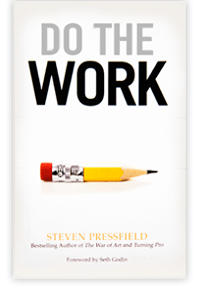
DO THE WORK
Steve shows you the predictable Resistance points that every writer hits in a work-in-progress and then shows you how to deal with each one of these sticking points. This book shows you how to keep going with your work.

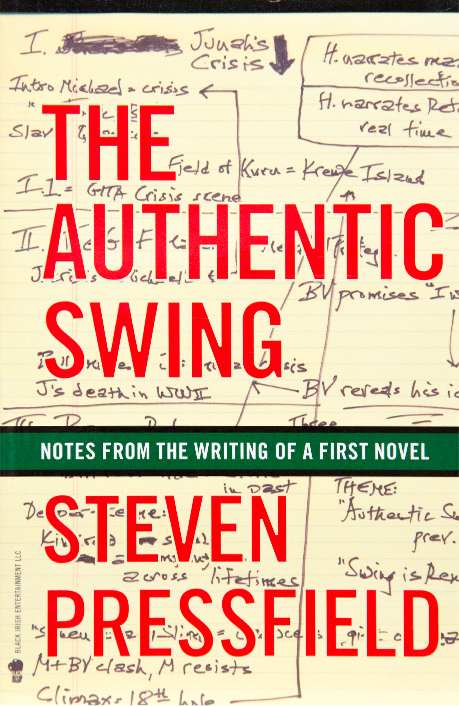
THE AUTHENTIC SWING
A short book about the writing of a first novel: for Steve, The Legend of Bagger Vance. Having failed with three earlier attempts at novels, here's how Steve finally succeeded.
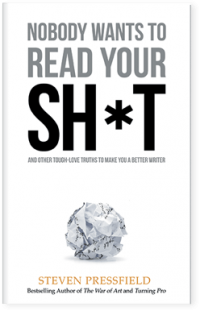
NOBODY WANTS TO READ YOUR SH*T
Steve shares his "lessons learned" from the trenches of the five different writing careers—advertising, screenwriting, fiction, nonfiction, and self-help. This is tradecraft. An MFA in Writing in 197 pages.
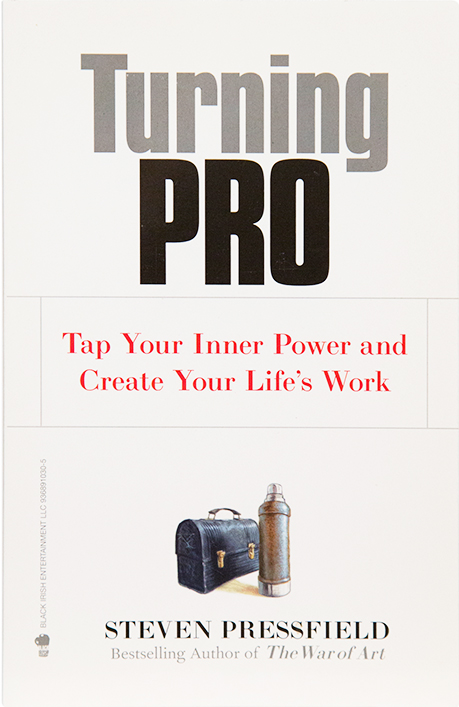
TURNING PRO
Amateurs have amateur habits. Pros have pro habits. When we turn pro, we give up the comfortable life but we find our power. Steve answers the question, "How do we overcome Resistance?"
Great example of doing it her way–with a dream, a goal and a plan! Just added “Composed” to my reading list.
I have Cash’s book on my list, too. Thank you for highlighting this wonderful excerpt.
Great article Steve. May we all awaken. Love John Stewart’s work too – check out California Bloodlines!
whoo boy! Cash’s passage takes my breath away. Thanks Steve
Very useful. You can’t have too many clues to remind yourself where you want to stand and how you want to be. Thanks for the tip and the inspiration.
Cash really made an effort to get out of her comfort zone and stretch. She has also had some personal/ health events- all of this stuff of living can really add to an artist’s growth if one is open to it.
I’ve had three apocalyptic dreams in a row, zombies, aliens and a fire. When you try and remake your world, it can get hairy and your subconscious lets you know not everyone is out to help you.
I’m really enjoying all the comments, and SO honored that Steven chose to excerpt my book, particularly because ‘The War of Art’ was an enormous inspiration and I am somewhat in awe of him! I like Ken’s comment ‘not everyone is out to help you.’ Yes. As Steven so eloquently described it, the forces of resistance are powerful and take a lot of forms.
Awesome post. Thanks for sharing the excerpt Steve. And thanks to Rosanne for writing the book and sharing her experience with us. Interestingly enough, when I forwarded this post on to a friend, she instantly remarked the hierarchy / territory distinction:
“I resisted the push to conform, to buy into a certain narrow aesthetic, and to become part of the established hierarchy. I didn’t want a lofty perch; I wanted to be in the trenches, where the inspiration was.”
Dovetails so much with The War of Art it’s eerie. Thanks again for sharing.
Nothing beats a story of self submergence into the mystic world of ‘art’ (whatever your art is), that fulfills the soul.
I came within an inch of buying Roseanne Cash’s book last Saturday, but I thought, No, it’s not what I came in the store to buy.
Thank you for informing my inner Artist that I need to go back and get it. It was a fun browse; now I know it will be a great read.
Appreciate being pointed to another good read.
This was my favorite passage from the book as well, and one I read and reread – it’s a zinger to the heart!
So glad I happened upon your recommendation a few weeks ago; picked up Composed yesterday and haven’t been able to put it down! Beautiful, lyrical and so honest. Many great moments throughout, but particularly love this quote re: using her 7th grade metaphor in her lyrics — “This one line, in this one song, is how I know who I am, and how I know I survived.”
Again, many thanks for the review/suggestion.
Thanks for your vulnerability Rosanne – its an inspiration to stay out in the woods.
I’m looking for info on Sharon Orr, the artist from whom you took lessons. I think I was a student of her’s year’s ago.
Wow! Amazing excerpt. Thanks.
Steven,
Question about what you have been talking about concerning “Turning Pro”, the “All is Lost” moment etc. With Rosanne’s dream and with your friend Paul’s breakthrough… It sounds like these moments were not something they willed to happen, or something they controlled. They controlled the work they did leading up to the moment, and the response they made afterward. Is there something is this process that you are talking about that happens in it’s own time and that the writer or artist does not control? Not sure if this is making sense…
I read and enjoyed this book last year, but had somehow skimmed over this passage without noticing it. Thanks for highlighting it, Steven – super important!
This chapter makes me want to read the rest of Roseanne’s book.
I too found The War of Art inspirational. Like my third grade teacher who wrote me a letter from School of the Air 160kms away in Broken Hill, to tell me that she knew I was daydreaming out the window on the family sheep and cattle station instead of doing my correspondence work (I was shocked that Miss Parker knew), Steven’s book made me feel guilty – it’s as if he KNEW my acts of resistance!
Roseanne’s Art dream, which gave her songwriting new purpose, evokes my own writing spiritual epiphany from a number of years ago. I stopped feeling born out of time, but that now was the right time to write.
Answering the spiritual call in creativity can be hard work, but it gives us new life, new responsibility, and new opportunities to… create!
Deeply grateful for this post, and reading Roseanne Cash’s words: >>With more success had come more pressure to be a certain way, to toe a certain line, to start a fan club (which I refused to do), to participate in big, splashy events, and to act as if the country music scene were a religion to which I belonged. I resisted the push to conform, to buy into a certain narrow aesthetic, and to become part of the established hierarchy. <<
Speaks to my experience in genre publishing. I never could fit there, was squeezed. Now, in the last third of my life, I find I've followed my instincts because I could do nothing else. The art is what makes me centered. I'm finding new joy. This post helps explain myself to me. Thanks again.