Watching Paul Anka

I went to a Paul Anka concert a couple of years ago and I learned something that I use now, every day, in my writing. Do you remember Paul Anka?
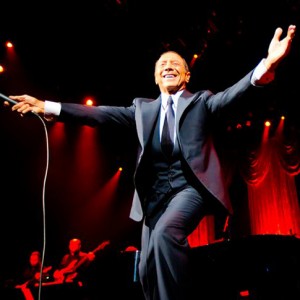
Paul Anka onstage. A pro delivers.
He was a teen idol back in the days of Fabian and Frankie Avalon. He’s still an extremely popular performer, who sells out shows around the world. Paul Anka wrote the Sinatra classic, “My Way,” along with hundreds of other songs. He tours with a band of about fifteen and he delivers a terrific show. Here’s what I learned from watching him onstage.
Throughout the performance, Mr. Anka communicated to us in the audience—by his body language, his smile, and by direct statements—how much fun he was having and what a unique and special evening this was. This particular show was at the University of Southern California, where apparently two or three of Paul Anka’s daughters had gone to school—so that may have contributed to the emotion of the evening. But it’s a pretty safe bet that Paul Anka says and does the exact same thing in every show he puts on—every night, in every venue.
Paul Anka is a pro. He’s been a headliner for fifty years. It wouldn’t surprise me if, sometime back in the day, an old-time, vaudeville-schooled manager took him aside backstage and told him, “Kid, you can’t just deliver the performance, you gotta sell the performance.”
The audience needs leadership. We in the seats want to be told that we’re having a great time. Otherwise we might not realize it. So Paul Anka steps lively, flashes a brilliant smile, prances to the edge of the stage and sells the fact that he’s having fun and so are we. How many times has Paul Anka sung “Diana?” Has the song gotten old to him? If it has, he can’t show it. “Hey, this is great, you guys are a blast, we are having a ball tonight!”
You and I as artists and entrepreneurs have to do the same thing. We have to shape reality. We have to shape it for ourselves.
It’s not hard to start a project—a book, a new business, a philanthropic venture. Novelty and excitement will get us rolling and carry us through the initial stages. But inevitably we will arrive at what David Mamet calls “the middle term.” Act Two. The belly of the beast.
That’s when we need to sell. We need that megawatt smile, we need that happy patter. We need to turn them on ourselves.
In the middle term the high-minded goal has devolved into what seems to be a quotidian, mechanical and ordinary drudgery: now we are not trying to establish a Jewish Homeland but negotiating a contract with a stationer to supply the paper so that we may write fund-raising letters.
We as professionals must keep reinforcing to ourselves the notion that we are having fun, this is art, this is innovation, this is a gift for others. This is our soul’s calling and our life’s passage. Because it is. We need to take a lesson from Paul Anka and be a pro like he is.
Paul Anka understands that it’s easy to get psyched for the playoffs. Any fool can amp himself up for the World Series. But what about Show #23 out of 47 in January in Terra Haute? What about us, dancing bone-on-bone in ballet class, stuck on page 63 of our screenplay?
The joke has it [says Mamet in Three Uses of the Knife]: remembering you set out to drain the swamp is hard when you’re up to your ass in alligators.
Paul Anka understands that. He knows that Show #23 in Terra Haute is just as important as the tour’s big-bang finale at Carnegie Hall. Terra Haute is the capital of the universe. Every show is The Show; every night is The Night.
That’s a pro. That’s hard-core. That’s killer.
If we could crawl inside Paul Anka’s head in his dressing room before the show, we’d see him turn to the mirror, straighten the tie of his tuxedo, and look himself square in the eye. “This is it, kid. People drove ninety miles through the snow to get here tonight to see you. Husbands have brought their wives, parents have brought their kids. Respect them. Respect yourself. Respect the art. Respect the lifelong process of night-after-night, show-after-show. That’s your calling, that’s your life. You chose it and you wouldn’t have it any other way. Get out there and give it everything you’ve got!”
DO THE WORK
Steve shows you the predictable Resistance points that every writer hits in a work-in-progress and then shows you how to deal with each one of these sticking points. This book shows you how to keep going with your work.

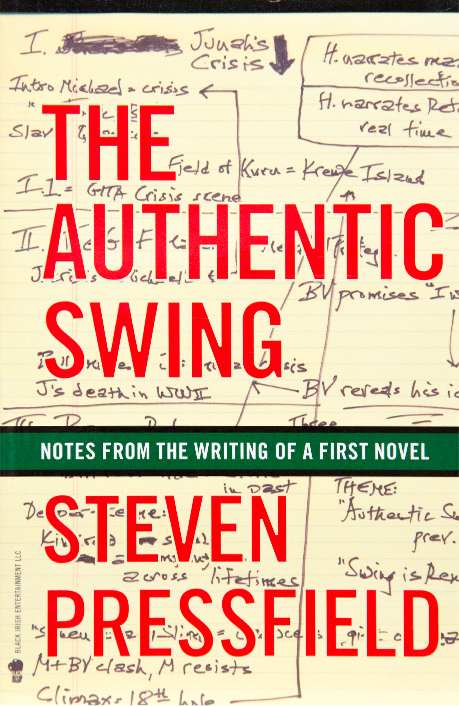
THE AUTHENTIC SWING
A short book about the writing of a first novel: for Steve, The Legend of Bagger Vance. Having failed with three earlier attempts at novels, here's how Steve finally succeeded.
NOBODY WANTS TO READ YOUR SH*T
Steve shares his "lessons learned" from the trenches of the five different writing careers—advertising, screenwriting, fiction, nonfiction, and self-help. This is tradecraft. An MFA in Writing in 197 pages.
TURNING PRO
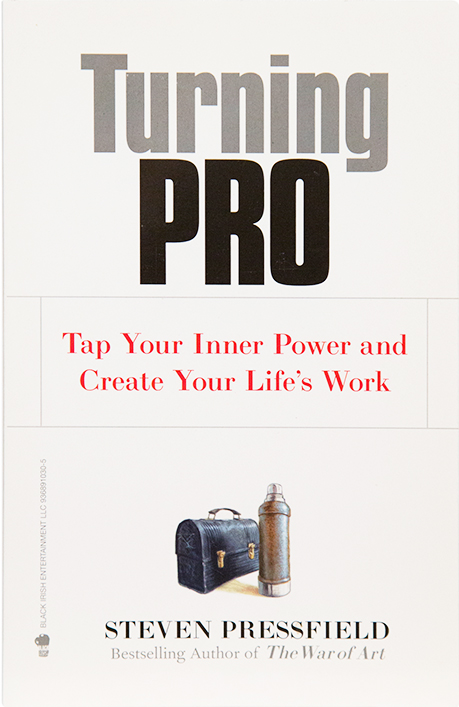
Amateurs have amateur habits. Pros have pro habits. When we turn pro, we give up the comfortable life but we find our power. Steve answers the question, "How do we overcome Resistance?"
I love you. No really. It was a few pages into The War of Art that I knew it. You kick me in the gut and inspire me all at the same time. LOVE IT.
I am Anka, and there is no reason whatsoever for me to not act like it.
I just saw Paul Anka in COncert and he is fabulous. Looks great, sings great, a real gentleman. Just cannot understand why he divorced his first wife, a classy lady and married a Swedish shrew whom he also divorced.
He should try to go back to his first wife who gave him all those beautiful daughters.
I always go see him when he is in my area and I am never ever disappointed.
Thanks, Steve, great post. So true — the great entertainers & icons have that trait in common — they deliver for their audience. They put the audience above themselves. Oprah — who has done 25 years of daily TV shows — said what makes it fresh for her is that each new member in her studio audience deserves to get the her best. It may be year 25 for Oprah, but for someone who traveled to Chicago from across the country to see her in person, Oprah owes it to them to knock their socks off. It’s worked for her and for so many top (lasting) celebrities. Good formula.
I once worked for a very respected U.S. presidential candidate, a man recognized as an accomplished speaker and quality individual. One day, I asked how it was going on the road, and he replied, “I just have trouble repeating the same or a similar speech day after day.” My solution: Treat the experience as a Broadway show; sure, the lines may be the same but the audience changes every night.
Now, this is not to suggest that politics is all theater or should be. Rather, I believe both the “performer” and the “audience” need each other. They each feed off the energy or lack thereof of the other. I also am not suggesting that the artfulness of the politician should substitute for the fundamental wisdom of the policy proposals. Paul Anka is an example that making the sale depends not just on the words but how they are sung.
I needed this. I’m doing my 2010 bookkeeping and taxes. I’m a receipt-in-a-shoe-box guy. I guess I don’t have to file taxes, so it’s really my decision. At least I have the power and privilege to make the decision, right?
Fantastic.
if your passion and your art is your work, then you show up psyched every day. its automatic. you then naturally stay psyched and pumped up and that becomes infectious. if that doesnt happen for you, then you are “working”, if not suffering…. anka must have written “my way” for himself more than sinatra.
Steven, Yes. I flipping love you. Youre the man. I love how you connect and motivate me…how you can motivate the artist. Most importantly, i love the respect you have for ART- the process of creating it, the obstacles againstit- “Resistance” (Yes i read war of art), the importance of it and teh appreciation of it.
Sir..youve gone beyond being a writer…
can’t wait for your new book! if a blog can be this inspiring, a book can be life changing with your arcane words.(which the war of art was)
Thanks, Fabian. Now if only we can hear from Frankie Avalon!
I am a neophyte in the Steven Pressfield world, having recently learned about you from Seth Godin’s books/blogs. I, too, love what I am reading here. Better yet, my 18-year-old son (who wants to join the Marines) reads you, too. Today, and I hope tomorrow and the next day and the next, I’m going to give it all I’ve got. Thanks for the encouragement.
I first read “Gates Of Fire” and was immediately impressed with your facile grasp of history and your ability to tell an absolutely engaging story. Of course, the rest of your books followed. I would place you directly next to Stephen Ambrose, David McCullough — masterful historical American writers. But you take it one step further: crafting history into fiction, based in truth, with incredible writing skills. Once started, your books can’t be put down. Very much enjoyed “Killing Rommel.” And looking forward to “The Profession,” sir.
Finally: It’s great to see and realize that we still have mature and exquisite historical authors. You are an American Treasure, sir, I submit. We NEED to acknowledge, see and read more history.
BZ
Wow, wonderfully incisive, Mr. Pressman. To think that I only became aware of your existence less than three hours ago, hearing you being interviewed by Hugh Hewitt beginning at 4:07 pm PDT on his syndicated talk radio show.
You touched a deep chord in me when — paraphrasing from the opening of your new book, “The Profession” — you noted the three things that a warrior seeks.
I am not a military veteran, but as the character Lt. Col. ‘Bull’ Meechum (played by Robert Duvall) says in the 1979 movie “The Great Santini” — à la
Patton when WWII ended: “Being a warrior without a war has its problems.”
I almost joined the Marine Corp after leaving job after job, failing to find honorable characteristics of the three warrior-sought-after aspects
After graduating with two degrees (in Engineering and Management), I became so disillusioned with the lack of proper values, virtues, honor, et. al. within most corporate organizations
Wow, wonderfully incisive, Mr. Pressfield. To think that I only became aware of your existence a mere three hours ago, hearing you being interviewed by Hugh Hewitt between at 4:00 and 5:00 pm PDT on his syndicated talk radio show.
You touched a deep chord in me when — paraphrasing from the opening of your new book, “The Profession” — you noted the three things that a warrior seeks.
I’m not a military veteran, but as the character Lt. Col. ‘Bull’ Meechum (played by Robert Duvall) said in the 1979 movie “The Great Santini” — à la
Patton when WWII ended: “Being a warrior without a war has its problems.”
I almost joined the Marine Corps and regret now not having done so. After graduating from top colleges with two degrees (in engineering and in management), competing successfully in athletics, and being something of a natural leader … I became quickly disillusioned with the atrophying of: proper/rational values in corporate America, specifically; and proper/honorable virtues in America, in general (a disgust with what the late Sen. Daniel Patrick Moynihan termed “Defining Deviancy Down”).
I’d left — and would continue to leave — job after job, failing to find the constellation of honorable, sought-after aspects that the warrior requires. I was like a Sir Lancelot, seeking a King, team, and enemy(s) worthy of my sword and abilities, and over the course of 30 years managed to encounter only a handful of Arthurs for whom I’d metaphorically go to war long-term and give my life.
They were transcendent experiences, with previously unimaginable, synergistic achievements and growth for all involved; however, as Don Henley noted in the final lyrics of the Eagles song “The Last Resort”: “… You call some place Paradise / Kiss it goodbye.” It never took long for an excellent, winning leader and team to be quickly and irrationally dismantled by those in power — to the detriment of the dismantlers and the organization as a whole — who, instead of utilizing and benefiting from such a team, were threatened by its very existence.
This brings to mind a Joe DiMaggio quote:
“There is always some kid who may be seeing me for the first or last time, I owe him my best.”
http://thinkexist.com/quotation/there-is-always-some-kid-who-may-be-seeing-me-for/381330.html
That is the essence of professionalism: recognising that the customer deserves your best, and delivering it.
Thank you for such an inspiring post. Mr. Anka’s performance is the one we should put every day on our lives. Loved that Mr. Pressfield takes the time to actually read what is posted.
Yes, i agreed. Nice article, Steve. I could relate tho’ my job is different from Paul, I always aim to give my best performance too, for my clients to see the sincerity of the services and products I am proposing.
The belly of the beast…
Nicely said, Steve…
I wish Paul was not having to go through all this turmoil at this stage of his life . I wish him well
I would love to see him but Denver rarely gets anyone special like him . I got to see Engleburt last summer on a fluke here . Paul is one I want to see but likely wont