How Screenwriters Pitch

Today, the 20th, is publication day for Do the Work
Today, April 20th, "Do The Work" goes on sale officially in all three formats—hardcover, Kindle, and audio.
Do The Work isn’t so much a “follow-up” to The War of Art
Today’s post and the previous two have come, slightly modified, from Do The Work. Let’s pick up where we left off last week …
We were talking about the Foolscap method of starting a project–i.e., boil your idea down so it’ll fit on a single sheet of paper. And about how to organize that single sheet: break it into three sections—beginning, middle and end … Act One, Act Two, Act Three … setup, story, punch line.
Today let’s get into the final piece of the puzzle: theme.
The last item that goes onto our single sheet of foolscap is what the project is about.
Here’s a way that screenwriters pitch a movie. They know that the people they’re pitching to have a limited attention span, so they, the writers, need a method that delivers the goods fast while at the same time presenting the story in the most compelling way. One method they use is to eliminate everything except:
1) An opening scene that hooks the audience hard
2) Two major set-pieces in the middle
3) A killer climax
4) A concise expression of the theme
In other words, “three-act structure on one page, plus theme.”
Okay. How do we figure out our theme?
Complete this phrase: “My project is about _______________.”
Theme informs and completes three-act structure.
When we know what our project is about, we know its ultimate expression. We know the climax. We know the end. And when we know the end, we can work backwards to the beginning.
Casablanca is about a man deciding to set aside his personal, selfish needs in favor of the greater needs of his country and its allies at the brink of world war.
The Los Angeles restaurant “Animal” is about eating meat with no apologies.
Moby Dick is about the clash between man’s will and the elemental malice of Nature.
When we know the theme of Casablanca, we know that our hero, Bogey, must do the right thing in the final scene. All that’s left is defining what that right thing is—and making it as difficult as possible for him to do it.
When we know the theme of Animal, the menu writes itself. (And the restaurant names itself.)
When we know the theme of Moby Dick, we know we need a man, a monster and a clash that lets them duke it out to the finish.
Theme plus three-act structure equals a foundation/blueprint for our entire project. The rest is just details and, if you’ll forgive the phrase, doing the work.
P.S. I wrote last week that the climax of Act Three should be embedded in the setup of Act One. The connection between the two is theme. Theme, if it’s handled right, should be present from the opening of any enterprise.
When Gandhi traded European garb and donned a homespun dhoti loincloth, he was expressing the theme of non-violent resistance to British colonial rule. Theme was present at the start, even if few people recognized it.
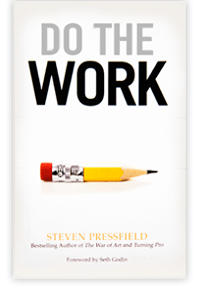
DO THE WORK
Steve shows you the predictable Resistance points that every writer hits in a work-in-progress and then shows you how to deal with each one of these sticking points. This book shows you how to keep going with your work.

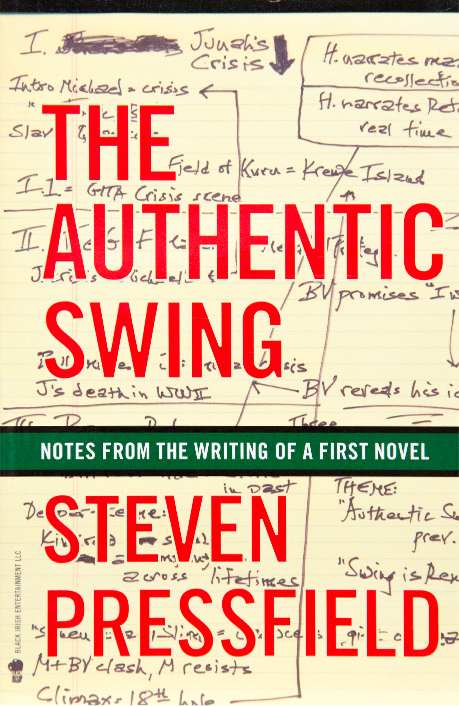
THE AUTHENTIC SWING
A short book about the writing of a first novel: for Steve, The Legend of Bagger Vance. Having failed with three earlier attempts at novels, here's how Steve finally succeeded.
NOBODY WANTS TO READ YOUR SH*T
Steve shares his "lessons learned" from the trenches of the five different writing careers—advertising, screenwriting, fiction, nonfiction, and self-help. This is tradecraft. An MFA in Writing in 197 pages.
TURNING PRO
Amateurs have amateur habits. Pros have pro habits. When we turn pro, we give up the comfortable life but we find our power. Steve answers the question, "How do we overcome Resistance?"
I so need it.
I am reading “Do the Work” right now. Thank you for writing something (again) that grabs me so deeply and kicks me in the ass.
You write life changing books. Thank you, thousand thank yous.
My hardcover copy just dropped through the letterbox! Yay! Now I have something to read in the dentist’s waiting room later (Boo).
Did you narrate the audio book version? (If so I shall buy that version too).
Thanks.
Paul
Can’t wait to read the Kindle version today. Thank you Steven!
Happy pub day Steve.
It’s only 7 am here and your book is already on the top 50 bestsellers list for the Kindle.
These ideas matter.
Hi Steve,
Thanks for the book — just got it on Kindle for Mac. I can’t wait to read it! Besides your writing, I love how you’re open to new ways of marketing your work through various outlets.
Best,
Janet
Wasn’t there a game out there where you tried to make a screenwriter pitch for a really bad movie that was made?
Hi Stephen,
searching everywhere for a downloadable audiobook –
audible/amazon etc..
Can you tell me where can i buy one!??
Chompin at the bit..
Hagop!
My copy of Do the Work arrived on my Kindle overnight. Thanks! Can’t wait to dig in.
Another great post. It always takes time for me to see the theme of what I’m doing, but once seen, knowing it becomes a great boon. Thanks for the illustrations as to how it hones the story.
You’ve done it again, Steven!
Delivered the wisdom, inspiration and kick-in-the-butt I needed.
I’m spreading the word on video…
http://www.youtube.com/watch?v=q95j4Y9kCo4
Do the Work is a great book. It’s better than the War of Art.
What’s next?
Where’s the bell?
Why is the audiobook on Amazon so much more expensive? Also no download on iTunes and Audible – what gives?
I just finished it last night. WOW. I am just coming out of The Big Crash, and to say that this book was exactly what I needed to read right now would be the understatement of the year. Thank you, thank you, thank you.
Yes, yes, yes!!
No, that wasn’t Sally’s Katz deli moment from WHEN HARRY MET SALLY, although her and my declamatory outburst are both screamed in regard to climaxes. But I was responding to “When we know what our project is about… we know the climax.”
This is something I really try to hit home in my classes: what happens at the climax of the film is the summation of the story’s theme. Too many writers focus on creating a “cool” ending but what they should really concentrate on is an ending that sums up what the larger meaning of their story is. If the story’s lovers do not overcome the obstacles and get together at the end, then the theme is NOT “love conquerors all.” For that to be the case… well, obviously, they need to conqueror all that’s in their way of happily being together.
Screenwriting guru Robert McKee has a great concept called “controlling idea” that essentially states the theme “controls” the specific outcome of the story. I don’t care if it’s “just” a simple action movie with no higher aspirations than entertaining — I bet the theme is some form of “good will triumph over evil” and the final fight scene better express specifically how that is accomplished.
Sometimes focusing on theme too early on can stymie the writer, so I think it can be okay to not worry about it until you know your story better; it’s an element I often use to help writers tackle a 2nd draft because at the point of rewriting you really do need to know what the theme is. But whether you know right from the beginning or you discover your theme during the course of the 1st draft, you must must come to the point where you’re able to clearly express what it is and use it to sculpt your story to Michelangelo perfection.
Killer, killer, killer. Your greatest skill I think is to break down what we already know and then return it in its simplest, clearest, least deniable form.
All the best with Do The Work. I’ll have a copy within the week, but I’d like to know: which format (hardcover, ebook) and which vendor (Amazon, bookstore, big chain) yields you the best percentage? I appreciate the systems that deliver art to us but I’d still rather see the sweetest plum go to the artist.
This is something I’m going to use for planning books, as well. I’ve found it helps to start with these kind of concise ideas, rather than just wondering into the story.
Thanks for setting it up in such a clear and usable way.
I have GOT to get my hands on this book! And when I say hands, I mean a real book, none of that Kindle stuff for me. I want to FEEL and smell the pages!
Peter
Hello Steven,
It’s St George’s Day today – I hope it’s a good one for you.
Is it a coincidence that I found your book “Do the Work” today?
“You are the knight. Resistance is the Dragon” – I love this picture!
Your book has equipped me with the shield and lance for my battle.
Thank you for sharing your knowledge. I appreciate it very much.
In gratitude and with all good wishes.
Read it today on my kindle. Before i used the war of art and read my highlighted sentences when i needed inspiration. Now you wrote a book exactly for that.
Thanks for slapping me in the face once again. I like it.
Hi Steven,
Just to let you know that I was able to download the kindle version with no hassle and no cost over here in Switzerland. Read it yesterday and laughed out loud in self consciousness many times. You have described my dragon so well. Our dragon. Its so empowering to know that I am not alone. Thank you ever so much for showing the way. Happy Easter! Today the swiss chocolate bunnies, tomorrow, Do the Work.
Thank you for the the free lecture on how to have a good blog!May God bless you!
Can you still provide another free lecture?,I do hope and pray that you will prosper in your job!
I have read the free lecture thank you!
I just finished your book, “The War of Art”. It was recommended to me by author, Joe Tye.It was inspiring even up to the last chapter. I am anxious to read “Do the Work” .
Thank you so much for Do The Work. A wonderful book. To paraphrase, when you write, people say, “Let us march.”