Seth Godin on the Domino Project

The Domino Project is a partnership between Seth Godin and amazon.com, in which together they find, commission, edit, design, print, advertise, market and distribute a specific type of book/audio/eBook that Seth calls a “manifesto.” The first such piece, published two months ago, was Seth’s Poke the Box; the second, two weeks ago, was my Do the Work.

Seth and his best suit
In last week’s post, I offered my own befogged take on what the Domino Project is, what it represents, and what were some of the possible implications of this model for all of us artists and entrepreneurs going into the future. Continuing that thread, I went this week to the horse’s mouth. Herewith, five questions and a bonus query with Seth:
SP: Seth, how did the idea for the Domino Project come about? Did you come up with it and take it to Amazon? What exactly is the concept of the Domino Project?
SG: In 1998, I pitched Jeff Bezos [the founder and CEO of amazon.com] on the idea of publishing books. After all, I said, that’s where the money is… when you sell what everyone else is selling, you make pennies. The publishers like bookstore competition, but they make dollars, not pennies, I said. I also pointed out that Amazon, alone among booksellers, knew who liked what. This was huge.
He laughed. He’s a good laugher. We shook hands and I went off to finish selling my internet company.
Five years later, I went back to Amazon to give a speech and pitched the whole room. Again, they weren’t ready.
In 2008, I had lunch with Jeff and pitched him again. No dice.
I am persistent, but not stupid. I gave up.
Last year, tired of being a hypocrite (I had been writing about the demise of big publishers for a long time), I decided not to re-up with my publisher. I happen to like the people I worked with very much. Senior management at the publisher, though, has no vision and huge fear and were making the whole process harder to justify. So I left, with no plan.
Two weeks later, folks at Amazon reached out and said, “Hey, Wiseguy, we’re ready.”
Amazon isn’t a publisher, but they’re working with Domino to power our back end. It’s a unique relationship, one that’s working for both of us. I wouldn’t be surprised to see them doing this with others one day.
SP: How would you define “manifesto?” What factors make a book a manifesto–and what factors make it NOT a manifesto?
SG: At the same time distribution changed, so did reading habits. Basically: there are tons of substitutes. Smart people in search of information or entertainment have way more ways to find it than they did ten years ago … and attention spans are shrinking. The idea of sitting with a single book/idea for ten hours is harder and harder to peddle to most people, for good reason. There’s a lot to consume, and time on a single project is harder to justify.
So the idea of a manifesto is that it’s as long as it needs to be, but no longer.
This is the opposite of traditional publishing, where the publisher has decided that the unit of transaction is $20 and the length of the work is 250 pages. Your idea better be around that size, or they can’t really publish it comfortably.
I’ll add one more element: the only books that reliably become hits now are books that spread. Not books that are promoted, but books that are talked about. By readers. And that forward propulsion is a key element of a manifesto. It DEMANDS to be shared and spread, because it will make your life better.
SP: In your view, what is the connection between the abbreviated length of Poke the Box and Do the Work — and their manifesto content? Would a manifesto in longer form not be as appealing? Or, looked at another way, does the short length dictate that only manifesto-like content will work? (Like, say, a novel would not work at 100 pages—or a serious biography of FDR.)
SG: Again, I think it’s about appropriate length. Snow Crash was perfect as a novel. Some of the later Stephenson novels had the same number of big ideas but were three times as long. He lost me.
In the world of the Kindle, the length isn’t a contributor to perceived value. All I care about as a reader is, “Was I moved?”
You know, hundreds of thousands of readers later, no one has complained that either book (yours or mine) is too short!
SP: Are there other literary genres that would work in this 100-page form? Are you experimenting and evolving this project as it goes along?
SG: We don’t really care about 100 pages. One book we’re working on will be way way way shorter than that. Another is going to come in at 3x the length.
SP: Do you realize that you’re inventing a whole new product category that has never existed before? Was that the whole idea?
SG: Steve, I’ve been inventing new categories ever since I was sort of thrown out of/left business school. That’s the whole point, isn’t it?
SP Bonus question: Where is Domino going? What’s the future?
SG: Build a permission base. Connect a tribe. Put on a show, one that’s worth spreading. Create souvenirs worth paying for while you spread ideas promiscuously. Repeat.
And if it’s not worth doing and if it’s not frightening, think twice about whether it’s worth spending your day on it.
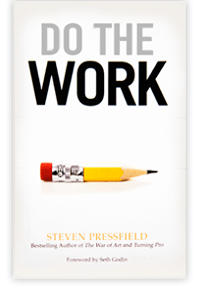
DO THE WORK
Steve shows you the predictable Resistance points that every writer hits in a work-in-progress and then shows you how to deal with each one of these sticking points. This book shows you how to keep going with your work.

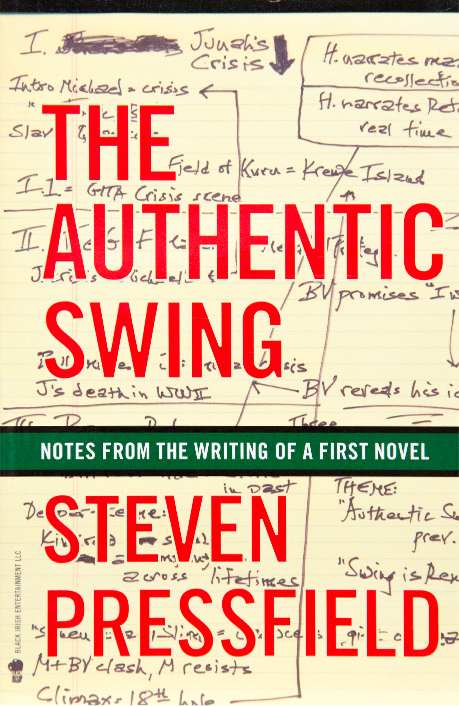
THE AUTHENTIC SWING
A short book about the writing of a first novel: for Steve, The Legend of Bagger Vance. Having failed with three earlier attempts at novels, here's how Steve finally succeeded.
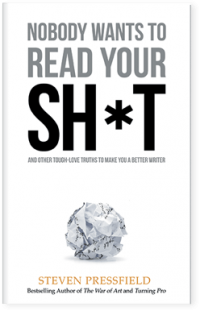
NOBODY WANTS TO READ YOUR SH*T
Steve shares his "lessons learned" from the trenches of the five different writing careers—advertising, screenwriting, fiction, nonfiction, and self-help. This is tradecraft. An MFA in Writing in 197 pages.
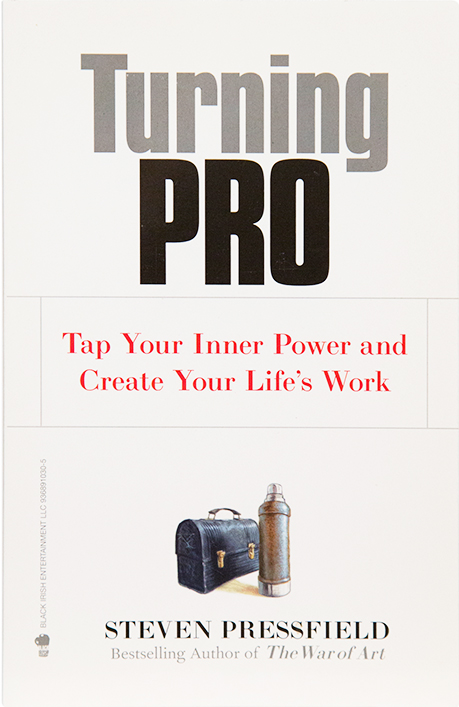
TURNING PRO
Amateurs have amateur habits. Pros have pro habits. When we turn pro, we give up the comfortable life but we find our power. Steve answers the question, "How do we overcome Resistance?"
Thanks for this, Steve. Always fun to talk with you.
A clarification: it’s not a partnership–Domino is an independent entity, not part of Amazon.
Your book, of course, continues to kill it. Thanks for the impact you’re having on the world!
Steve,
I just recently read “The Work of Art.” Unbelievably inspiring. I’m now in the process of reading “Do the Work.”
Awesome ideas to get me moving. In fact, I just started a blog last week as a result of doing “something.” Who knows where it will go…and who really cares. I’m doing something! Thanks.
Yay,
what a delightful precious read it was.
Thanks goes to both of you, gentlemen!
Your art is such amazing source of inspiration for many (including me).
Both, Do the Work & Poke the Box – > however short they are, they are filled with wisdom & ideas, which requires focused reading & I must confess, that they were so powerful & tough to digest, that I have re-read both books.
My latest “sneeze” (as Seth calls it) about your art is here: http://www.slideshare.net/senda5/do-the-worknotesdeck
Slide-deck with notes from Do the Work.
😉
Happy shipping to all of you!
Greetings from Slovakia,
i.
P.S.: still smiling at the caption under Seth’s picture -> …”in his best suit” 😉
Inspiring read.
“The Domino Project” is a wonderful example of what emerges when you “Poke the Box” and “Do the Work”.
The short length is a blessing in disguise. One can go back and re-read as required.
Thank You!
I really enjoyed both books. While I was re-reading them while stuck in a hospital waiting room it struck me that these wonderful books were real solid proof that the ideas were valid. This project isn’t just a bunch of catchphrases and semi-inspirational brain candy because the evidence was right there on my iPad screen!
I don’t know about the “manifesto” idea. It’s not totally working for me. “The War of Art” was brilliant. Changed my life, kicked my ass, embarrassed me to get the hell going. “Do The Work” just kicked my ass. To me there was no new material. I got it for free on my Kindle, so no money worries, but what’s the point? It felt redundant. When I need to be moved, again, to do the work, no doubt I will pick up “The War of Art”. It just cannot be beat.
“Poke the Box” was short and, let’s be honest, could have been even shorter. There was lots of repetition going on there, Seth.
Is this really where we’re going as readers/writers/publishers?
Uh oh.
This post reminds me of one of my favorite quotes: “I’ve been absolutely terrified every moment of my life and I’ve never let it keep me from doing a single thing that I wanted to do.” — Georgia O’Keeffe. Thanks to Seth Godin (and others) I combat that fear every time I “ship”–because I am a real artist.
Do the work. It had the effect of a coach or a director pushing me to my best performance .
Manifesto? That doesn’t work for me unless of course you are playing on the idea of a revolution. Do the work is more a manual or a field guide than a manifesto. It’s a guide book. It’s how to build a work of art in spite of the forces that will seek to oppose you. I will carry it in my back pack when I am in hostile territory with the forces of Resistance coming at me from all directions. I will pull it out and read what to do next. I need a field guide when I am writing a play not a lengthy exploration or a detailed analysis of a well made script. I need the directions that will get me out of the trap that my enemies set for me. Good luck with the revolution.
Steven, good post. I like the whole issue about manifestos and ‘moving’ people. It seems to me that a purpose or credo must do this to be of any value. For example, here’s my own credo at:
Clientonomy.com
Without emotional engagement, we’re simply moving stuff around. Shuffling paper. Manifestos matter, a lot.
Regards, Mac.
I’m really looking forward to the post-publisher business model for books. I think that cutting out publishers will make things much more efficient for authors. Self-publishing a book will be a much faster process and authors will finally earn a fair profit margin.
“Do The Work” was a great little book, and one that I was able to share to help others with their own Resistance. But the book I REALLY want to read now is the book that Seth HATED… “The Warrior Ethos”! Your description of it spoke to me, and it is now on it’s way to me via Amazon.
Also looking forward to reading some of your fiction!
But now, I’ve got a comicbook here that I’ve been working on that needs to get done. Resistance be damned.