My Years in the Wilderness

When I was living out of the back of my ’65 Chevy van, there was a kind of dude I used to run into from time to time. A hard-core road character, burnt brown by the sun, unbathed in months, living on dimes a day. I probably met and spent time with a dozen guys like this in places like Texas and Louisiana, northern California, Washington state—giving them rides, working day-labor jobs, staying up all night talking. They carried guitars and no-hope dreams. I used to ask myself, listening to their tunes in a stoned haze some place that I could never remember twelve hours later, “Am I as over the edge as these guys? Am I heading as straight down the tubes as they are?”

A still from Terrence Malick's "Days of Heaven"
They were great guys, wonderful companions; I wish I knew where some of them are today. Okay, I hope. But I’m not so sure.
When I was struggling to teach myself how to write, I was so far gone that the idea of choice never entered the equation. The question wasn’t, Does this make sense? Am I getting anywhere? The question was, “Am I out of my mind? How much farther down is this road gonna take me?”
From time to time I’d make a stab at returning to reality. I’d get a real job. I’d work hard, I’d make friends, sometimes I even had a girlfriend. But I could never stick. I had to write. All through this time, I was estranged from my family. My Dad could make no sense of the choices I had made; I broke his heart. I had long ago driven my wife away. My mother thought I was crazy. What mainstream friends I had were on my side, but, on the rare occasions when I saw them, they regarded me partly with pity, partly with puzzlement, but mainly with that look that people get when they’re afraid they’re standing too close to something contagious.
Was I doing good work? Hell no. Everything I wrote was crap, and mainly I didn’t write at all. I had nothing to say. I had no point of view. I knew nothing and thought nothing. But still I was desperately driven. I’d work, save money, take a year or two and write a book. I say “book” but they weren’t books; when friends would read them, the look on their faces was excruciating. They were mortified.
I myself thought I was crazy. I’d had writing jobs, in advertising, which should have been easy. I wasn’t even any good at that. Who was I kidding? What did I imagine I was accomplishing? I didn’t even have a dream. Money? It never even crossed my mind. Praise? Critical success? I couldn’t get my own mother to pay attention. And still I couldn’t stop. The times I tried, I could hold it together for six months. I spent a season picking fruit. The tramps in the bunkhouses had an expression: “Pull the pin.” The term came from the old railroad days when the switching crews would literally pull a steel pin to uncouple one car from another. “Pull the pin” meant to bolt, to pack up in the middle of the night. You might wake up and the bunk next to yours would be empty. “What happened to Jack?” “He pulled the pin.”
That was what I did. I pulled the pin. (By the way, here’s the bunkhouse distinction: a “tramp” is an itinerant worker; a “hobo” is an intinerant non-worker; a “bum” is a non-itinerant non-worker.)
Sometimes in a city at night I would walk past a ballet studio and look up at the dancers hard at work. I envied them. They had each other, they had a troupe, a class. I envied actors who had rep groups and theaters. I had nobody. Not a soul who believed in me or thought I wasn’t crazy.
What keeps a person going? As I write this, I’m aware that there are people reading who know exactly what I’m talking about. Young painters and film-makers and novelists who are in that exact same place. Lemme say this to you:
Don’t quit. Bleed from your eyeballs if you have to, but don’t stop. What kept me going was the same thing that kept those dancers working at the barre. I just loved it. Even when the work was garbage, which was 99.9% of the time, I had to keep trying—and if you’re trying now, God bless you. Keep hammering. If you have a choice, you’ll know it and you’ll stop. But you who are like me … you don’t have a choice.
I had a friend in New York years ago named Denise Golinger. She was a painter. Tragically she died. Young, way too young. But I remember her painting these dark, Rembrandt-esque miniatures. Her apartment off Abingdon Square was her studio, and she filled it with these miniatures that even I could see were going nowhere, though Denise was beating her brains out trying to get better. I went away and came back a year later. “Lemme show you what I’m doing,” said Denise. And she pulled out a dozen new paintings that were fucking spectacular. What had happened? I didn’t know and neither did Denise. But she had broken through. She was painting full size and she had found her gift.
Don’t quit. Keep slugging. It takes time. There’s a price. Keep hammering.
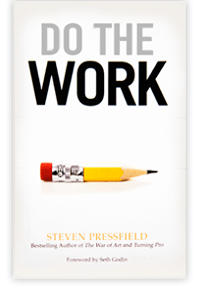
DO THE WORK
Steve shows you the predictable Resistance points that every writer hits in a work-in-progress and then shows you how to deal with each one of these sticking points. This book shows you how to keep going with your work.

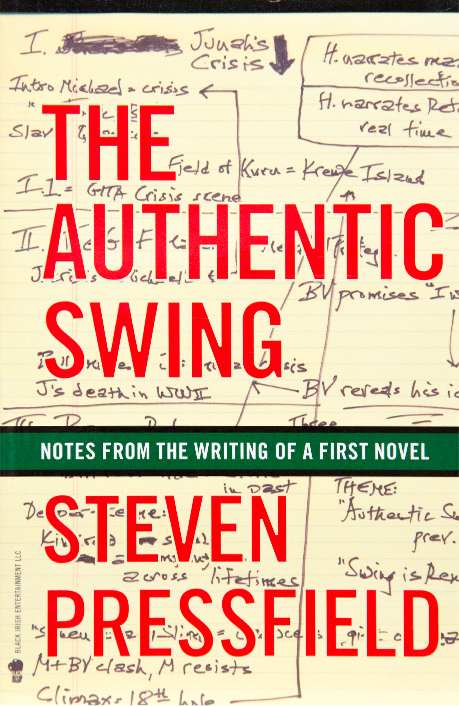
THE AUTHENTIC SWING
A short book about the writing of a first novel: for Steve, The Legend of Bagger Vance. Having failed with three earlier attempts at novels, here's how Steve finally succeeded.
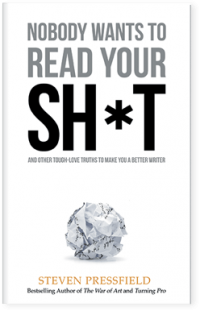
NOBODY WANTS TO READ YOUR SH*T
Steve shares his "lessons learned" from the trenches of the five different writing careers—advertising, screenwriting, fiction, nonfiction, and self-help. This is tradecraft. An MFA in Writing in 197 pages.
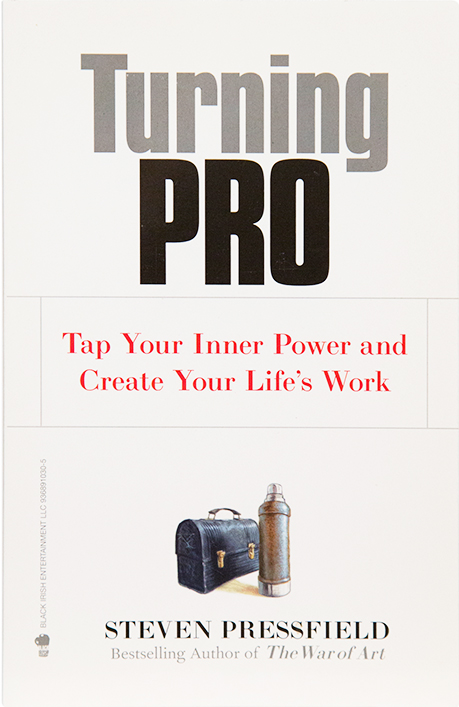
TURNING PRO
Amateurs have amateur habits. Pros have pro habits. When we turn pro, we give up the comfortable life but we find our power. Steve answers the question, "How do we overcome Resistance?"
i am saving this. for when i need a kick in the ass…
what keeps me going is my passion. without that, i too would have been some form of spiritual hobo.
Thank you for sharing this with us Steven. I too, cannot stop writing. It has cost me, but at the same time driven me. I appreciate the encouragement.
Thank you, Steven, for today’s post, for THE WAR OF ART, the posts on art and addiction, and the many ways that you repeatedly affirm that, yes, it’s hard ass work, and, yes, it’s worth doing. I work with students in an educational setting, and I’m good at what I do. I could probably make a lot more money than I do if I would just throw myself into to. But, I want to write. I’m not even sure what I want to write, but I’m pretty sure that the first step is wielding my machete against the seemingly never ending tangle of “commitments” that pull me away from my desk. I take heart when I read what you have to say on this subject.
Thanks, Steven. Learning to be an artist is one of the most difficult apprenticeships, and it’s great to hear a successful person’s story of that time. No doubt your story will help lots of others struggling through it.
It’s true that it takes a lot of persistence and a lot of faith to keep hammering. I once heard someone say the best way to learn how to write was “to apply the seat of the pants to the seat of the chair.”
Thank you, Steven.
THAT. Is so rockin helpful and encouraging.
Thanks so much for this great article!! Really needed to hear it.
This is great and timely. Thank you!
It’s easy to climb the wall
when it’s not in front of you…
The rest of the poem will follow.
Writing Wednesdays gets us over hump day.
I think there’s an essay in the “tramp, hobo, bum” definitions. Mind if I write it? Or will you?
We’re asthmatics, Steven, we can’t breathe – literally, not just figuratively – if we don’t write.
Please write it, David. And let us all see it, okay?
Thank you for your kind mention of my Aunt Denise, Steven. It’s nIce to know after all these years she’s been gone that you still feel her impact on your life. And, that’s a wonderful story about her emergence as an artist! We miss her!
PS: I’m a writer, too.
Thank you so much for this.
Well, clearly, you stopped writing garbage, because this was very inspiring!
Thank you for this humbling reminder of the power of the creative force inside all of us. Whether we’re experiencing success or struggling mightily (at the moment), remembering the importance of honoring that drive is crucial to creating. This piece reminds me that I am a writer because I write, not because I have achieved A, B or C in the publishing world.
Yes.
Wonderful stuff. Thank you, and boy do I understand.
I love this – “Sometimes in a city at night I would walk past a ballet studio and look up at the dancers hard at work. I envied them. They had each other, they had a troupe, a class. I envied actors who had rep groups and theaters. I had nobody.” I have friends, writer friends etc. but I SO understand the draw of the musicians or actors who have a troup, a group, a band of colleagues. Yes please. But writing is solitary (with socializing after you are done).
Thank you again – very helpful on an office day Wednesday.
Reading this article is worth more than a year’s worth of writing classes for beginning writers I’d bet. Hell of a message indeed.
Thanks,
Shane
Thank you. On a morning when I received TWO rejections from agents, this was what I needed!
Your piece reminded me of Picasso’s famous line: ‘When inspiration strikes, let me find me working’.
Brilliant post! Just what I needed on this very day. Thank you.
Dear Mr Pressfield
You are a rare breed. The dilemna you are in is that you are on a path of truth. A path that is both treacherous and awakening. If you ever google my name you will find that your site has been the only one that I have ever responded to. The reason I do this is simple because souls like you deserve the utmost of respect. I ask you kindly don’t get too angry with those that ask much from you without giving back. Just allow them to be and respect your gift. Please forgive my counselling but seeing you talk on Youtube your words as well as body language show the signs of a noble warrior.
with the utmost respect
Jasvir Samrai
Thanks, Jasvir. I take that very seriously and very much appreciate it. Best to you.
Hey!!!
You talking to me?
I love you, Steven Pressfield!
Thank you.
Thank you thank you thank you.
I had lunch this afternoon with the partner of an artist friend who wondered aloud; “Do you think they’ll make it?”
I thought about it and it’s nearly impossible to say. This person is talented and likable. They put together good work. And in the end I feel like there’s a drive necessary to fight through all the B.S. that life (Mmmm… Resistance) throws at you.
That said; do what you love. Move towards the things that make you nervous and excited. Learn to be at ease with discomfort and lighten up in your process. And commit.
Resistance can’t mess with commitment.
Great to read a post about your lean years Steven. Thanks for that!
Yes.
Tuesday evening I read “Do The Work”.
Wednesday evening I listened to the audio rendition of “The War of Art”.
Today I’m sitting here trying to figure out how a fella I’ve never met, a man who doesn’t even know I exist…how the hell was this guy able to write MY biography?????
How’d he know about all those times I’d sold out to the fear?
Betrayed my artist’s DNA for security, or comfort, or a pretense of being “normal”–how’d he find out?
Who’d he pay off to discover just how close to the precipice I’ve been dancing all these years…certain I was certifiable because the Creativity Monster wouldn’t let me live my 8-5 stupor without Prozac?
How’d you know, Steven?
And more importantly…..how can I ever thank you enough?
Cool. I’ve been slugging away for16 yrs at jewelry and gotten damn good at it. It pays the bills and then some. Only thing is, I love writing and film so much more. I don’t care if I do write or film crap cuz I love it so much
I hope you write your autobiography one day.
This is classic wisdom being passed from a veteran writer to aspiring writers. Real, honest advice like this is hard to come by. It is much needed for all of us!
If you have a choice, you’ll know it and you’ll stop. But you who are like me … you don’t have a choice.
Steven has written that Resistance will not impede a shift from the hard path to an easier path; also, he has warned that Resistance is not out to cripple or impair: it intends to kill. Someone who thinks he has a choice but actually doesn’t is headed for heartbreak after heartbreak. Upon failing on an easy path, who would conclude that he should never have left the hard path?
If a potential host for the Muse blocks her entrance, Resistance will not be mollified. When the price of one’s work seems too high, Resistance may offer detente–but the offer is a lie. Detente with Resistance is impossible. So is appeasement.
The foregoing is how I interpret my life experiences, but, reader, be cautioned that Steven’s insights are fairly new to me. My work is reviving, but I have not yet finished anything.
Wow.
I’m living this right now. I’ve been having those “get a real job” thoughts quite a bit lately but I can’t imagine another life. I take that back -I don’t want that other life.
Haven’t checked in on this blog for weeks, then I pop in for a quick look to satisfy curiosity and hit pay dirt with this post. Extraordinarily timely.
Thank you.
Thank you, Steven, for not quitting.
And for this.
Thank you for this – am passing it on as well as saving it for those difficult days.
This is the kick I needed, Steven! Thank You!
To put it differently, perhaps: it seems as if there is an unconscious force that drives you through that wilderness zone, but at some point you exit that zone when you make your (Goethe) commitment to your art truly conscious. And then because you claim your inner authority, those outer projections (however painful) fall away and you are no longer dependent upon outer validation, or the lack thereof.
Steven,
This is what I’ve been thinking since I discovered your blog a few weeks ago, which led to buying and reading “The War of Art”:
Where have you been all my life? 🙂
Every time I feel like quitting (which is daily… sometimes hourly) I’m coming back to reread this.
From the bottom of my heart… thank you.
Doberman Dan
Steven, when were trapsing around the country, living out of you van? We may have hung out together, and if we didn’t, we surely floated with some of the same people 🙂
Thanks so much for this, I can’t tell you how much I needed to read it. I am so ashamed of the book I’m working on right now. And people around me have got that look that you describe: I’m inspiring pity and fear in my peers like a pathetically watered down tragic hero. I suspect they use me as a cautionary tale.
Thanks! I needed to read this today Steven.
Hammering on.
For other times I have the video chat that we (Domino Project Street Team) did with you for DTW launch.
You make it is easy to believe that better things (writing) is on way.
This is absolutely brilliant Steve! I loved every word of it! I truly believe that if we do the work as you say the day will come when that click happens. Then mediocre becomes brilliant and even if it never comes it is so much better to die trying. Thank you! 🙂
Very inspiring post. I love it. Thank you very much.
Steven: Just want to thank you for this entry which helps me see that even successful writers have gone through hell to find the way to motivate themselves to write. Your book, The War Of Art, has made a big difference to me and my ability to sit and write. I wear my lucky shirt that helped me pass all my law school exams and prepare by reading the writings of Kahil Gibran who wrote a lovely ode on “work” and how we can move from a perspective of looking at it as a burden or looking at it as an act of love that connects us to the life and seasons of the planet. I especially like this column on Writing. Please continue!
I needed this today. I’ve been in the wilderness for a very long time. I have to admit, though I loathe my logos prison, I also relish it. In the blood, sweat and breast-milk, I know I’m alive. And I know I’m going somewhere. Even if it’s not where I planned to go.
I’m a newbie. This sight is Mecca, my Alezandria. No I will write.
Damn fingers, I meant Alexandria, Now I write.
Wow, this brought tears to my eyes.
There are days when I just wish it would let go of me; let me go. Give me the peaceful meandering that seems to inhabit other lives. Those days; well, these days, it makes me angry to be told not to give up. Give up? I wish I could. Some days, I want to get a job in a factory and never ever do this again.
But I can’t, and I bleed from the social abrasion of those who don’t understand. THEY think I’m making THEIR life difficult. Hey, pal; live in THIS head for an hour. Slide naked down the serrated knife-edge between sanity and creation; see how it feels.
And yet, tomorrow, after the nightmares fade, I will do that thing I can’t not do, and I will remember why.
Needed this. Thanks for writing it.
I my minds eye I see everyone I’ve ever loved – every ancestor that ever held a pen paintbrush or shovel. There is no planned path for an artist and I do consider writing one of the many mediums of art. I don’t think anyone truly creates from nothing and I do think life’s lessons, experiences and survivals have everything to do with it. You show me a young artist with very little life experience and tons of success and I will show you a vapid creator with very little to offer to withstand centuries of contemplation understanding and appreciation. You see my brothers and sisters our life’s timeline does not and will not confirm or deny the validity of our expression in our lifetimes. I loved what you wrote and that was a gift of your own personal knowledge and perspective that I have never know. In this essay you allowed me to see through your eyes and travel with you in that 65 Chevy.
You mentioned Denise Golinger, I had a classmate at NYU who was the most wonderful person I knew at school. She was short, long brown hair, and her roomate was Wendy Sherman. Please tell me we are not talking about the same Denise. I loved her dearly.
As Denise Golinger’s brother I second what Eva said here. The family is graced with quite a few of Denise’s art works in our homes.
I have long been sad not only that she left this world so soon, but also that she did not live long enough to see her artistic gift and her dedication to it bring her the wide recognition she had earned and deserved. It is therefore very touching that you mention her here as being such a fine example to follow. Thanks. And congratulations on your career.
It would be easy to feel a little discouraged reading this – the mortgage, the kids, the wife, et al. For me to leave the day job would be throwing everything away.
I’m hoping this doesn’t make me a dabbler or dilettant, but it probably does, doesn’t it?
I’ve abandoned writing before and hope to never do it again. Turning pro can be around the corner, but more than likely some corner light years away…
Great post.