Habit

March 31, 2010, “Habit” first appeared on the site—and is revisiting the home page today as I’m on the road.
Konrad Lorenz, the Nobel Prize-winning zoologist, had a pet goose that he allowed the run of the house. The first day when the goose waddled in the door, there happened to be a mirror near floor height; the goose mistook his own reflection for some rival bird and flew into attack mode.
He pecked the hell out of the mirror before moving on to the kitchen and the rest of his day. Next morning: same thing. After a few days, Mrs. Lorenz removed the mirror so it wouldn’t get broken—but the goose kept pecking the same spot. It never stopped. Over a lifetime, every time that goose webfooted its way into the Lorenz house it was compelled to peck that very spot where the mirror had been.
That’s habit. But here’s the intriguing part: the goose’s offspring, who had never seen the mirror, learned the habit too. Two generations later, every one of them, when it first entered the house, was still pecking the spot on the wall where the original goose had kicked off these shenanigans years earlier.
The point of this story is that habit is powerful, not only among us humans but in the animal kingdom as well.
Habit can be a mighty ally in the day-to-day struggle against Resistance.
We usually think of habits as bad. A drug habit, an alcohol habit. But habits can be tremendously positive too. The habit of going to the gym, of meditating, of daily visiting someone who could use a little kindly attention.
What I’m trying to do, myself, day-by-day in my professional regimen, is to reinforce the habit of a regular work schedule. I don’t succeed all the time. Days definitely get away from me. But the goal never changes and I never let up. I want to build a groove, I want to establish a positive, momentum-generating pattern.
Why? Because habit eliminates thought. Negative, Resistance-spawned thought. If I’m a ballet dancer and I make it my business to take class every morning, habit will compel me to get ready mentally the night before. When morning comes and it’s time for class, habit makes me grab my gym bag without thinking about it, throw in my sweats, my shoes, my Evian water. Habit keeps Resistance from raising its ugly head and starting to talk me into sluffing off. Before I know it, I’m out the door and on my way to class.
The Muse favors habit. Each day when she looks down on us from Mt. Olympus, her first question is: Where is that S.O.B. who was sniveling and beseeching my aid yesterday? If she sees us in our studio, at our desk, making our calls, a warm glow suffuses her immortal heart. Ah, she says to herself, a true devotee! The Muse is like any other boss; she values talent, yes, but what she favors even more is devotion, dedication, perseverance. When she sees our butts in our seats, she can’t help herself; “Okay, okay, I’ll give this poor sucker a couple of ideas today.”
Habit builds up energy over time. The repetition of any action–good or evil–generates power. Energy concentrates and accumulates. Bad habits become harder to break. But good habits do too.
If we think about collective endeavors, like team sports or military drills, the process of “training” is primarily the inculcation of habit. Our basketball coach makes us go to practice every day. He’ll bench us if we’re late or miss entirely. Why? Because he knows how powerful habit is, for good or ill. In the army we run Immediate Action Drills in case we’re ambushed or come under fire. Why? So we don’t have to think when trouble strikes. Habit will take over and save our lives.
In sports or the military (or any communal endeavor), discipline and habit are imposed on us from the outside. Some VP or senior staffer makes us do it. In the world or the arts and entrepreneurship, it’s different. We’re on our own there. We have to teach ourselves the right habits. Our discipline as artists must be self-discipline. We ourselves have to make ourselves show up, run those lay-up drills, do those wind sprints. We need to reward ourselves when we do well, and take ourselves to the woodshed when we drop the ball.
The goal is habit-inculcation to overcome Resistance.
Habit borders on superstition. If we could look into Konrad Lorenz’s goose’s head, my bet is that there was a ritual component to its pecking of the wall. “I did this before and that Bad Goose ran away; if I do it again he’ll bolt today too.” Superstition gets a bad rap these days; it’s perceived as irrational, nutty, OCD-esque. But ritual has been a powerful tool since cave man days. It’s a tremendous weapon against Resistance.
But the most positive aspect of habit/ritual, in my view, is that it’s a step on the way to “having a practice.” I’ve already done one post on this subject, but I’d like to get into it a little deeper next week. When our daily labor becomes ritual and then an actual practice—like Musashi Miyamoto with the samurai sword—then we have elevated our endeavors to a plane beyond mere ambition or aspiration. More on that next week. But first I must validate myself for continuing the weekly habit of writing these posts—and I must validate you, dear reader, for continuing to read them. Thanks and we’ll see you next week!
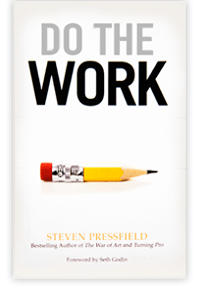
DO THE WORK
Steve shows you the predictable Resistance points that every writer hits in a work-in-progress and then shows you how to deal with each one of these sticking points. This book shows you how to keep going with your work.

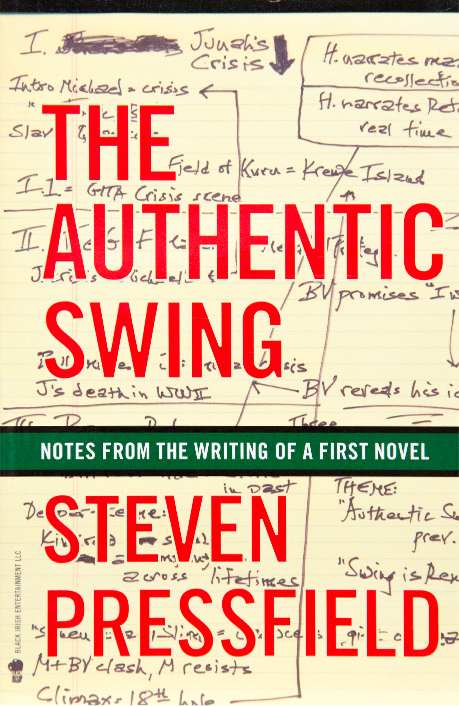
THE AUTHENTIC SWING
A short book about the writing of a first novel: for Steve, The Legend of Bagger Vance. Having failed with three earlier attempts at novels, here's how Steve finally succeeded.
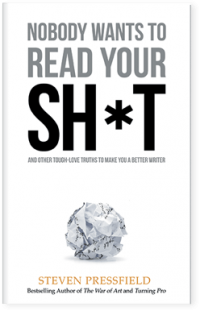
NOBODY WANTS TO READ YOUR SH*T
Steve shares his "lessons learned" from the trenches of the five different writing careers—advertising, screenwriting, fiction, nonfiction, and self-help. This is tradecraft. An MFA in Writing in 197 pages.
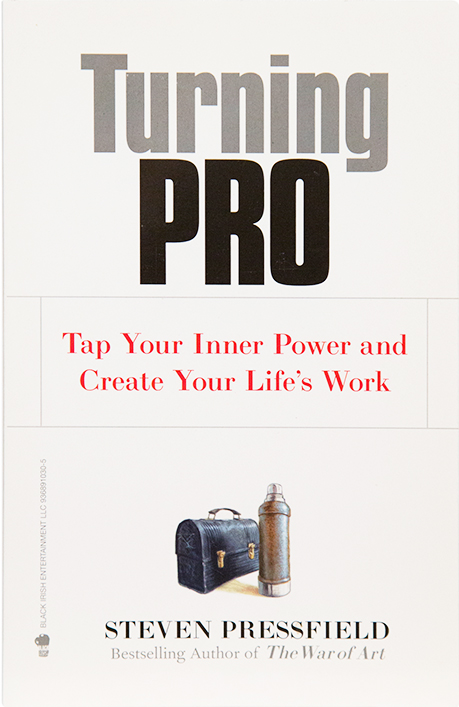
TURNING PRO
Amateurs have amateur habits. Pros have pro habits. When we turn pro, we give up the comfortable life but we find our power. Steve answers the question, "How do we overcome Resistance?"
This is a great post. I have always wanted to write my memoir of when I left everything behind and went to live in Montana. I wanted the memoir not only for me but so my grandchildren could understand their crazy grandma life.
So I started a blog called Montana Monday and have been making it a habit to post every Monday. The post is not effective on Tuesday just Monday.
So I agree good habits are keepers, bad ones you need to just change to positive ones.
Good habits can change your life.
This post could be the one to truly make a difference in people’s lives.
Read it.
Think about it.
Live it.
My prayers are often answered through your words. Thank you.
Right now my work schedule is all over the place. I work some days and some nights,including weekends and holidays.Its HELL! I have found that I am a creature of routine and if the routine is broken up I fall apart.
I always think back to when I read “Virtues of War” the mentor to young Alexander (forgive me I cannot remember his name) would wake his pupil up every day before sun up and have him take a cold dip in a nearby stream.Young Alexander hated this morning routine and figured he could avoid this shock to his system by just going down to the stream and coming back appearing as if he went in. However he did not give in to this idea, he steadfastly rose every morning on his own and jumped in the cold stream.
The routine was meant to toughen him up mentally and get used to hardship. Its always a good reminder for me when I want to shirk my duties and take it easy.
This is a true post. The work is an act of devotion. When person accepts this no more justification is needed.
Yes, yes, yes…you are so good at expressing this. Thank you so much for continuing the habit of Writing Wednesdays.
I learned a new way to create positive habits this summer. It’s called the “simple method” by Leo Babauta, taught in the Habit Course. I signed up after reading the impressive list of positive habits Leo created in the past 6 or so years. You start very small, very easy, with a trigger, and a reward. It is simple. And it works. So far, I’ve created two habits, one this summer & one this fall. I am ecstatic to say I do them every day, with ease. Good habits do generate power. You can take the course or read how to do it in Leo’s blog Zen Habits. Just follow the simple method.
This is SUCH great information! I was a “Grinder” until I found your work. I created a successful business, but it was because I was pushing a boulder up the mountain – sheer willpower and long, long hours. Using the habits I’ve learned primarily from you, and from a handful of other incredible leaders like Seth Godin, Carol Dweck, and Chip and Dan Heath, I’ve finally turned “Pro.” THANKS!
What I’m trying to do, myself, day-by-day in my professional regimen, is to reinforce the habit of a regular work schedule. I don’t succeed all the time. Days definitely get away from me. But the goal never changes and I never let up.
My Muse has standards for me but, fortunately, a forgiving disposition. If I let my work lapse, she relents after I get recommitted to trudging up the straight and narrow path.
She makes allowances for my fallibility, but it would be a really reckless idea to take her forgiveness for granted.
I would love for you to post the comments from the first time you ran this back in March of 2010. I loved it then and still do.
The Muse is like any other boss; she values talent, yes, but what she favors even more is devotion, dedication, perseverance. When she sees our butts in our seats, she can’t help herself; “Okay, okay, I’ll give this poor sucker a couple of ideas today.”
That sounds so real and true. I like the idea of her being pleased with my dedication. If truth be told I could not imagine doing anything else other than my chosen proffession…even when things are tough and all I do is imagine doing something else.
I just had a baby and am trying to get back into the habit of writing. Never since I set out to conquer resistance several years ago have I had to deal with so much of it! Of course, some things in my right now life aren’t resistance – I must take care of my son when he needs me. But MAN. Resistance has me from all sides now – telling me I can’t be a writer because I’m too tired, or the house is too messy or *insert lame mommy excuse here*.
This post is so timely because after melting down last week because writing with a newborn on top of the other stuff in my life really is a LOT, I devised a schedule for myself – and writing starts out the day! And the big idea behind my plan is to get in the habit!
Thank you for this post. It’s a welcome confirmation that I’m on the right track.
Thank you. James Altucher has inspired me to write my own daily practise, but I gave only partial thought to making it a habit, or routine. You’re right, habits are powerful.
I like the idea of sitting without neither hope nor fear. I need to do that, as I’m propelled towards writing by hope and then doesn’t write anything because of the fear (exactly like you wrote in The War of Art). The hope is as bad as the fear. I just need to do the work without any thought as to outcome.
Just stumbled across this NY Times article that examines the 10,000 hour rule…http://www.nytimes.com/2011/11/20/opinion/sunday/sorry-strivers-talent-matters.html?src=me&ref=general Interesting reading…now we all need to have our IQs and working memory capacities measured so we know if we should bother with the writing habit at all. 😉
Your tihinnkg matches mine – great minds think alike!