Working on Two Tracks

When we complete a work of art or commerce and expose it to judgment in the real world, three things can happen:
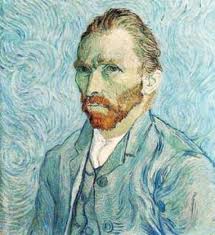
Vincent van Gogh, a Track #1 guy who got killed on Track #2
1. Everybody loves it.
2. Everybody hates it.
3. Nobody notices that it even exists.
All three responses present you and me—the artist or entrepreneur—with serious emotional challenges, and all three drive deep into the most profound questions of life and work.
It will not surprise you, I suspect, when I say that in my opinion all three responses are impostors. None is real, and none should be taken to heart by a professional.
When we work in any field that combines art and commerce, we’re working on two tracks. (I picture them as railroad tracks running side-by-side.)
Track #1, the Muse Track, represents our work in its most authentic, true-to-itself and true-to-our-own-heart expression.
Track #2, the Commercial Track, represents the response our work gets in the marketplace. In other words, points 1-2-3 above.
Track #2 counts for putting bread on the table and getting our kids through college.
Track #1 equates to our artistic soul.
The problem with Track #2 is that it also represents the siren song of riches and fame (or at least applause and recognition in the real world).
Did you see the post I did a few weeks ago called “Paul’s All Is Lost Moment?” My friend Paul had just finished writing a TV pilot. It was the first time he had really completed a project from FADE IN to THE END. He turned it in to a friend who is a serious producer and who was anxious to see it. Almost immediately Paul’s spirits went over a cliff.
He became depressed, anxious, irritable. He couldn’t sleep. He stopped working. He was waiting breathlessly to hear his producer friend’s response.
In other words, Paul let himself get sucked over onto Track #2, the Commercial Track.
Hollywood (or any big-buzz field like music, publishing, games, software) is a Rorschach test for the heart. Can you keep your focus where it should be? Can you find your real self and stand up for it? The dream of success/glamour/megabucks is like “dark matter.” It exerts a gravitational pull that’s so strong it can haul even the best us down into a black hole.
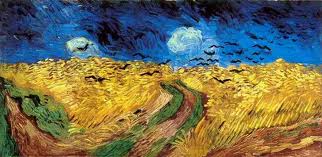
"Wheatfield With Crows" was not worth a sou in 1890. Today, according to Sotheby's: $35M.
What’s the antidote?
The antidote is remaining grounded on Track #1. There’s nothing wrong with success. I have no beef with cashing a check or getting a parking place with your name on it. But both will kill you if you confuse Track #1 with Track #2.
While Paul was pacing his living room, wondering if he could really kill himself by leaping out a second-story window, the real truth of his situation was this:
He had completed his first serious full-length piece of work.
He had shipped.
He had delivered.
His creative momentum was high.
The Muse was with him.
On Track #1, Paul was rolling!
But on Track #2 he was getting eaten alive (or, more exactly, he was eating himself alive.)
My advice to Paul was to start another project instamatically. In fact Paul was already working on Project #2. But he had stopped. “Get back on that sucker!” I told him.
Why is this so important?
Because getting back to work grounds us on Track #1. We pick up where the Muse left off and we keep rolling.
On the other hand, when we finish a project and stop working while we wait on pins and needles to learn the world’s response to it, we have planted our butts squarely on Track #2. Track #2 means evaluating our work (and defining our artistic selves) by the opinions of others. Nothing good ever came from that. Even success can be bad. In fact success can be worse than failure. How many actors have won Oscars in Year X, only to vanish into rehab in Year X+1?
Van Gogh was a Track #2 failure his entire life. And yet: how was he doing on Track #1? True, a century ahead of his time, but still smokin’ hot. If only he could have realized it! If only we could all realize it.
The ideal position for an artist of authenticity is when Tracks #1 and #2 coincide—when he is working his real stuff, and that stuff is finding a home in the wider world.
When an artist’s voice is true enough to his own heart and authentic enough to his own vision, Track #1 pulls Track #2 to it. Bruce Springsteen. Bob Dylan. Hunter S. Thompson.
I don’t knock Track #2, the Commercial Track. Real art can be commercial too. And I don’t overvalue Track #1, the Muse Track. If our stuff is navel-centered and obscure, it doesn’t deserve to find a wide audience.
But we lose our way when we overvalue Track #2 at the expense of Track #1. “Sunflowers” was just as great in 1889, when Van Gogh couldn’t give it away, as it was in 1987 when it sold for $39.9 million.
Whatever Track #2 fate awaits my friend Paul’s pilot, the bottom line truth is this: he knocked it out of the park on Track #1.
More on this subject next week.
DO THE WORK
Steve shows you the predictable Resistance points that every writer hits in a work-in-progress and then shows you how to deal with each one of these sticking points. This book shows you how to keep going with your work.

THE AUTHENTIC SWING
A short book about the writing of a first novel: for Steve, The Legend of Bagger Vance. Having failed with three earlier attempts at novels, here's how Steve finally succeeded.
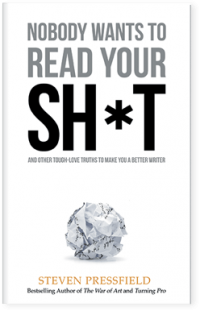
NOBODY WANTS TO READ YOUR SH*T
Steve shares his "lessons learned" from the trenches of the five different writing careers—advertising, screenwriting, fiction, nonfiction, and self-help. This is tradecraft. An MFA in Writing in 197 pages.
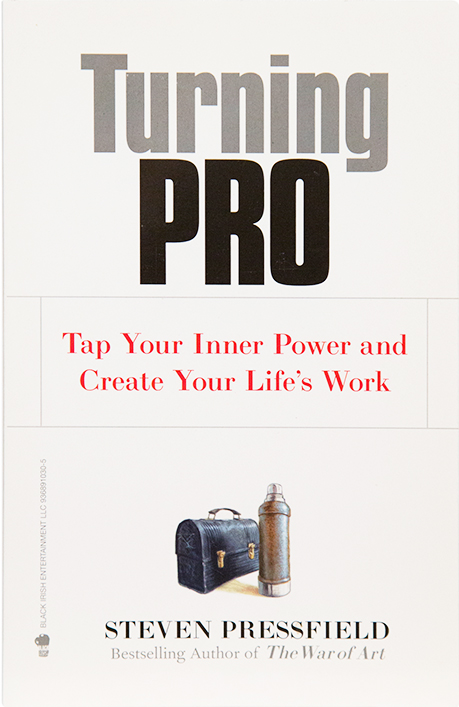
TURNING PRO
Amateurs have amateur habits. Pros have pro habits. When we turn pro, we give up the comfortable life but we find our power. Steve answers the question, "How do we overcome Resistance?"
Thanks for this inspiring post.
The more you stay grounded on the track #1, the less you need the props.
You’ve put the “artist’s dilemma” in a different frame. I’ve heard it said that if Shakespeare were alive today, he’d be writing TV scripts. Actually, I heard that at least thirty years ago. Not sure what he’d be writing now. Track #2 verifies Track #1 – or at least so we’ve been led to believe. But Keats is another example of your point. Considered the least of the Romantics during his life, with only Shelley really seeing his potential, he’s now considered the greatest. Art for Art’s Sake is also a misnomer – it becomes navel lint, after all, without an audience. I’d posit there’s a “third rail” – the editor-audience. (A friend calls those who perform editorial services, including therefore reviews, curators. Perhaps it’s a better word.) We don’t create in a vacuum; we create to communicate, that is, to discover connection and significance. That requires an audience. It does NOT require Track #2. Local repertory theaters may be a good example: not commercial successes, by and large, but travels along Track #1. You “curated” Paul, you were his third rail, enabling him to get back to Track #1 and get derailed on Track #2. “Third rails” provide electric power, usually through a direct current. They are also highly charged, and therefore difficult to address. Maybe Van Gogh just needed a third rail, though good ones are hard to find.
You are so right!
Track #1 and again, and again, and again, and again…
Thanks for another excellent post. Exactly what I needed to read today.
Dear Mr Pressfield
Only yesterday, I was listening to s youn employee who is gifted in graffiti/street art and yet under pressure to follow another career set by his parents. All I could do was feel his pain. The dichotomy was there all to see, do we rejoice and follow our calling (muse) or give in to the world? Krishnamurti is the only one I know of who gallery’s this subject head on. In front a gathering of school children he listened to a young boy tormented with the choice of following one path or another set by adults. After comforting the child with loving words Krishnamurti stated that an individual has to follow their true calling, even if at the end of their lives they die in poverty. A person can die in peace knowing they celebrated their true gifts (muse). Is this easy? No way! One path is our inner passion the other worldly acceptance. These two mental illusions will continue to fight within us until we either give in and respect the muse or accept that lousy 9 to 5 job. I truly respect the artist who follows their calling, quietly without fanfare. There exists an example of a warrior in modern times.
With kind regards
Oh, how true. To know that track #2 isn’t real, and to create for art’s sake. Besides, until you ship, you won’t know what the response is anyway (if that is what you need to do, anyway.)
Perfect timing, thanks once again.
“Sunflowers” was just as great in 1889, when Van Gogh couldn’t give it away, as it was in 1987 when it sold for $39.9 million”
It depends how we define “great” or “good”. Is something good if no one buys it (or even sees it)? is something intrinsically good?
Let’s look at it the other way round: Let’s say that a painting (or a book) is considered great, and then a few years people consider it to be not good at all (due to change in fashion/taste, for example). Did that work of art stay good, depsite the fact that nobody now thought so?
Very well communicated, this can happen in all walks of life.
Bravo Steven!! Excellent article. I’ll do my best to engineer the day today balancing time between tracks properly… but promise to kick myself in the caboose if I don’t.
Steven.
This is gold.
Thank you for mentoring me from afar.
AG
Thanks for passing along a link to this article Seth.
Perfect timing for me to read this too.
Just finished my first novel to almost non-stop 5 star reviews from fans who love it, but agents and publishers (who love it too) who are “put off” by some of the content and can’t decide if it’s “Christian” or not. They think it is, but the Christian publishing houses won’t touch it. I’m confident that it’s awesome and don’t care about the commercial. This helped me explain my feeling about it all. Thanks!
Thanks Steven! Seth’s link directed me here. Thanks again for blessing the world with your wisdom & insight. Your books(The War of Art & Do the Work) are absolutely amazing!!!!!! 🙂
Really like the multiple tracks concept. On my bulletin board (courtesy of Noah Lukeman) is a quotation that goes something like this (not at home so can’t quote exactly). Rejection is nothing. While waiting for responses, get busy writing your next book. In the same spirit as your post.
What I think also helps is to develop a tangible plan which includes different categories of tasks all centred on the main objective of writing what you love and being rewarded for it (not just monetary reward). I’ve written quite a lot on my other blog, onewritersvoice.com under the topic of The Business of Writing. Hope that’s not seen as self-promotion … merely trying to help.
The problem with track #1 is that it may take more time than most people are willing to wait before track #2 kicks in. That’s why it’s so rare and valuable.
Great post Steven, I’m a big fan.
Thanks for your timely blog.I finished a short story and starting sending it “out there.” I’m staying sane by getting back to my novel. Marjorie Hudson, author and writing teacher, has challenged some of us to be working toward our first 99 rejections. I’ve made 24 submissions and gotten 4 rejections. I take that as a sign I’m, pardon the pun, on the right track.
Again, thanks.
Greta
Holy smokes! What a shipment, Steven…
Just today, after one week on Track #2, I have recollected my spirit to get back on Track #1.I am so glad I did…
I salute to your art, how precisely you can describe one’s struggle,tears and joys on a path of an artist.
Thanks for continuous shipping.
with respect,
– is
This post is fabulous. Especially the way art and money associated with it is compared with two tracks of a railway. It will motivate those artists who struggle to convert their creativity into money and make them concentrate on their creative process. Thats why I am a firm believer of this – You can’t start art(painting,singing etc) without having another source of income. Your creative activity should be independent and not bear the responsibility to fetch you bread. It is then only you can go ahead creating what your heart desires and without any inhibition, expectation or burden. And who cares if no one appreciates your work! Just keep working! At the end of the day it should give you joy and that is priceless. As you go ahead in this process, little tweaking or tuning of your work can be explored ofcourse to generate some inflow of cash from your artworks. But one shouldn’t get obessessed with that. That is my philosophy.
Hm, what an interesting post and I suppose the big question for me is..if a piece of work is not “accepted” on track 2 – is that because it’s genuinely out of kilter with its times or because (whisper it) it’s not really of a high enough standard..so maybe that means there needs to be a track 2 that pays the bills – that may or may not be to do with your art – what Barbara Sher calls a “good enough job” – like T.S. Eliot working as a banker..so that one can have the freedom on Track 1….
So tell me again how you get around Track #2 (counts for putting bread on the table and getting our kids through college) when Track #1 (the Muse Track, represents our work in its most authentic, true-to-itself and true-to-our-own-heart expression)doesn’t? Do you get another job and hope it pays enough to cover all of Track #2 expenses + leaves you enough time for Track #1 work….. because that rarely happens. Sometimes (most times) you just have to suck it up, stop being a self absorbed cry baby, be responsible and do some Track #2 to pay for your Track #1 habit.
Thanks, Steven. Seth sent me here and boy I’m glad he did. As always, you are an inspiration to keep on keeping on.
Excellent post. I’m looking forward to reading more.
Whew, Good timing. Just when there’s a blank canvas on the easel, waiting for me. Dan Goodwin sent me here; I need to give that man a raise…
true artist = work-a-holic!
it can never be shut off (even if you try, which I do not recommend, the fire will kill you – or at very least make you very, very sick)
it is (the soul’s) survival.
keep going, even if it is only for yourself!
“When an artist’s voice is true enough to his own heart and authentic enough to his own vision, Track #1 pulls Track #2 to it.” That sentence wraps up the whole post. Just keep working true as best you can. I need this reminder and thank you.
Thanks, Stephen. I needed this.
Gah… I meant “Steven” I did… I swear… I blame my fingers… they have a mind of their own.
Cross post and thanks for the kick in the ass!
http://susancalvert.blogspot.com/2012/03/steven-pressfield-online.html
Steven
I read this post yesterday on the train.
Firstly, thank you.
Without wishing to appear too gushing, I have been struggling for a while trying to create a new persona as a writer, speaker and creative spirit, having previously practised law for 14 years. When I look back at my early career beginnings, I have no idea why I fell into law, which is very left brain, logical in its purview. In truth, whilst I can argue with the best of them, I never felt comfortable working in a adversarial way when all I really wanted to do was collaborate to reach a Win/Win scenario. At the same time, my love of reading, writing and music never left me, but I had no outlet for my work given the intolerable hours that I was working. Having stepped away from law in 2010, my biggest problem has been to give into the temptation/necessity to pursue the monetary prize at the expense of the creative journey. It has been immensely frustrating because in many ways it has felt like I was being dragged back to law, even though I wasn’t practising. I used to call it The Golden Handcuffs Syndrome – the more successful I got the tighter and shinier became the damn cuffs. This post reassured me that I wasn’t going mad, and that there are two parts to me that probably will always remain in conflict. I just have to work out a way of keeping things in balance, and if the need arises and I will have to go back into the workplace.
I am really looking forward to the new book, and to sharing your exceptional writing.
Julian.
Amen.
This line resonated: “The dream of success/glamour/megabucks is like “dark matter.” It exerts a gravitational pull that’s so strong it can haul even the best us down into a black hole.” So true. Thanks for reminder to focus on track #1.
Great post and great distinction. It reminded me of two quotes I read last year, and I brought them together with your ideas and added some of my own thoughts, then posted it to my blog:
http://suratlozowick.com/blog/2012/08/art-and-influences/
Thought you might be interested.
Just keep working! At the end of the day it should give you joy and that is priceless. As you go ahead in this process, little tweaking or tuning of your work can be explored ofcourse to generate some inflow of cash from your artworks.
Thx for this post!