The Hero’s Journey, Part One

I netflixed The Power of Myth last week and watched it over a couple of nights. Have you ever seen it? It’s the PBS series that Bill Moyers did in 1988, interviewing Joseph Campbell. The program was great then and it’s great now.
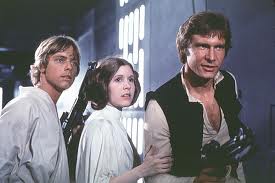
You meet all kinds of people on the hero's journey
What I realized, re-watching Joseph Campbell (tragically he died a couple of years after the series aired) was what a powerful influence his books and thought have had on me. The Hero With a Thousand Faces, Follow Your Bliss, The Power of Myth. I decided I would dedicate the next few Writing Wednesdays to exploring those subjects. I don’t know exactly what I think about them, but writing is a very efficient way to find out.
What exactly is “the hero’s journey?” What is it in myth? What is it in our psyches? Is it the software we live by? We know George Lucas built Star Wars (and Luke Skywalker’s inner journey) around the concepts in Joseph Campbell’s Hero With A Thousand Faces. But how does that stuff impact you and me? As artists, do we have hero’s journeys? What are they? What do they mean? Is the hero’s journey the same for women as for men?
What is the hero’s journey in story terms? Novelists and screenwriters use bits and pieces all the time, often unconsciously. The hero’s journey in one form or another is the template for almost every screen story from Conan the Barbarian to The Hangover. Concepts like the inciting incident and the All Is Lost moment come straight from Joseph Campbell’s studies of myth and legend. Is the hero’s journey still alive today? Can you have one in a cubicle or on Facebook?
I have my own theory about the hero’s journey as it relates to an artist’s evolution. I’m not sure exactly what that theory is, but I’ll try to hammer it out a bit over the next few weeks.
What I do think is critically important about thinking in mythic and metaphorical terms is it keeps you from going crazy. When we look at our lives, particularly when we’re young and trying to figure out who we are and what our purpose is in this lifetime (if indeed we even have a purpose), it’s easy to see the landscape of our days as constituted of chaos and disorder and ruled (if they’re ruled at all) by randomness and happenstance, animal appetites, fear, risk aversion, habit, even plain old evil.
When we think in terms like that, the world becomes a form of hell and we experience ours lives as careening in circles, heading nowhere except down the tubes.
A concept like the hero’s journey changes all that. If you’ve ever had a terrible dream—one you woke up from in a sweat, shaken to the core—and then analyzed that dream later, you may have come to see it as a breakthrough, as overwhelmingly positive. The dream may have been a warning. It might have opened your eyes or kicked you in the ass. In the end, terrible wasn’t terrible after all. You were better off having had that terrible dream.
In the hero’s journey in myth, the hero suffers terribly. He’s lost, he’s drowning, he’s thrashing around in darkness and terror. But here’s the point. The suffering isn’t random. It’s isn’t chaos, and it isn’t without meaning. In fact it’s loaded with meaning.
What makes our suffering seem random and hellish is that we perceive it without context. The idea of the hero’s journey supplies that context. If we believe it, it puts our trials into a framework that stretches back across thousands of generations. Our ordeal is nothing new. We’re not unique; we’re not the first trolley to ever trundle down this track. Others have traveled the same path and, fortunately for us, left clues along the trackside. Guys like Joseph Campbell have helped decode those clues. Thank you, Joe!
I’ve had my own hero’s journey, and you have too. We’re both still on those journeys. Concepts like “the call” or “the wise crone” or “the chance encounter” don’t apply only to Luke or Yoda or Obi Wan Kenobi. They’re hard-wired into our psyches, I believe, like the “take me home” feature on your Mini Cooper’s navigation screen.
More to come in the next few weeks.
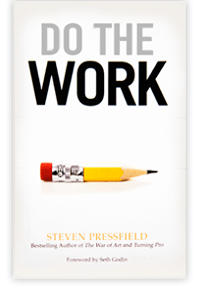
DO THE WORK
Steve shows you the predictable Resistance points that every writer hits in a work-in-progress and then shows you how to deal with each one of these sticking points. This book shows you how to keep going with your work.

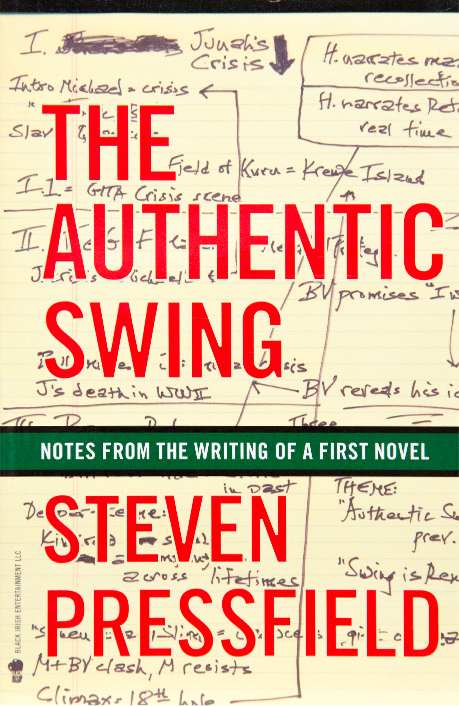
THE AUTHENTIC SWING
A short book about the writing of a first novel: for Steve, The Legend of Bagger Vance. Having failed with three earlier attempts at novels, here's how Steve finally succeeded.
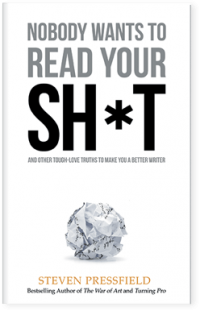
NOBODY WANTS TO READ YOUR SH*T
Steve shares his "lessons learned" from the trenches of the five different writing careers—advertising, screenwriting, fiction, nonfiction, and self-help. This is tradecraft. An MFA in Writing in 197 pages.
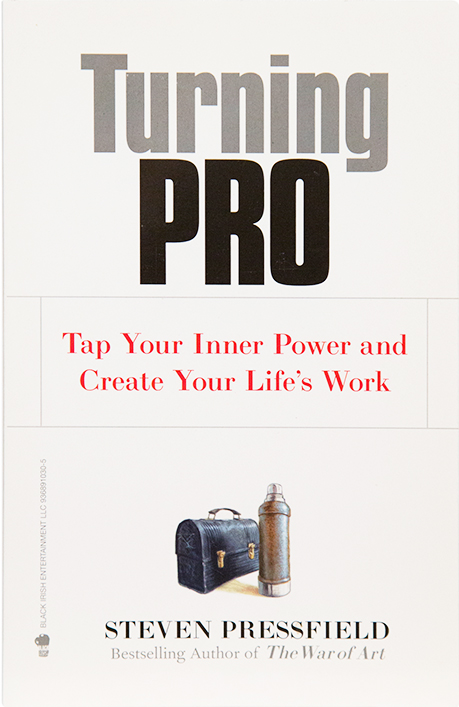
TURNING PRO
Amateurs have amateur habits. Pros have pro habits. When we turn pro, we give up the comfortable life but we find our power. Steve answers the question, "How do we overcome Resistance?"
Hi Steve & all,
This train of thought following narrative structures and devices which seem to be born out of everyday human life reminds me of a book by Christopher Booker called ‘The Seven Basic Plots: Why we tell stories”. (It’s a UK book, so it might not be available in the U.S.)
It’s a pretty mammoth piece of work, because within it Booker analyses a myriad of stories from across the world and categorizes them down to ‘Seven Basic Plots’:
-Overcoming the Monster (say, Perseus, Beowulf and James Bond)
-Rags to Riches (Aladdin, The Fresh Prince of Bel Air)
-The Quest (The Odyssey, Raiders of the Lost Ark)
-Voyage and Return (Orpheus, Brideshead Revisited)
-Comedy (Lysistra, Guys & Dolls)
-Tragedy (Agamemnon, Scarface)
-Rebirth (A Christmas Carol, The Last Samurai)
These plots may overlap, some stories might contain several, hell, some might even contain all seven plots! (‘The Lord of the Rings’ being Booker’s example of an all-encompassing plot).
Having explained each plot he goes onto analyse different ways that the plots have broken down, mostly during the twentieth century, into shadows of their former selves.
Booker also tries to get at their relevance, at the reasons why all stories from ancient folk tales to Hollywood blockbusters seem to be following these plots without fail. His answer to this riddle is that all the plots represent important human experiences and contain lessons which were just as relevant to our earliest ancestors as they are to us today. In short, all stories are outgrowths of some problem or challenge which is deeply buried in the human psyche, and serve as a means not only to pass on messages of hope, but also techniques for victory.
Anyone who thinks this sounds a little crazy might want to flick through ‘The War of Art’; there is as prime an example of the ‘Overcoming the Monster’ plot as you are likely to come across! Unfortunately, it’s very much only a script; we have to act it out if that story is to be told properly!
Thanks Steve and Mike–looks like I have some reading to do.
Steve, great find on that book.
Thanks so much for sharing this, Steven.
“The Hero with A Thousand Faces” and “The Power of Myth” are revelations. They are road maps not only into and through our psyche, but through life.
It is amazing how Carl Jung’s life work corresponds so directly to Joseph Campbell’s hero quest.
This should be taught in every school.
So glad that you are teaching it!
campbell should be required reading.
I guess it’s only the tip of a really large iceberg, but we watched recently and were completely blown away. For anyone who hasn’t yet seen this gem, it’s well worth a watch.
What I absolutely love about the online space is how easily we’re led to new and wondrous things that we might well have otherwise missed. I’m off to find on my Kindle! 😉
Joseph Campbell says that people are not seeking the meaning of life but rather the experience of being alive. To just ‘go along’ in a life that does not do justice to the awe we feel in those moments of being blown away by the incredulity of life itself, to become who we sense we are meant to become, is a subtle, desperate and all too shared grief; Thoreau’s ‘mass of men’. Joseph Campbell’s “The Hero’s Journey” is a gospel for a life that breathes’, that makes sense of failure and courage and heart. More importantly he shows us that it is a recurring thread through the ages, a story of life, regardless of station, ethnicity or era. It is a theology that both binds mankind and frees him.
The old myths are worth studying deeply. They give great insight into the human psyche.
For me as a writer, the “Hero’s Journey” is simply the most satisfying way to take the reader through the protagonist’s way through the plot. Having a good story to tell is a gift, and the Hero’s Journey is a way to live out that gift on the page. It’s not the answer for everything, of course, but if the best writing advice is to write the thing that you would want to read, then that’s good enough for me.
Thanks so much for sharing this Steve. As an aspiring golfer, and writer, these glimpses into the psyche of a hero have helped me establish a basis for my own journey. A constant struggle resides deep from within as my heart desires to follow my dreams to the PGA tour, and my soul eloquently captures this as I write in my journal.
Again I just want to thank you as your writing has not only been a great inspiration to my own writing, but to finding who it was on the golf course as well. For years my game had become filled with a forceful vengeance, years of expectations had widdled down the poetic swing I once had. My renaissance has begun, and with your help I’ve begun to put one foot in front of the other. I’m becomming the the person I have envisioned staring back from the other side of the mirror. Thank you!
This is so true. My favorite part of the piece.
I’m so glad you are doing this, Steve, as I too am an ardent believer that this is every person’s path if we choose to think of our lives in this way. I have not seen the Bill Moyer’s series, but I have read The Hero with a Thousand Faces.
Great post and great comments! I especially like Mike’s summary of Booker’s seven basic plots; thanks for putting that up.
Every now and then I re-read Don Quixote and wonder at how relevant this farcical tragicomedy is to my own life. Myth is powerful because it is the hook upon which we hang our coat and hat at the end of each day, trying to make sense of what transpired.
Great post…I just watched Power of Myth too…Joseph Campbell was amazing…I plan to read his books next…
This campfire of yours, Steven, never ceases to amaze me, excite me, inspire and delight me. Joe Campbell is one of my most beloved heroes…and looking at his work through your writing is better than sea salt caramel chocolates! 😉
BTW–A recent arthouse documentary, “Finding Joe”, did a beautiful job of distilling the work of Joseph Campbell down into the modern day Hero’s Journey we each take whenever we step off the beaten path. Highly recommend it.
Thanks for this blog post. Another Joseph Campbell quote is “We must let go of the life we have planned,
so as to accept the one that is waiting for us.” We all need to listen that inner voice that says “Go that way.”
I love this! Nice replies!
I love Joseph Campbell, Carl Jung, and I have used their work and yours, Steven, (The War of Art) in a playshop I developed for creatives and not-so-creative people, to help them move through resistance; I’m still refining the playshop, since it comes from a graduate school final class project and my interest in creativity, bringing the shadow to light, and resistance. (Master of Education in Adult Learning) The hero’s journey as I understand it is, is one who is an innovator, or a maverick, creating or bringing to the world, or consciousness, a new way of looking at something, be it art, music, writing, or a mirror to one’s own self.
I have always loved The Power of Myth and I am thrilled you are doing this, Steven!
Great article and comments.
As it seems the subject touches everyone’s soul.
We need to have a meaning in our lives and the metaphor of the road and the journey is established deep within us.
“We’re both still on those journeys” – good thing too! I have (I hope) an open ticket with unlimited layovers and mileage! Best wishes for a continuing good journey…Roger
I just came from a conference that talked about this idea in a similar way. If we think that our suffering (and all events) are random, then we don’t take ownership for what we’re going through and we don’t create a good story with it. We just go through it get pushed around by it all. We simply react instead of being proactive.
I think this has to be why the world of sports, which we will once again glorify in London this year, takes such a prominent place on the world’s stage. A sporting event, like good fiction, offers the chance to personally or vicariously live the hero’s journey. Really, why else would we care one whit about who scores the most points?
The Writer’s Journey by Christopher Vogler and Hero With a Thousand Faces were two of the first books I read on writing. Myths break all barriers of time and place and connect us with storytellers from all different eras and cultures.
I recently watched A Dangerous Method and have become intrigued by Carl Jung’s research on archetypes and the collective unconscious. I am eager to study the connections between the work of these two great men, Campbell and Jung. (I’m assuming Jung’s research on archetypes had an influence on Campbell.) I am especially intrigued by the collective unconscious, since it helps explain how a story can have such universal appeal, and ties in perfectly with Campbell’s concept of the Monomyth.
Interesting how our myths are just representations of, what I believe Joseph Campbell referred to as, the ‘authentic life.’ He also said the greatest cure for unauthentic living is the one living authentically. Maybe that is why we uphold our myths. We aspire to live our passions, ‘follow our bliss.’ And though we ridicule the person doing so along the way, we uphold them on our shoulders when they’ve passed through the refiner’s fire.
Looking forward to future posts on this one! Thanks, Steve!
“The suffering isn’t random. It’s isn’t chaos, and it isn’t without meaning. In fact it’s loaded with meaning.”
Yes – it makes all the difference when you see it that way. (Even if it doesn’t necessarily get much easier in the short term!)
Campbell made a big impression on me years ago, enjoying your take on it and looking forward to more…
Hi Steve,
I am just now also watching Power of Myth and listening to JC in my car in order to inspire my paintings. It’s a good way of coming home as we age I think.
Nancy
The Power of Myth series is excellent. I discovered it during the summer of 1988 when it aired for the first time and it was exactly the kind of thing I was looking for at that stage on my life as a 20 yo. It introduced me to ideas that informed the next decade of my life. And it led to the discovery of thinkers such as Mircea Eliade, Stanislav Grof, Michael Harner and his work on shamanism, John Weir Perry and his book “Lord of the Four Quarters” and others.
The work that I think is most relevant to your project here on this blog is Campbell’s “Creative Mythology.” It’s the fourth volume in the “Masks of God” series (Primitive Mythology, Oriental Mythology, Occidental Mythology):
“…in the fields of literature, secular philosophy, and the arts, a totally new type of non-theological revelation, of great scope, great depth, and infinite variety, has become the actual spiritual guide and structuring force of civilization
“In the context of a traditional mythology, the symbols are presented in socially maintained rites, through which the individual is required to experience, or will pretend to have experienced, certain insights, sentiments, and commitments. In what I am calling “creative” mythology, on the other hand, this order is reversed: the individual has had an experience of his own–of order, horror, beauty, or even mere exhilaration–which he seeks to communicate through signs; and if his realization has been of a certain depth and import, his communication will have the value and force of living myth–for those, that is to say, who receive and respond to it themselves, with recognition, uncoerced.”
The great revolution that has taken place over the past few centuries has been the liberation of the individual to venture deep within and encounter there previously unknown constellations of meaning. And instead of subordinating oneself to inherited, external systems of meaning, one has the opportunity to discover/create them from within.
I just came to your site through twitter (I just love the way Twitter leads me to great sites.) Steven I’d love to interview you on my TV show at http://TalkStoryTV.com.