The Hero’s Journey in Real Life

We’ve talked over the past weeks about the hero’s journey as myth, as movie or literature, as a blueprint in our psyches. But what is it in real life? What is the spontaneous hero’s journey?
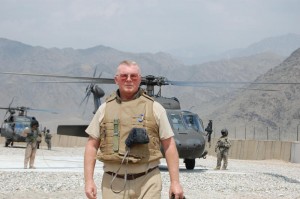
Andy Lubin on "the hero's journey" -- but not the obvious one.
One of our readers (and my friend) is a journalist named Andy Lubin. Andy has written in to our Comments section taking issue with the term “hero.” He feels such an exalted term should apply only to soldiers or Marines who save their comrades’ lives in combat, or firemen who run into burning buildings. The truth is, Andy himself is a hero in the sense that Joseph Campbell meant when he wrote about the “journey.”
Andy, when I met him a few years ago, was a struggling writer with a son in the Marine Corps. For fun and experience, and in solidarity with Phil, Andy unofficially embedded himself with several Marine units in Afghanistan and wrote short pieces about the experience. Today, only a few years later, Andy has literally dozens of embedded deployments behind him; along with Michael Yon and Bing West he has seen parts of Afghanistan that the generals in the Pentagon have never even heard of. He writes for Leatherneck magazine and the Huffington Post and numerous other print and electronic media.
But it isn’t the bullets he has faced that make Andy a hero by Joseph Campbell’s definition. It’s the fact that he has actualized his vision. He has gone from aspiring journalist to real journalist. From amateur to pro.
Andy may not admit it, but he has “heard the call” (and tried to avoid it); he has launched himself with trembling tread into the unknown; he has dueled monsters, received aid from unexpected sources, experienced All Is Lost moments, and at length returned home, bearing a gift for the people.
The gift Andy brings is his writing. His gift is an album of life as it is lived in Konar and Paktia, under the helmets of Marines in the field and in the shit.
The hero’s journey in real life begins in darkness. A seed burgeons, way below consciousness. This seed is the germ and kernel of ourselves-in-becoming. It is not us-as-we-are. It is who we will be.
We are pregnant with ourselves, as Andy was, and we feel it. We experience it as restlessness, dissatisfaction, anger, shame, irritability with ourselves and with others. We experience it as Resistance.
The hero’s journey in real life is personal. It is about us and us alone. Our gift—which is unique to you and me and which no one else on the planet possesses—breaks through the soil like a fiddleheaded sprout, which is ourselves-in-becoming. No wonder our knees knock as we launch on the journey. No wonder we feel fear and pain. No wonder the stakes seem like life and death. They are.
The hero’s journey can take place on a battlefield or in a cubicle. We can live it out amid public clamor or in the soundless vault between our ears. The demons we are dueling are always the same. They are our own fears of becoming who we are. No one who has ever lived—or ever will—has a journey like ours. And yet our journey is universal. It is every woman’s and every man’s.
Nor can we fail on our journey, because failure is part of the tale itself. It may indeed be the point of the tale.
It gets kinda mystical, talking about this stuff. But what could be more mystical than birth or rebirth? What could be more miraculous?
What do we achieve when we undergo a hero’s journey? When we “return home,” what have we got?
First, we have acquired a history. A personal history that is now tattooed on our innermost, secret souls. This narrative is ours alone. No one can take it away from us. This history differentiates us from others. It starts us on the path to becoming who we are. (If we undergo this passage as part of a group or platoon or gang, we acquire brothers and sisters who share our secret and will be bound to us for life, as we are to them.)
Second, we have changed. The definition of death is statis; the definition of life is growth. To change—and to know that we have changed—gives us the only power that means anything. We might not have money, we might not have found love, but our toes have touched the seafloor and we know we have not gone under. If we can do it once, we can do it again.
Third, we have done what we were meant to do. We have not shrunk or held back. We have answered the bell. We may be only an acorn (for now), but we have turned our face to the sun and started on the path to becoming an oak.
I believe in hero’s journeys. I believe we undergo them, one after another, throughout our lives. The human being was made for this. It’s in our DNA. The life of comfort and ease is not what we were designed for.
Andy, you have proved it by your journey—and I don’t mean the outer one. You have dueled inner dragons, and you’re still dueling them. That’s a hero in Joseph Campbell’s book and it’s a hero in mine.
Where the hero’s journey ends, the artist’s journey begins. We have returned, like Odysseus, to Ithaca—you and me and Andrew Lubin. We bring a gift, which is unique to us and is the product of all we have undergone and witnessed and assimilated.
Ah, but what is that gift?
We will spend the rest of our lives answering that question, as artists and entrepreneurs. And we will discover the answer one work at a time as the Muse precedes us and, following her, we bring those works into material being.
DO THE WORK
Steve shows you the predictable Resistance points that every writer hits in a work-in-progress and then shows you how to deal with each one of these sticking points. This book shows you how to keep going with your work.

THE AUTHENTIC SWING
A short book about the writing of a first novel: for Steve, The Legend of Bagger Vance. Having failed with three earlier attempts at novels, here's how Steve finally succeeded.
NOBODY WANTS TO READ YOUR SH*T
Steve shares his "lessons learned" from the trenches of the five different writing careers—advertising, screenwriting, fiction, nonfiction, and self-help. This is tradecraft. An MFA in Writing in 197 pages.
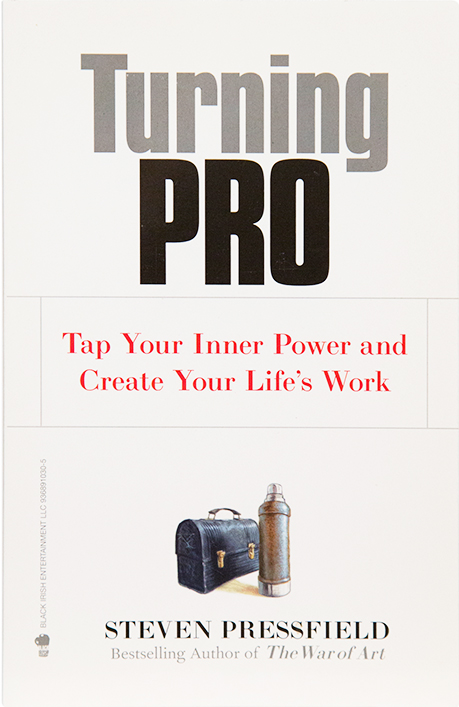
TURNING PRO
Amateurs have amateur habits. Pros have pro habits. When we turn pro, we give up the comfortable life but we find our power. Steve answers the question, "How do we overcome Resistance?"
Truly spectacular! Probably my favorite hero’s journey post. Your writing was poetic.
THANK YOU for your weekly gift to us, Mr. Pressfield.
Well said. Our oldest son is home after three Marine Corps tours- Afghanistan and Iraq. Your insights are excellent. Thank you!
Michael: good to meet another member of the “Parents of Deployed Marines Club” Like your, my son did 3 combat tours: 2 Iraq’s and an Afghanistan, and there’s no doubt in my mind (especially afer 14 embeds) as to who are the finest fighting men in the world. Well done by him – and by you! s/f Andrew
Michael: good to meet another member of the “Parents of Deployed Marines Club” Like yours, my son did 3 combat tours: 2 Iraq’s and an Afghanistan, and there’s no doubt in my mind (especially afer 14 embeds) as to who are the finest fighting men in the world. Well done by him – and by you! s/f Andrew
The deepest article of the Hero’s Journey series.
I won’t forget it.
Absolute brilliance.
Somewhere, Joseph Campbell is proud.
Awesome! For me, the “hero” part of Hero’s Journey is a bit more geeky and technical, but might prove interesting, as it’s related to this post.
In at least one story structure paradigm, they separate the term hero, protagonist, and main character. A protagonist is the character who’s activity and decisions push the storyline forward. The protagonist is out there making it happen. A main character is who the reader identifies with and who provides us with the subjective experience of the story. The hero of The Great Gatsby was Gatsby, but the main character was Nick. The hero of To Kill a Mockingbird was Atticus, but the main character was Scout.
A hero is when the protagonist and the main character are the same person. When the person driving the story and taking action IS the person through whom we subjectively experience the story.
We become the hero in the hero’s journey when we muster the courage to take action which pushes our own story forward. It doesn’t necessarily mean that such a person is a hero in the conventional use of the term, in the sense that we might describe a service member facing combat as a hero, but it does denote something crucially, profoundly important — exactly the stuff that you cover in this post.
You always say exactly what I need to hear, when I need to hear it.
I so strongly believe in this way of thinking about a life, and I agree with others who have commented here that you have a beautiful way of articulating this vision.
Steven, I always so greatly admire your writing, courage and insights. I took the leap of faith and followed the hero’s path by walking the 900 mile route of the Cherokee Trail of Tears. Embracing this was not easy to say the least, but it was life-altering. The book resulting from my journey, Walking the Trail, was nominated for a Pulitzer. If I may, I’d like to share my story in a PBS interview/documentary that aired two weeks ago.
: http://wtcitv.org/watch-online/the-a-list-with-alison-lebovitz/jerry-ellis-season-4-episode-6/
And I was havin’ such a frickin’ bad day until I read yer blog…and realized I did four pages on my novel-in-progress today. To : I will be sure to see your I/V and share it with my friends at TheRedNation.com Write on, people.
Shucks, Steve, you’re too kind…
Maybe my time back here (8 months now!) has given me a little time to reflect; while sharing combat time w/Marines has given me a keener appreciation for heroism than most, perhaps it’s my role to be absolutely the best writer-photojournalist-filmmaker I can be in order for these stories to see the light of day.
Heroism? I’m still not convinced, but Hey 1st Sgt, let me finish my Red Bull & Gatorade and I’m ready to go out again!
Andy called me today because he was offline, and asked me to read the piece to him. Now, you know, Steve, that silence from Andy is kind of a rarity. He was 16 months old when I was born, and his voice was certainly one of the first things I heard — and have been hearing for 58 years, as his sister. So, his stunned silence today at your words and his subsequent argument that he’s not a hero have me kind of amused.
I’m a Joseph Campbell fan because of his perspective on the shared human condition. I gravitate to stories that try to explain and share that, whether they be myth, articles, books or blogs. Thanks for seeing that in Andy’s work, and in his heart.
It certainly took me by surprise to learn that one doesn’t leap from childhood into adulthood and success. Athena may have come, fully armed, from Zeus’s forehead, but that wasn’t the real world for my brother, most of my generation or me. I now honor the journey, cherish every moment, and teach my children to savor each step.
Yes, my brother is a hero. Thank you for saying that more loudly than he can protest against it.
“Where the hero’s journey ends, the artist’s journey begins”
I needed that confirmed. Thank you sir.
Thanks again, Steve. Your theme of change is what makes the journey so valuable. For Cavafi, you will recall, it was all about change:
Ithaca has given you the beautiful voyage.
Without her you would never have taken the road.
But she has nothing more to give you.
And if you find her poor, Ithaca has not defrauded you.
With the great wisdom you have gained, with so much experience,
you must surely have understood by then what Ithacas mean.
Very cool, Rod.
Thank you Steve.
Thank you Andy. While I’m indeed working to embrace my own hero’s journey, you’re certainly a hero in a way I can only dream of. God bless you and all those who risk everything for us.
S.J.- It’s just a matter of picking a goal and working hard. Or as we say on those balmy 142′ days …”living the dream!” Stay focused! Andy
Thank You.
Bless You.
Hi Stephen- Thanks for the post.
“The hero’s journey can take place on a battlefield or in a cubicle. We can live it out amid public clamor or in the soundless vault between our ears. The demons we are dueling are always the same. They are our own fears of becoming who we are.”
All I have to say is: Yes.
Just finished “Turning Pro” and gave it to my wife.
Steven, not Stephen. Apologies for misspelling your name.
What a beautiful tribute to Andy. Yes, he certainly has taken the hero’s journey; heard the call of his muse and followed it with mind, body, heart, and soul.
Your timing couldn’t have been better. I’m working on a High School English unit about Campbell’s Hero Journey and was working on modern heroes that follow Campbell’s Journey. Your words and insight are exactly what my students need to hear. I will be sharing this entry with them in the Fall. Thank you!
Caroline
Wonderful post Steven. My brother served two tours, fifteen months in Iraq and a year in Afghanistan as an Army Captain. As an actor/writer, I found myself doing a major gut check on the validity of my calling while he was over there. My struggle so pale compared to that of his unit as they braved night time convoy protection runs and suicide bombers on base. I actually dropped out for awhile, telling myself “entertainment” was self indulgent. Took my brother asking me to read something of mine, giving me thoughts and notes, talking about movies he and his guys were watching, books they were reading to finally accept the worth and value of what we do as creators. Giving story to those who want to get away, transcend their moment, import laughter into grave place. Thanks again for the insight into why all of our journeys are valid and heroic. It can be a tough word to ascribe to oneself.
Thank you. Thank you for this articulate, profound, and inspiring message.
I am particularly grateful for your words today.
== niki
This is brilliant, Steven, thank you. Your writing and insights bring the light of day to the subtle and invisible. I feel inspired by your writing, and I feel inspired by Andrew’s hero’s journey. Thank you Andrew for so courageously expressing your indomitable spirit of generosity.
I cherish the awareness that our true vision lies within, as the seed that is burgeoning forth. That our truth is underground in seed form, where heart and soul purpose nest in the warm embrace of possibility and dream fulfillment. That there are no good days and bad days, but that all the moments of all the days in our lifetime are part of the sacred journey, and we can be on fire with our soul-purpose, through the thin and the thick. Realizing that there is no failure, that it is about courageously facing our fears, and going out there “in the field,” just showing up, in answer to the call from within.
Both your writing, Steven, and your life, Andy, are for me very engaging and heartwarming. And after reading this and paying attention, my knees aren’t knocking so much….
Just discovering you/your writing and am deeply grateful. I’ve been in the charity world for 25+ years and realize I am burned-out, maybe for a long time running. I want to “write the book” but I can’t bring myself to write about what I know — fundraising. It bores me now. But I do know burnout, or am coming to recognize it, it’s purifying fire. This might become my new expertise. “Nor can we fail on our journey, because failure is part of the tale itself. It may indeed be the point of the tale.” Every line of this post, but this one especially, stopped me. Your writing gives me hope. Thank you.
I love this! Thank you for explaining the aspects of the hero’s journey. I just completed a heroic inner journey and love the idea that the fruits will continue to reveal themselves one artistic expression at a time.