How We Get Better

My friend Paul had a writing breakthrough last week. I mean a serious one, where his game elevated two or three levels in one shot.
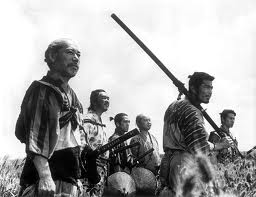
Kurosawa's "Seven Samurai." What does it take to get to the next level?
It’s tremendously encouraging to witness something like that because for most of us, most of the time, the experience of artistic enterprise is like toiling in the muck, slinging shovel after shovel of ooze and wondering if we’re advancing by so much as a centimeter, or—our direst fear—falling back.
That’s where Paul has been for as long as I’ve known him. Now, all of a sudden, POW! His breakthrough was like a touring golf pro who out of nowhere fires a 62 in competition. Or a downhill racer who posts a time that’s four seconds faster than her personal best.
For the rest of us struggling in the trenches, I offer a few tentative observations, based on watching what happened with Paul over the past week.
1. Paul’s breakthrough was preceded by an All Is Lost moment.
2. When the breakthrough happened, he didn’t recognize it.
3. The essence of the breakthrough was not technical–i.e., an increase in skill. It was a finding of his own voice.
4. This new voice was not the “real” Paul; it was the artistic Paul.
5. Paul’s breakthrough came not by improving within a lesser medium, but by leap-frogging to a higher medium entirely.
Let’s examine these one at a time.
First, the All Is Lost moment. Suffice it to say that Paul, for reasons of his own, had reached a state of near-suicidal despair about his work. Paul has a full-time business apart from writing. He had failed so many times, over so many years, in pursuing that artistic dream that he couldn’t take it any more. He was throwing in the towel.
Second, Paul didn’t recognize the breakthrough when it happened.
Desperation can be a good thing sometimes because it gives us permission to cast caution to the winds. In despair, Paul sat down at the keyboard and tried one last Hail Mary. The form this took was a six-page story. Paul worked on it hard. He cut and tweaked and revised and reworked.
But when it was done and he looked at it, he didn’t know what it was. It scared him. He read it and thought, Man, this is dark. This is creepy. This is beyond the pale.
Paul was afraid to let anyone see the story. He feared they would say, “You are one sick mo-fo.” (Which in fact is exactly what I told him.)
Third, the essence of the breakthrough was not so much increased tech skill, but rather a more powerful expression of his own voice.
What stops us from writing in our own voice is our fear that such work will be too _________. Too crazy. Too twisted. Too slick. Too dumb.
Paul’s state of despair had carried him past that. He didn’t give a damn what anybody thought because they all hated his stuff anyway. So he wrote for himself alone.
Fourth, the voice that surfaced was not Paul’s “real” voice but his artistic voice.
Paul saw his voice on the page and it frightened him. It frightened him because it was coming from some part of himself that he recognized but that he had never, except in fleeting moments, been able to access.
It was like looking in a mirror and seeing someone that’s simultaneously you and another-you. Where did this doppelgänger come from? Can it be me? If I embrace this creature, what will become of the “regular” me?
Last (and most important), Paul’s breakthrough came not by excelling in a lesser arena but by ascending to a higher arena entirely.
The work Paul has been struggling with for years has been TV. Pilots. Screenplays sometimes. (Not, as Jerry Seinfeld once said, that there’s anything wrong with that.) But Paul wrote this story, his new one, at the novel level.
He aimed higher. He wrote over his head.
What this tells me is that his game was always at that higher level. The problem was he had been shooting low and playing small. When he shook off the shackles, he discovered he could fly.
So where does this leave Paul?
He’s not a pro yet. You and I can’t invest a quarter mill that he’ll deliver the goods. He has dark forests still to tramp and dragons yet to slay.
But I take my hat off to the man. He has run a mile in under four minutes. He has driven a major-league curve ball into the upper deck.
What remains is turning pro. What remains is the unfolding of his gift and the management of his emotions, dreams and fears.
Can he do it twice? Can he sustain that level over a full-length piece? Can he bring it in on-time and under-budget? Can he do that twice?
When we turn pro, our DNA changes. I can’t prove it in a lab, but I can look in Paul’s eyes and see that his molecular structure has altered.
Godspeed, my friend.
You are on your way.
DO THE WORK
Steve shows you the predictable Resistance points that every writer hits in a work-in-progress and then shows you how to deal with each one of these sticking points. This book shows you how to keep going with your work.

THE AUTHENTIC SWING
A short book about the writing of a first novel: for Steve, The Legend of Bagger Vance. Having failed with three earlier attempts at novels, here's how Steve finally succeeded.
NOBODY WANTS TO READ YOUR SH*T
Steve shares his "lessons learned" from the trenches of the five different writing careers—advertising, screenwriting, fiction, nonfiction, and self-help. This is tradecraft. An MFA in Writing in 197 pages.
TURNING PRO
Amateurs have amateur habits. Pros have pro habits. When we turn pro, we give up the comfortable life but we find our power. Steve answers the question, "How do we overcome Resistance?"
Good luck to Paul. I empathise.
I had an “all is lost” moment a week and a half ago. I have a day job and have always had the dream of being able to support myself by writing fiction. I’ve been writing a children’s/teen novel for the last few years and I’m on the final draft. I was two thirds of the way through it (coincidentally at the “descent into the cave” moment for my main character) when I had a sudden concern that a film a few years earlier that I had not seen might have similarities with my plot. I looked it up and was hit with an “all is lost” moment as it appeared that someone else had written the story before me. I really didn’t know what to do. I’ve never had that sense of despair as writing has often been my lifeline, my reason for being. All I can compare it to is the Door of the Law parable in The Trial. All that hope and effort gone in an instant.
A day later I checked out the film itself (which was terrible) and the similarities were surface incidents at best and not any part of what I would call the “deep structure” like they were of mine. Still I couldn’t quite shake the despondency so I spoke to my sister who gave me the best advice. She said “Shut up, write the damn thing and get it out there.” or words to that effect.
I can’t tell you how much that no-nonsense message helped. I jumped back into the book and fell in love with it again. I now feel that because it happened at exactly the moment my character has her “all is lost” moment there was a deep reasonance going on and it was an important part of my “hero’s journey” as well.
Thanks for your posts, Steven. I always recommend The War of Art to anyone I thinks is looking for it.
Hi Robertdee – loved your sister’s advice to you – I need to write that up and stick it on the wall. Glad to hear you are getting on with it!
Thank you Steven Pressfield for writing this article – it is what I needed to hear. It’s good to be able to recognise what is happening and that it happens to others.
thanks for the story.
“The problem was he had been shooting low and playing small.” looks like a chronic disease.
As usual, so much to think about. Here’s to all of us throwing off the shackles.
Steve,
Your story about your friend Paul elevating his game compels me to ask you a question that I’ve never read anywhere else. You said the questions after awhile become repetitive but I don’t recall anyone asking this question. When you were standing in the movie theater watching your movie King Kong Lives bomb, did you believe inside you was a novel on the magnitude of Gates of Fire? Going from King Kong Lives to Gates of Fire has to be one of the greatest literary pivots of all time. Talk about elevating your game. Where did it come from?
Hey, wait a minute, Paul … “King Kong Lives” was GREAT!
Now I think I understand what your friends at the premiere felt…
I always take great joy in watching a man chased to the cliff, where he leaps, only to find that he can, indeed, fly after all. Great piece, Steven, and I am happy for your friend, as well as you, getting to see him soar–even if for a little while.
Loved this, Steve. I can relate to these rationale. I have begun finding my voice, and I had no idea. Such truth. Thanks for spurring us on.
Thank you Steve – very encouraging. Just the right shot in the arm to get past resistance.
Loved your book War of Art ad looking forward to reading Turning Pro.
God Bless you Steve! I needed this!
Thank You Steve. This story has come – as synchronicity in action – when my path needed illuminated confirmation – I deeply appreciate your work – Especially your newest book – Turning Pro.
Robert Greene calls this “the death ground strategy.” Soldiers fight harder and better when they know there is only one way out. I like it
This “All is lost moment” seem to be so vital!
Sometimes, when the “All is lost moment” has a long time to hit me, I start to worry (All is lost moment hasn’t come yet!).
All is lost! The All is lost moment hasn’t come!
Oops, something sounds very strange here…
I’d better return to my work and write…
God bless you both. I’ve “watched” Paul’s progress through your blog and have been inspired and uplifted on many occasions. Thank you for that. When you’re in the midst of your own dark tea time of the soul, feeling uplifted is a minor miracle.
Thank you for this piece. I’ve found this pattern true for me personally–before I grow as a writer I hit the darkest moment, have that feeling that all is lost, that, a feeling of dislocation, and then, at some point soon after, things coalesce. I’m glad to know this is a universal pattern. Looked at neurologically, we are making new pathways, new connections, in our brains when we learn and improve, and I suppose the all is lost moment could be seen as that final moment before new connections are made. Regardless, this is a very powerful process to keep in mind.
I’m currently experiencing an All Is Lost moment, but this post reminds me that when I feel that way, I’m on the verge of something greater. Thanks for the nudge of encouragement.
As Marlon Brando said in “On The Waterfront. “I coulda been a contender, Charlie, you was my brother…” and something about “taking a dive for the short money,” which is what we do when we stop believing we can be contenders, when we stop doing the road-work, the boring calisthenics and sparring with our doppleganger.
The recreational boxing I do (@ 57yrs old) has helped me in every conceivable way with developing my focus, my direction and my mental stamina. Plus, instead of hurling my MacBook off the deck in a fit of writing pique, I put on some wraps and slam the hell out of my heavy-bag–a few minutes of that, and I can usually get back to work, sweaty but unbowed. A good blast of oxygenated blood refreshes the writer’s brain, gets the kinks out of the legs and back and renew one’s efforts.
If my dogs come snooping around my desk, I know I need a break as much as they do, so we go for a run or a hike. Breaking-up my work-day with physical activity has really helped, as I said, my focus and mental stamina. Plus, boxing makes you feel like you can kick anyone’s ass, like a book reviewer’s or a recalcitrant editor’s…
I think this carries over into the corporate world as well. It’s that moment when you stop doing what others expect and start following your own “gut” for decisions. This happened for me years back. I was reading a new business book a week and trying out all the ideas. I stopped reading so much and started going with my gut. I feel the on-going outside education, paired with my experience, got me to where I was now the expert.
Another fantastic post. I started this week with an “all is lost moment” slap in the face. Notes on a project I’ve been working on for months. Brutal notes that made me want to run and hide. Fought off the urge, let the notes settle and found my Tuesday and Wednesday so full of creative flow I was left humbled. Everything I had held dear in the writing process thrown out by some trick of mind, stripped away as I went for a run. The miles restructuring story for me.
So grateful for your site, your books, love War of Art and JUST got Turning Pro in the mail, and your message. Thanks for making concrete and understandable what can be a mystifying and sometime shocking journey. It’s like you’re putting names to the animals we all are going to face.
Steven, I’m told that addicts who go clean talk about a moment of clarity in which your world gels to a new truth about how you are going to choose to live.
I’ve had two such moments of clarity in my career.
The first was a dozen years ago when I made the scary decision to step away from a secure, salaried, pensioned job to become a full-time writer. It was both point-of-no-return catharsis and an act of faith that I could step off a cliff–to hell with whether I knew how to fly. At the time, I would have told you that this was synonymous with the decision to turn pro. But in hindsight, I had no idea what was really going to be involved.
Turning pro (for me at least) took a few all-is-lost moments before it sunk in. What can I say? I’m a slow learner. But when that lesson finally finds its hook, it never lets go.
You know I always enjoy Writing Wednesdays columns, even if I sometimes don’t get to them until Friday. This week I was busy getting my latest novel ebooked and out there. A “muck moment” came afterward. Got to run on two rails or get de-railed.
This line goes in “on the wall, off the wall” quote box/bulletin board:
“What stops us from writing in our own voice is our fear that such work will be too”
That’s it. Just too.
Thanks for being here, for writing and hosting this forum. Love the comments people share.
Steven,
Thank you for the article. My two sons and I are seeing this as well through following the career of RA Dickey of the Mets right now!!!!
Fantastic! Is there a way I can forward these as an email to friends?
Thank you Steven! Here is an email I just sent to a friend and every word of it is true.
Sonny:
I have to tell someone, tag your it! I don’t know how it happened or why, but I started a novel.
I didn’t even know I wanted to write a novel. Well, in college I did, but I think everyone in
college has a novel in their back pocket. I have actually started. I read this article and it
said just start, start with an outline. I did and it’s begun. I don’t know where it’s going or
if it will be any good. The truth is I don’t care. I just have to write it. In fact, in a way it’s writing
itself. I’m just the scribe.
Wow, so I told someone. I told you. Wow! The cat has been let out of the bag and there
is no putting it back. It’s weird. I’ve been releasing with Bill and I was in such resistance.
Then bam out of nowhere, I was going to say but really out of me. It came to me. This idea.
This need that I had been hiding under piles of resistance. I understand now why I can’t do
my own accounting. Why I start to set my own books up for me and I can’t do it. Why I
can’t spend hours drawing or painting. Why I hate every job I’ve ever had, even though I’m
good at it. These are all my resistance. All my piles of crap covering my true passion. All
my ways of shoving down and stuffing who I am. It’s crazy. I’m crazy and I don’t care.
This is me.
Thanks for letting me spill the beans…Woohoo!!! I’m writing a novel.
Go figure! Who am I to think I can write a novel? I don’t know and I’m not
going to figure it out.
Wow I feel like I could run a marathon right now but I think I will go back to sleep.
Love and Kindness!
Camille
Thanks for the great read. I think it’s hard to let go and find your voice when you are worried about what others think and producing what you think they will approve of.
Great post! Thank you. Love the part about him “writing over his head”. That’s what works: something that pulls forth our greatness.