Finding “Real”

To say that a voice (or a look or a sound) is “real” in art requires quotation marks. We will never speak in our “real” voice because the very act of speaking in a compelling and interesting manner requires, first, a point of view—and every point of view implies a voice that is dictated, and thus made “true,” by the context in which that point of view is taken.
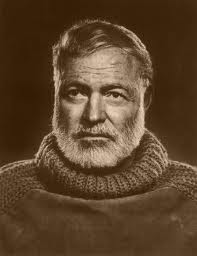
Was Hemingway's voice "real?"
Was Churchill’s voice “real?”
Was Homer’s?
Our “real” voice, when we’re lucky enough to find it, becomes the voice of that point of view. The more closely the voice coincides with that point of view, the more “real” it sounds.
But that “real” is always artifice.
Is Lady Gaga real? Are her lyrics “true?” Yes, but only to degree that they are authentically contrived—in other words, more fakely real.
Was Hemingway’s voice “real?” Did he really talk like that? Does Gaga walk around her Mom’s living room wearing a bra that mounts two AK-47 rifle barrels?
We can never speak or write in a real voice. But we can write in a voice that sounds real and feels real and works better than real.
So what we’re looking for is not real-real, but a “real” that rings true to a point of view.
That’s do-able.
But how?
In my experience, it’s a form of sleight of hand. Only instead of fooling the audience or the reader, we’re fooling ourselves.
Have you ever watched early episodes of Seinfeld? George wasn’t George yet. Jason Alexander hadn’t found him. And Kramer was way, way away from being the Kramer that Michael Richards finally found.
But when Jason and Michael found those characters, they found them completely. They inhabited them to the point that they could never, ever be false in them from then on.
I saw a documentary once on Joan Crawford. The film detailed the “looks” that the actress tried on during her early years. There were literally hundreds.

Joan Crawford. It took a lot of experimentation before she found her look.
She looked sweet, she looked threatening, she looked angelic; she was the girl next door, the vamp, the hard-bitten D.A. The eyebrows were plucked, they were shaped; some in the 20s were pencil lines so faint you could barely see them.
When Joan finally found a look, she stuck with it.
Was that “her?” Was that the “real” Joan Crawford?
Do we ourselves even care about being real in the sense of our in-our-bathrobe, in-front-of-the-TV selves?
That’s not the “real” we’re looking for. The real Hemingway was the Hemingway that Hemingway-the-experimenter-with-himself found in that voice on the page (which, by the way, he stole largely from Gertrude Stein.)
Buddhists believe there’s no such thing as the self. You and I do not possess a “personality.” The nature of the human mind in its highest state, Buddhists believe, is no-mind. Everything that you and I believe is “us” is nothing more than chatter and baggage.
If we believe that (and there’s a lot to it, if you ask me), then what is our “real” self? What is our “real” voice?
What I’m trying to achieve as a writer is to find a voice that works. That voice changes from book to book and piece to piece. I grope for it like an actor trying to find a character. I know less about what it is than what it isn’t. I can hear it when it’s wrong.
What’s fascinating to me about the process is the aspect of exploration and of surrender. What I’m trying to do as I write this sentence is to let go of what I think a sentence should look like, or how I ought to sound, or who I “am,” and instead let the sentence find its own truth.
When I read pieces I’ve written, they rarely sound like “me.” I’m not interested in “me.” I’m looking for what’s real and for what works. “Me” is the enemy of that.
The process becomes an effacement of “me,” i.e. the conscious ego. The harder we try to “be ourselves,” the more fake we sound. And conversely, the more we let go, the more real our voice becomes.
Do I know what I’m talking about? No. I’m making it up as I go along. But it sounds true, doesn’t it?
Even I believe it, and I know how not-real it is.
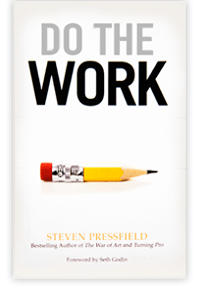
DO THE WORK
Steve shows you the predictable Resistance points that every writer hits in a work-in-progress and then shows you how to deal with each one of these sticking points. This book shows you how to keep going with your work.

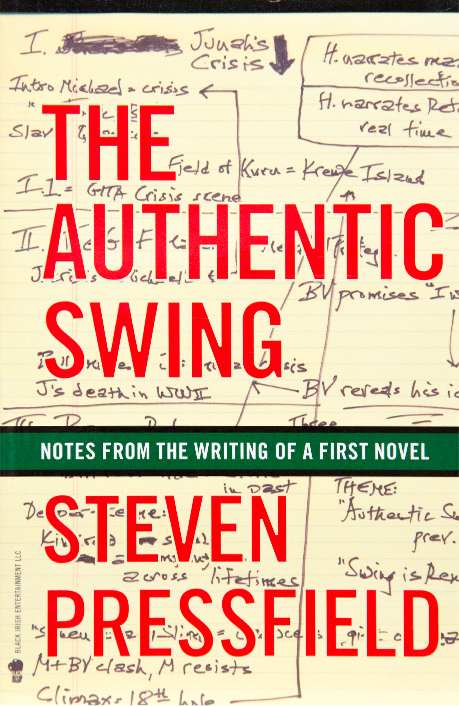
THE AUTHENTIC SWING
A short book about the writing of a first novel: for Steve, The Legend of Bagger Vance. Having failed with three earlier attempts at novels, here's how Steve finally succeeded.
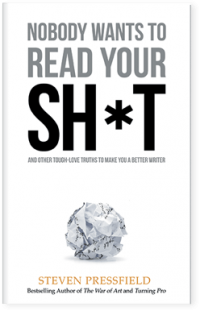
NOBODY WANTS TO READ YOUR SH*T
Steve shares his "lessons learned" from the trenches of the five different writing careers—advertising, screenwriting, fiction, nonfiction, and self-help. This is tradecraft. An MFA in Writing in 197 pages.
TURNING PRO
Amateurs have amateur habits. Pros have pro habits. When we turn pro, we give up the comfortable life but we find our power. Steve answers the question, "How do we overcome Resistance?"
I think ‘real’ is a category that is not real. People invented it to designate states of our imperfect minds. For me the working definition of “real” is very simple – If it moves you – then it’s real. If it moves other people – even better. And it doesn’t have to be emotional. E=MC2 is one of thousands of equations scientists use to describe our universe. Many are more useful or just as important, but this one formula is the superstar. Why? It still moves a lot of people. It is more real and less likely to be questioned or revised (God forbid 🙂 than anything else humankind has come up with. It is all in our minds. I think the real excitement comes from the discovery that our thoughts are actually real and can change the World … which means we shouldn’t believe every thought that comes to our mind. We can choose what to make real and what to dismiss …
Thank You for an interesting article…I often feel like I am looking for that elusive ‘me’ in my art and I cannot find it…When I look at famous artist’s work, it looks like they have found something in themselves…and some writer’s…Thank You for some insight in this area of the unknown…
I think your post is scary good. You nailed it. Thank you !
“The secret of success is sincerity. Once you can fake that you’ve got it made.” -Jean Giraudoux
” The harder we try to “be ourselves,” the more fake we sound” Love that, Steven. The minute an agent told me to continue writing in “my voice,” referring to a certain piece of mine he liked, I forgot how to approach the work. Tried to hard, began to mimic what I’d already done. Only through a tortured and lacking (terrible) first draft was I able to learn what bs the effort to force a “voice” was. “All is Lost” moment came, forcing the “voice” stopped, bullshit meter returned, doing better work. Thanks for this post, every Wednesday I’m here for some writing inspiration.
Good insight that bears repeating.
I cannot remember who said it, but my poor paraphrasing is: “Before we can expect the reader to become the character, we must do so. Get into the character’s skin, shut up and listen to what the character is saying. Then write it down as fast as you can.”
Great article. Please keep them coming.
I like how you said letting go of what you think it should look like, so it finds its own truth.
Reminds me of the metaphor about Michelangelo. When he chipped what wasn’t David from a block of marble, the master piece David appeared. This chipping away, or letting go, brings us to our masterpiece.
Thank you Steven, much appreciated.
Wow! Sounds like a bunch of nonsense to me. You elitists can have one of those cocktail parties I saw in a movie once, and talk about finding a voice, or whatever else people who fancy themselves to be intellectuals can be introspective about. Meanwhile, the rest of us who will be forgotten in a generation or so, are gonna be too busy fighting to push the world on. Maybe after I get off work from this record heat in Arizona, I’ll find the time to experiment on my voice while scraping my rough hands through the dirt to find enough change to buy gas in order to get home and kiss my children before they go to bed. This from the guy who wrote, “Gates of Fire” One of my favorite books of all time.
Matt! that’s the point-it’s All nonsense–Finding YOUR voice may come through the process of seeing what other’s write as fancified,superior musings.How important are the real things YOU do and say? Begin to understand how you have decided what is really important to you and what is nonsense to you and you may find your voice in the middle of this and everything else.FURTHERMORE! Continue to read Writing Wednesdays.I AGREE with you-However-I enjoy all kinds of intellectual nonsense-Read “Death in the Afternoon” under WAR STORIES on this,Steven Pressfeild’s ‘SIGHT’ FOR YOU-Understanding what finding your voice is may be part of the fantastic,scary,joyful,daredevil, journey of discovery-Work hard and GOOD LUCK!
This is a hard concept to articulate, but you did it. The Seinfeld characters–how true!
I find I am sometimes shocked by how that “voice” comes out on the page, but in those times, I let the Muse take over. Thank you for exploring this, Steven.
“Letting the sentence find its own truth” sounds riht to me, Steve. It sounds like getting out of self.
Love it. Oddly enough, it reminds me of advertising.
Clients sometimes believe that it’s enough to simply tell the truth, and I’m forced to explain that merely “telling” the truth is rarely persuasive, that if one wants to persuade people, one’s ad has to cause them to realize the truth for themselves. And that’s where the art of advertising (or at least honest advertising) comes into play.
In this age of putative authenticity, it’s soul-soothing to be reminded that very act of communicating (or enacting) authenticity also requires skilled artifice.
Thanks for all you do, Steve.
This is one of the things readers just can’t seem to grasp. (At least my friends and family can’t.) How do I make my characters seem like real people? I’m never quite sure what to tell them. Now I’ll just tell them what you told us:
Do I know what I’m talking about? No. I’m making it up as I go along. But it sounds true, doesn’t it?
Even I believe it, and I know how not-real it is.
Love it!
Thanks.
P.S. Really enjoyed “Turning Pro.”
I may miss your point, but I have had good luck with improvising in situations I care about, because the engagement of my heart in the setting, I think, produces something real for the listener. It’s a way of thinking/feeling without over-thinking.
Steven, if I may be respectfully honest, I was disappointed with your post last week. I came away feeling let down. Today, however, you have in my eyes not only redeemed yourself but glowed golden. You were concise, clear and profound about the “voice.” I am especially fascinated with this because I am just finishing a new book, Ciao From Roma! Spring in the Eternal City of Love. Having lived in Rome every spring and autumn–I am an American–for ten years, I finally took the leap of faith to address my experiences in Rome, the Romans I have gotten to know well and the Roman culture with its many nuances. “Voice” is certainly paramount in any book, but to convincingly write of another culture–one most Americans will never know firsthand–has been a fascinating challenge. Readers will start deciding this month, when the book is released on Kindle, if I
“put them there” but the narrative came easily, thanks to the “voice” that seemed to rise from my soul. Thanks, Steven, for doing such a wondrous and insightful piece today!
Have heard and read a lot about “voice.” This is by far the best explanation of it; simple to the point of almost not making sense. I really like this.
Once again great article!
One thing is to know somethings by your writing instinct and an other to understand them truly -through words-, as we repeatedly experience in this site/articles/books.
Quoting you from above: “We can never speak or write in a real voice. But we can write in a voice that sounds real and feels real and works better than real.”
As I’m reading “The Art and Craft of Writing Historical Fiction,” by James Alexander Thom, I see him speaking to that very thought: “… one of the most important words in the historical fiction business [is] verisimilitude… VERISIMILITUDE: The appearance or semblance of truth. As Mark Twain once said, the difference between history and fiction is that fiction has to be believable.”
Thanks for the post.
Thought provoking piece. Nicely done. “Real” may not be transparent. If a person or character is conflicted, or has an inner dialogue with the self, what emerges through those filters is the self chosen to be revealed, like a PR strategist. It’s a layered process. Regarding Seinfeld characters, fleshing out a fictional character so well the audience knows his foibles, anticipated responses, etc. as well as the actor/director. There’s a track record, a consistency that may not be authentic, but it allows us to buy in and suspend disbelief, because we feel that we know these characters. Dickens did the same thing.
This is great and really resonated with me. I think the question of what is real has changed with the popularity of social media and online connection. Some people are not able to separate their personas from their writing voices; and whether that’s a good thing or not ultimately is determined by the reader – what is helpful to them, if they feel like they can see themselves in what is being written and/or if they can find aspects of the work that mirrors back to them something that feels like it authentically mirrors their experience.
Thanks, this exploration was useful on several levels … I’m going to “mark as new” and read a few more times … as I’ve done with a dog-eared, Art as War, many, many times.
Of course! Hemingway aped Gertrude Stein! Great observation. He probably would have been at her soirees in Rue Whatever, taking notes. A really interesting post.
Well said! Marylin Monroe is another example of someone who went through a period of finding her “real”.