“Forget it, Jake, it’s Chinatown.”

We were talking last week about stakes and jeopardy. It is critical in any story, I was saying, that the stakes for all characters be as high as possible—preferably life and death. There’s a further aspect to stakes/jeopardy that might be worth exploring this week.
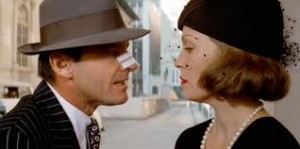
Jack Nicholson gets nosey with Faye Dunaway in "Chinatown"
The stakes in a story should always be on-theme.
Lemme digress for a minute. As I’m writing this, I’m wondering, “Is this subject of interest?” It is to me, but I’m wondering if getting into such nuts-and-bolts detail about storytelling is only tedious to readers who log onto this blog.
Am I boring you with this stuff?
Please let me know in the Comments section. I’ll stop if this is a drag.
Where were we?
Oh yeah … the stakes being “on-theme.”
What do I mean by that?
One way to raise the stakes in a movie or book is to increase the jeopardy to the characters. If a serial killer suddenly appears and starts whacking people’s heads off, that will up the ante nicely. But such escalation can also destroy the story’s integrity. We can’t start throwing around dead bodies just to add drama.
There has to be a purpose to this carnage (or to whatever other means we employ to raise the stakes), and that purpose has to fit in with what the story’s about.
Robert Towne’s Chinatown is about secrecy. It’s about things seeming to be one thing on the surface—and turning out to be completely different underneath. Chinatown is about duplicity and deception.
Therefore the stakes and jeopardy must be about secrets. Their drama must be played out on a landscape of deception.
What the characters must fear most is being exposed.
Evelyn Mulwray (Faye Dunaway) fears that her incest with her father (John Huston) will be discovered. Those are the stakes for her. She is terrified that the product of that incest, her sweet young daughter Katherine, will fall prey to this same monster, her father.
The genius of Chinatown—hats off to Robert Towne—is that the story takes a pulp genre, the Private Eye Story, and elevates it to the level of literature by employing it in the service of great drama. The drama in Chinatown plays out on two levels, macro and micro. In both the stakes are about secrecy.
On the macro level is the true, historical story of how L.A.’s earliest civic barons brought Owens Valley water to the thirsty, infant burg of Los Angeles—and in the process made the city and themselves rich. These devious doings are the political secret, the criminal secret, the founding-of-an-empire secret that is being kept by John Huston.
Then there’s the micro-secret, also being kept by this villain: that he has slept with his daughter Faye Dunaway years past, produced a daughter by her, and now wants that granddaughter for the same unspeakable purpose.
John Huston will do anything to keep those secrets.
Faye Dunaway’s further secret is that, to keep her daughter safe, she has passed her off for years as her sister. She will do anything to keep that secret and thus protect Katherine. This covert truth is finally extracted from her by Jack Nicholson, in this immortal exchange, amid face slaps and anguished tears:
JAKES GITTES
Who is she?
EVELYN MULWRAY
She’s my sister!
JACK GITTES
I said who is she?
EVELYN MULWRAY
She’s my daughter!
JAKE GITTES
Tell me the truth!
EVELYN MULWRAY
She’s my sister! She’s my daughter! She’s my sister and my daughter!
The stakes are exposure. The theme is secrets. When the two work together like this, the result is dramatic dynamite.
Chinatown was directed by Roman Polanski, who as a small boy survived the Nazi invasion and occupation of his native Poland much like the hero of his 2002 film, The Pianist. For Polanski, a story of such hidden evil could believably end on no note but the darkest.
At night on Alameda Street Faye Dunaway, trying to flee with her daughter, is shot and killed—in error, by police who have no clue to what’s really happening. The villain succeeds in keeping his secret. John Huston gets his granddaughter and spirits her away, while Jack Nicholson, who knows the truth and has tried his best to help Faye Dunaway, can do nothing but watch helplessly.
This is no happy ending. The evil secret remains unexposed. But what makes the story work so powerfully as tragedy is that the stakes remain on-theme.
In the movie, Jake’s backstory is that before he became a private investigator he had been a police officer in Chinatown, where the language was foreign, the culture alien, and a round-eyed Anglo cop could never really know “what lies beneath.” In this Chinatown past, Jake had tried to help a woman he loved (the movie tells us no more than this) but had instead wound up hurting her—because of, again, secrets and deception, and his failure to understand the hidden, underlying truth. Now, in the movie’s climax, Jake does know the secret. But it makes no difference. Evil triumphs anyway.
In the movie’s final beat, Jake’s associate Walsh puts his arm around the shattered detective and delivers another (thank you, Robert Towne) all-time classic:
WALSH
Forget it, Jake. It’s Chinatown.
Keep the stakes on-theme. It works.
DO THE WORK
Steve shows you the predictable Resistance points that every writer hits in a work-in-progress and then shows you how to deal with each one of these sticking points. This book shows you how to keep going with your work.

THE AUTHENTIC SWING
A short book about the writing of a first novel: for Steve, The Legend of Bagger Vance. Having failed with three earlier attempts at novels, here's how Steve finally succeeded.
NOBODY WANTS TO READ YOUR SH*T
Steve shares his "lessons learned" from the trenches of the five different writing careers—advertising, screenwriting, fiction, nonfiction, and self-help. This is tradecraft. An MFA in Writing in 197 pages.
TURNING PRO
Amateurs have amateur habits. Pros have pro habits. When we turn pro, we give up the comfortable life but we find our power. Steve answers the question, "How do we overcome Resistance?"
I love these kinds of posts, Steven, keep ’em coming! They really help me elevate my writing.
It’s like the creation of chess problems. You can’t create an effective mechanism if you don’t keep the balance and make sure that everything is working according to the theme you choose to use.
But it was a good idea to clarify it Steve.
And since chess crossed my mind, the most powerful threat in the game is the one that is hanging over the players head like Damocles Sword. Something that the Grand Masters of the game love to achieve against their rivals.
Steven!
These kind of posts are the reason I RSSed you, and keep reading what you have to say!
I’m writing for my own personal Expat website right now and you have given me a lot of inspiration and guidence with both how you write your articles and what you write about. I’ve found your open-loop structure particularly valuable (and engaging, obviously), so have been trying to impliment it in my own writing.
Keep up the A+ work, and I’ll keep reading.
Evan.
As a storyteller, I find these posts enjoyable and helpful. They provide good checkpoints for my trilogy.
Delurking to say I LOVE these posts. I know of nowhere else to get this sort of detailed writing information at this level, and I’m far enough along in my writing career that I need advanced information like this. Please keep it up!
Love this kind of inside baseball stuff. Keep em coming.
Not bored in the least. Please, keep this kind of discussion in your posts.
All of the above. LOVE these posts. Stay on theme, please. It works.
Thank you, not one bit boring, and a better presentation of stakes than just about any I’ve seen.
Steve, these posts are invaluable and incredibly insightful. Such a gift to learn from a seasoned expert. Please keep them coming!
Stephen, As always I love your writing posts. I keep them in mind as I work on my novella and edit my novel, book 2 in my fantasy series.
Thanks!
As always, a fan,
Beth Barany
I say keep writing this stuff. It is instructive and insightful.
These posts mark my week. Wednesday > take a short break > read Pressfield. If they didn’t come, I’d go straight from Tuesday to Thursday. So I need them to keep the “T” days apart. Plus – they are well written and very helpful. Never been bored once. Carry on.
No question for me. Keep going, please!
Agree! Totally interested and keep these coming!
Yes, please. More of this.
Another great one, Steven. Never doubt the gems you’re throwing out. “War of Art” gives me constant doses of courage when the Resistance gets strong and pieces like this help sharpen the blade so I can keep on the attack. Thank you!
Thanks, you guys. I will keep ’em coming!
love these kind of blogs! I imagine that they must quite hard to write. Thank you for your effort.
I guess I am in the minority on this post, but I must admit that I was bored. Me personally, I dont come to your blog for the “nuts and bolts” of storytelling. I come for the inspirational and motivational wisdom.
Last week’s post about stakes was very informative for me, but honestly thats all I needed.
Steve,
Great stuff. I look forward to these posts. Storytelling 101 from a master. Thanks!
Your posts keep all of our stakes on-theme, Steven. I read them, and parts of Do the Work, each day before I begin writing. Magic! Thank you.
Awesome series, can’t wait for more. And might I add, you’re upping the stakes with each post. Thanks.
This is one of your best. Thank you. Going out pronto to borrow Chinatown.
Really, Steven, do you have to ask? Of course I’m interested. Talking craft with a fellow writer – especially one further up the ladder? Every post here is of interest – yours, Shawn’s, Callie’s. I appreciate the effort you put into producing these. It’s creative time; it’s sharing time. (I try to respond to every post, if only with a thank you, because I realize how much you all are giving.)
Someone mentioned chess. (Basilis) I’m a chess player (retired), coach and have worked on some chess books. As Emmanuel Lasker said, chess is a struggle. It’s the dynamic tension, the hidden tactics and plans and motifs, that raise the game to more than a game.
To this specific post: I found it an important continuation of the theme or topic. The idea of raising the stakes, without explanation or qualifier, turns a story into a slasher fest. As you said last time, the stakes are physically anything, but emotionally critical – life or death in an emotional if not a physical sense. In a children’s story, for instance, the missing roller skate is for the 8 year old as big a crisis as the ticking bomb on the airplane to the FBI agent. The next part, or act, which you elucidate here, is to tie the “stakes” or “conflict” or “emotional investment” (life-changing) event (plot) to the theme. What’s the story about.
So often writers, and people who explain writing to writers, forget what theme really is: the deep story. Reduce theme to a cliche (love conquers all) and you lose the theme and the story and the conflict and the characters.
To be brief: Yes, Steven, yes. Thank you! Keep it up.
Lasker! As mentioned by Kasparov one of the greatest experts of the chess player psychology. Apart from his technique, this was another reason why he was a Chess Champion for so many years. (Once I met Kasparov in Athens. A chess genius!)
(Dramatic) chess problems like those of Samuel Loyd’s make me thing that there are a lot of similarities to the way plots and musical themes are constructed.
But I agree that something more is needed than just technique. A mojo, a spark from the soul, commitment, a muse, all of the above (and even more) are needed to create something so great as Loyd’s work!
(By the way: I love Alekhine’s, Tal’s and…Capablanca’s -as surprising as it seems adding this 3rd name near the other two- way of playing).
Steve, keep it up. It might only be boring if its the first time someone has read any of your blogs (even then I think it would be insightful on some level). These insights, lessons, and etc. carry over into any creative endeavor (many to any worthy endeavor) anyone could pursue, or inspire that pursuit. Keep it up, always a joy to read a new/different view and learn something.
I stumbled onto War of Art which lead me to this blog…you guided me to McKee’s seminar last Spring (WOW and Thanks–I was reviewing 5 legal pads chocked full of remarkable insights and hilarious quotes from that just yesterday) and all of your craft oriented posts are helpful to guys like me (Duke haters-go Tarheels) who have the hunch of ambition to tell stories, to write the truth but need all the help we can get. You’re still welcome in NC anytime.
Hey Steve, I really like the “Writing Wednesdays” posts! But, I don’t know how this happened, but, when I subscribed to the Writing Wednesdays’ RSS feed -I also get “What It Takes” posts, in my emails, as well… and… I find those posts really boring, sometimes, and not very useful…
Sorry, but I have to be honest here… just my humble opinion…
Is this boring? No, not at all – fascinating. Thanks for sharing it.
This stuff is better than gold, Steven. Every post gives me a new idea. Please don’t stop sharing.
I consider these posts vital parts of a double-fisted approach to writing and learning. The War of Art and Turning Pro get me to the blank page and help me fight Resistance, but these discussions of ‘separate drafts’ and stakes and themes, the nuts-and-bolts, answer critical questions on how I can constantly work to be better. Thank you.
Ditto for what everyone else has said. I *treasure* these posts. Please, please, please keep them coming.
What do we know about Robert Towne’s intentions when he wrote the screenplay of his modern classic?
I love these types of post – great stuff to really sharpen my writing.
Thanks!
– Tom
Keep it coming, Steve. You’ve got a knack for investigating and explaining ideas in an everyman sort of way. Direct, logical, accessible. Even if I’m already familiar with the ideas I still come away from your posts with a deeper or more specific understanding. I’m just one eyeball. You’re a good vantage to team up with for some perspective, y’know?
We’re never an audience of one. If you find it interesting, other people will too. You built it and we came. Just keep playin ball.
Sick post as usual Stephen
Love this blog, love The Art of War, digging into Turning Pro right now
You’re helping a lot of people with this shit brother… myself included
So happy to see you writing on this topic—very synchronous for me.
I just returned from a writer’s conference that included six days of intense workshops with a bestselling author. A similar topic was one of the big areas of discussion—making plot grow “organically” from character, rather than just creating preposterous plot lines to make things exciting. (As you say, “We can’t start throwing around dead bodies just to add drama.”)
I discovered that I’m guilty of throwing in plot developments that I think make sense at the time, but that later prove to have been my way to add in “excitement” when I felt the story sagging.
I left the class confused, however, as to how to correct this. Many of the instructors were “outline” writers, planning and plotting their books before drafting them. They were coming from the more analytical approach of adding a character here or a plot development there to move the story in the right direction. I understand this approach, but I’m more of an intuitive writer (start with character and write), and I’m having trouble solving my problem. The clarity I need to rewrite is eluding me.
I would love to see any tips you may have about determining the specific theme of the story, and then figuring out what type of central conflict (macro level–outer action) will work with that and with your character—in other words, how to avoid sagging spots in the story in ways that make sense to the story and the theme.
I have been brainstorming ideas since I returned, and though I feel some of these ideas could work for a book in general, none seem to fit this specific story I was trying to tell. I’m afraid of losing the heart of my story while tinkering around with attaching new parts.
I’m a huge fan—please keep these types of posts coming. :O)
Are you serious? Bored? Love these epic little gems and I barely write! :). Thanks for doing what you do!