The Warrior Ethos

Today we launch something new on the site. Some people may hate it. (We’ve already had one high-profile colleague flee, screaming, from his first sight of it.)
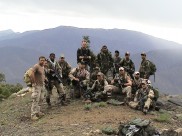
Wars change, warriors don't. Special Forces ODA 316 in Konar province, Afghanistan. Photo by Maj. Jim Gant.
It’s called The Warrior Ethos. It’s an ongoing series about exactly what the title says. The primary audience I’m writing it for is our young men and women in uniform, but I hope that other warriors from other walks of life will give it a chance as well. The first Warrior Ethos post will appear in this space today, Wednesday 2/9, a couple of hours after this intro runs. After this week, the series will appear every Monday.
Warriors and Artists
What is a warrior anyway? It’s you and me, as we fight the daily battle against our inner demons of self-sabotage, self-betrayal, self-doubt and so forth—not to mention the real, external foes we must contend with in our art, our businesses, and our personal lives.
We duel adversity every day, you and I. We get bloodied; we experience casualties—and we have to get up and find a way to fight again. We might not be wearing body armor or carrying M4 carbines, but we know in our bones that the warrior virtues of patience, resolution, tenacity, selflessness, capacity to endure hardship, etc. serve us every day of our lives. Life is a struggle. That’s why the word “war” is in the title of The War of Art.
Where this came from
The Warrior Ethos evolved out of my preparatory work in writing my upcoming novel, The Profession. The story is a military/political thriller set a generation into the future, when conventional armies have largely been replaced by mercenary forces. This brought up a lot of questions for me, stuff I had never really had to define for myself before.
What is a warrior? What ethic does he fight by? Is a code of honor necessary? If so, what are its tenets? How does it arise? Is it something we have to be indoctrinated with by mentors and elders? Or does it arise spontaneously, summoned by the exigencies of the struggle and the imperatives of the human heart?
Trying to answer these questions, I went back into history. I read Xenophon and Herodotus and Thucydides; I read Caesar and Arrian and Curtius and many others. I studied the Spartans and the Romans and Alexander’s Macedonians. This blog, as some of its readers may know, evolved out of an earlier blog called “It’s the Tribes, Stupid.” That blog was about Afghanistan and the struggle there today. So there’s some of that too in The Warrior Ethos.
Warriors and Professionals
Remember, in The War of Art, the concept of “turning pro?” That was my nutshell answer to the question, “How do we overcome Resistance?” A pro shows up for work every day; a pro is patient; a pro endures adversity. A pro doesn’t take success or failure personally; a pro accepts no excuses; a pro plays hurt.
The Warrior Ethos takes the concept of “professional” and traces it back to its roots in the primitive hunting band and the ancient hoplite phalanx. A pro is a warrior, and a warrior is a pro. I hope that those who might react negatively to anything with the word “war” in the title will reconsider the metaphor—and how it may help them (it probably already is) in their artistic, entrepreneurial, and personal lives.
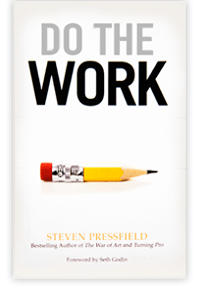
DO THE WORK
Steve shows you the predictable Resistance points that every writer hits in a work-in-progress and then shows you how to deal with each one of these sticking points. This book shows you how to keep going with your work.

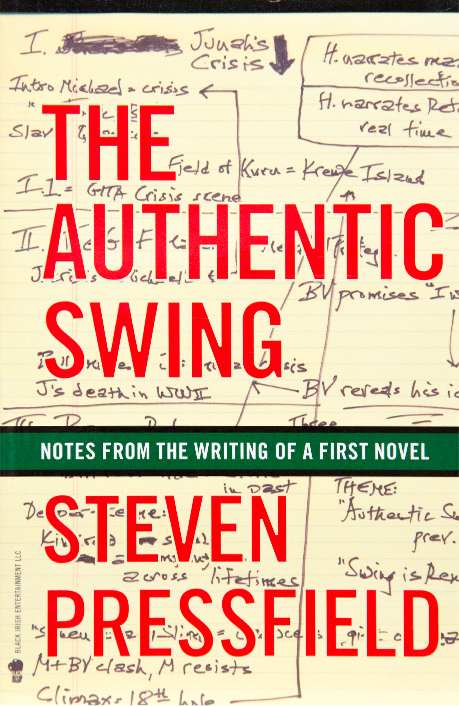
THE AUTHENTIC SWING
A short book about the writing of a first novel: for Steve, The Legend of Bagger Vance. Having failed with three earlier attempts at novels, here's how Steve finally succeeded.
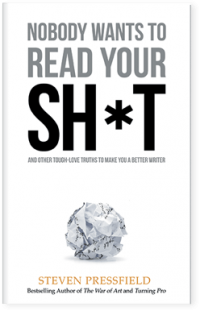
NOBODY WANTS TO READ YOUR SH*T
Steve shares his "lessons learned" from the trenches of the five different writing careers—advertising, screenwriting, fiction, nonfiction, and self-help. This is tradecraft. An MFA in Writing in 197 pages.
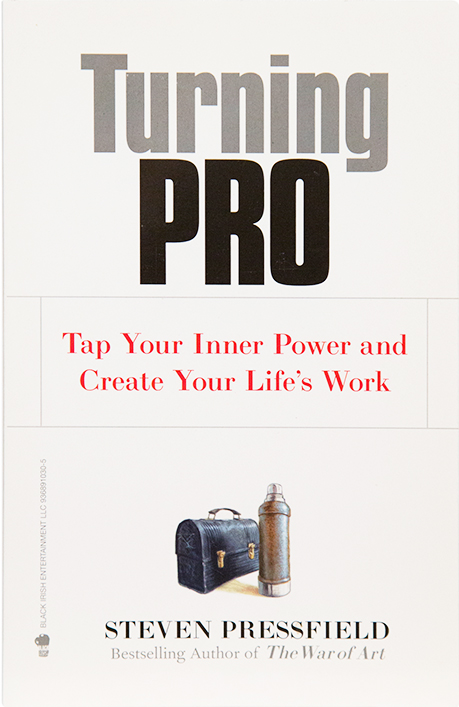
TURNING PRO
Amateurs have amateur habits. Pros have pro habits. When we turn pro, we give up the comfortable life but we find our power. Steve answers the question, "How do we overcome Resistance?"
And a ‘warrior’ is also a state of mind. When it gets ugly, people either fight or flee, and no amount of training can change that first instinctual step forward or back…
Great idea. Many of us warriors, both active and former, try to live our lives by a certain ideal but many either cannot or choose not to understand that. Cannot wait to see what’s coming.
Sounds great, Steve, looking forward to it. Nobody who’s read The War of Art is going to run from a warrior ethos, it’s your (and our) greatest weapon, pun intended. Here’s a short link to this intro in case you need it, by the way, tweeting it out there via @Porter_Anderson http://ow.ly/3TaqM
Steven, you ask some great questions in this introduction, and I’m looking forward to the posts and discussions that will follow. I really enjoy the contributions from active and former warriors who also fight The War of Art (like you Ken, thanks!).
And new posts on Mondays, Wednesdays, and Fridays? You’re spoiling us.
Martial Arts first introduced me to the warrior virtues. I have struggled with the concept now for twenty five years. There is a void at the heart of the warrior. In the Illiad the warriors seem so many children, squabbling and killing to no purpose past thier own aggrandizment. In the Odyssey, Achilles, in the underworld, tells Odysseus that lif as the lowest laborer is better than being a dead hero.
Historically warrior societies are as much about oppression as protection. The Spartans enslaved and oppressed the Helots. The flower of the Confederate warriors cut their teeth as vigilantes chasing black slaves seeking freedom and any whites who might have been sympathetic. The Samurai upheld the social stratification with no thought as to right and wrong.
Yet we admire them in those instances when they transcend those weaknesess. It’s not enough to serve a greater cause. All three groups mentioned served a greater cause, at the expense of others.
It reminds me of a sales training class I took. At one point someone raised thier hand and asked, “aren’t all these techniques manipulitave?”
Without hesitation the trainer answered, “yes, yes they are.”
If you use those techniques to help people achieve their goals in an honest, sustainable way, that is okay. If you use them against thier interest, that’s evil. Of course home ownership and manipulitive sales techniques are one thing. Warriors deal in foce, death, violence. I’m not a pacifist, there are times those tools are legitimate ones, but too often our institutions use them and our young warriors inapporpriately. Most times, I would say.
Still, in the end, the warrior ideal is, for me, rooted in the western ideal of the individual. We fall into the trap of ego, yes. We lose our way, but the ideal that the individual can and should make a difference, that we are not the helpless victims of forces beyond our control, is a worthwhile one. We are not only able to stand against injust fate, we are called to.
Thanks for another great post. The resistance had been kicking my ass again, up until a couple of days ago. I’m back!
Ever heard of “Shambhala: The Sacred Path of the Warrior” by Chogyam Trungpa? Sounds like similar themes.
Looking forward to this new series! Now we all have special Monday’s and Wednesday’s! Thanks for sharing
Whether one runs from or embraces the warrior ethic, those scant nine paragraphs are extraordinarily well crafted. Thanks. TJF
Glad I found this.
Chapters 1 and 2 are missing. No links go to them.
Nice.
Paul – Thanks for leaving this comment. When this post went up, the first Warrior Ethos post sat next to it on the site. It should have included a link so that people looking at it in the future, when the two posts were no longer sitting side-by-side, could read it. Thanks for pointing this out. You can find all of the Warrior Ethos posts under the Warrior Ethos series on the site: https://stevenpressfield.com/category/the-warrior-ethos/. Callie
Warrior ethos? That which Barack Obama isn’t and can’t comprehend.
Paper warriors need paper words. Military warriors need the ethos. When your enemy is the keyboard, or resistance, or a dinosaur-era client whose focus is keeping you from writing, or shipping some product, your weapons are a long, hot sweaty run, a cellphone and anyone who will listen to you bitch. When your enemy is getting your attention with rockets, IED’s, mortars and armor piercing bullets and focused on killing you – literally – then you need something more substantial than “do good work.” You need a warrior ethos. If people don’t like the book, they’re obviously part of the paper war, not the real one. hoorah.
This is a fantastic portal. I am both, literal and figurative. I was a Navy Medic for seven years, went to some interesting places put some curious people back together and kept my marines healthy and full!
But I’ve been an artist ALL my life. I’ve battle Resistance in numerous ways, and much in my youth I was able to over some.
So bringing the warriors life to the hands of the artist is truly important. It heals our souls, and those around us when we create.