Cover the Canvas

Is the first draft the hardest? Is it different from a third draft, or a twelfth? Does a first draft possess unique challenges that we have to attack in a one-of-a-kind way?
Yes, yes and yes.
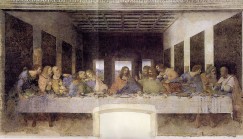
Leonardo DaVinci's "The Last Supper"
First drafts are killers
A first draft is different from (and more difficult than) all subsequent drafts because in a first draft we’re filling the blank page. And we know what that means: Resistance.
Here’s my mantra for first drafts. Cover the canvas.
What that means is get something done from A to Z, no matter how imperfect. A first draft doesn’t have to be great; it doesn’t have to be pretty. It can have gaping holes; it can leave every “t” uncrossed and every “i” undotted. Momentum is everything in a first draft. Get it done. Cover the canvas.
Resistance and first drafts
Why is this so important? Because in the first draft, Resistance is at its most powerful. The blank page, day after day … Resistance has ten thousand chances to come up with reasons for us to quit. The work is too hard, it’s too painful; a jillion other people are doing the same thing better; we’re too old, too young. We’re not worthy!
If we dawdle on our first draft, even good news can destroy us. A raise, a new baby, a winning lottery ticket. Aw shit, there goes our symphony.
Cover the canvas. If our new piece is “The Last Supper,” sketch in the apostles, lay in Jesus, get the table down. Don’t sweat the details. It doesn’t matter if Matthew’s hair isn’t right, or Peter’s left hand has four fingers. We’ll fix that later. Get the picture down. Cover the canvas.
Some smart sonofabitch once said, “There’s no such thing as writing, only re-writing.” He was wrong. The first draft is writing. Pure blue-sky, blank-sheet writing. But he was right too. Because after Draft #1, it’s all rewriting.
Our priority in the first draft is to beat Resistance. Quality is secondary. Brilliance can come later. Get something down, however crappy, that looks roughly like a book, a doctoral dissertation, a new business proposal. Once we’ve got that, we’re over the hump.
Advancing on Baghdad
Gen. James Mattis commanded the 1st Marine Division in Operation Iraqi Freedom. His mission was to capture Baghdad and remove Saddam Hussein from power. His plan was exactly like ours for writing a first draft. (This was the same scheme, by the way, employed by Gen. Schwarzkopf in Desert Storm, Erwin Rommel in the blitzkrieg conquest of France, and Caesar and Alexander in every battle they ever fought.)
Gen. Mattis made known his “commander’s intent.” Here’s what he told his Marines: speed is everything, keep advancing no matter what; if we hit resistance, bypass it; keep rolling north, stop for nothing.
When Mattis and his Marines were trying to do was to demoralize the enemy and weaken his will to resist. Mattis wanted to sow panic among the foe by moving his attacking forces so fast that the enemy would believe that nothing could stop them. It worked. Iraqi soldiers defending Al Kut and An Nasiriyah went into battle wearing civilian clothes under their uniforms, so they could bolt at the first chance and melt back into the populace.
When our “commander’s intent” is Cover The Canvas, we’ve got a powerful directive ordering our priorities. Get to the finish line. Don’t stop. Bypass problem spots. Keep advancing.
Why Cover the Canvas works
The genius of this conception is twofold. First, we discover that the strongpoints we’ve bypassed often melt away by themselves. Second, once we’ve reached our objective, however shakily, the enemy frequently gives up. He can’t believe we’re on his doorstep. He waves the white flag.
Our enemy as artists is Resistance. If we make the mistake in our first draft of playing perfectionist, if we agonize over syntax and take a week to finish Chapter One, by the time we’ve reached Chapter Four, we’ll have hit the wall. Resistance will beat us.
But if we can stay nimble and keep advancing, slapping paint on the canvas and words on the page till we’ve got something that works from east to west and north to south, however imperfectly, then we’re like Mattis’ Marines on the threshold of Baghdad. True, we’ve got plenty more fighting to do, but at least we’re here. We’ve got something we can work with.
Cover the canvas.
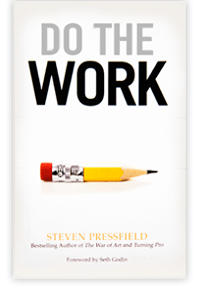
DO THE WORK
Steve shows you the predictable Resistance points that every writer hits in a work-in-progress and then shows you how to deal with each one of these sticking points. This book shows you how to keep going with your work.

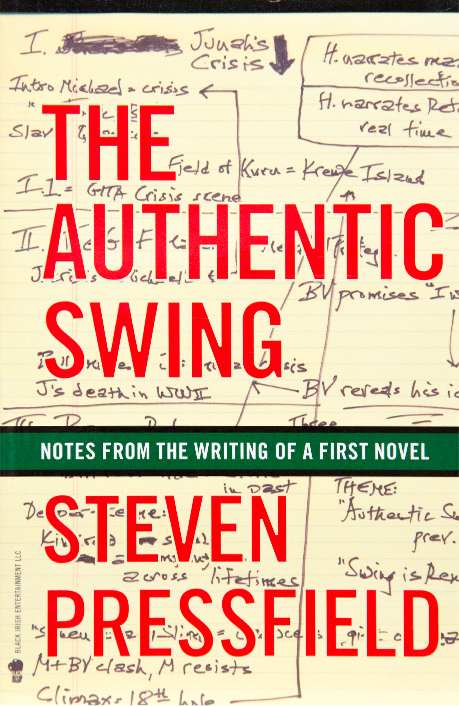
THE AUTHENTIC SWING
A short book about the writing of a first novel: for Steve, The Legend of Bagger Vance. Having failed with three earlier attempts at novels, here's how Steve finally succeeded.
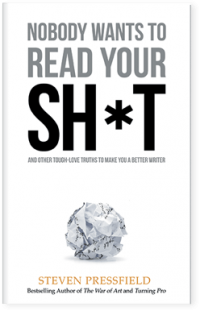
NOBODY WANTS TO READ YOUR SH*T
Steve shares his "lessons learned" from the trenches of the five different writing careers—advertising, screenwriting, fiction, nonfiction, and self-help. This is tradecraft. An MFA in Writing in 197 pages.
TURNING PRO
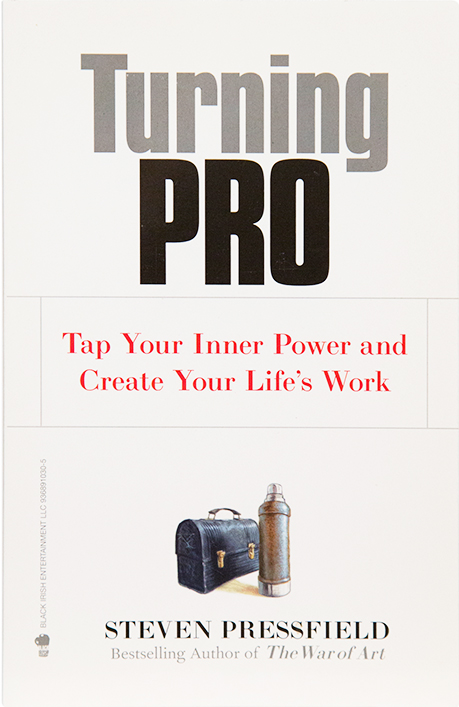
Amateurs have amateur habits. Pros have pro habits. When we turn pro, we give up the comfortable life but we find our power. Steve answers the question, "How do we overcome Resistance?"
So simple, and so right.
Hi Steven,
Another excellent post that’s inspirational and provides succour to those overwhelmed by the tyranny of the blank page.
Your Commander’s Intent of “Cover the Canvas” is just the thing needed to defeat the anxiety of the first step.
As Sun Tzu says “When the army engages in protracted campaigns the resources of the state will not suffice”: when we “dawdle” on our first attempt our resources are rapidly depleted and we risk being defeated by Resistance.
Just what I needed to hear as I struggle through another first draft.
Thanks!
I was starting to run out of steam on my first draft but this post has inspired me to finish the sucker.
Thanks!
Hey Everyone,
What is your opinions of screenwriting contests? I just entered my first and I wonder if it is a waste of time.
MovieBytes has a forum to discuss the merits of contests. Look up the Nicholl Fellowships.
On the money. I’ve been conceding to resistance lately, and it used a “serious illness” as it’s weapon of choice. For now, I received a clean bill of health yesterday, so the illness resistance used existed only in my somewhat thick noggin. So, off I go.
This is exactly where I am in my novel, and this is exactly what I needed to hear.
Having grown up in the age of word processors, I tend to write my rough draft in a non-linear fashion. I jump around to whatever’s on my mind, writing disjointed scenes that I can connect later on. I find this especially helpful when I get “stuck” on one scene or one bit of dialog, I simply type a row of asterisks and move on to the next part. Then, when I skim through the scenes, I get ideas for connecting bridge segments to tie them altogether.
So far, this plan is working for me, and I am filling pages as quickly as I can.
Man! This was a GUUUUUREEEEAAAT read! Thanks so much for sharing. I was asking myself the very same questions you pose in the beginning. But this is a great mentality to go into writing a spec. Genius I say, Genius!
Great reminder. My best paintings came about when I covered the canvas first.
I am constantly amazed at your use of metaphors that fit my life. Earlier you talked about learning to run and the endurance of a long race. I was once a runner, I understood your language. Now you speak of painting, something I absolutely love to do. I understand the concept of covering the canvas. Why am I not applying that which I already know? Resistance! Ugh!
Thank you for this post. Next, you will be talking about golf: trying to do too many things right at one time and giving ourselves a brain meltdown. Don’t laugh, it happened to me once. I froze and could not even swing the club, let alone hit the ball.
Ines 😉
I believe the more you do, the more you become absorbed on the subject (no matter how small or insignificant the progress may seem). That i believe is the crucial momentum that’s necessary to achieve creativity liftoff. In the middle of a space shuttle lunch you can’t stop the engines because the ship will fall, same goes to the creative process…i think? As an artist i’m very familiar with the progressive layering process of the art, and this process is not only crucial to the design but also to the survival of creativity.
I really enjoy your writing style Mr. Pressfield you give the impression that your 1st draft was flawless….but everyone one knows the simpler an artist makes his art look the harder it was to create.
This post, combined with the post on second acts, is just what I needed to hear. Back to the first draft, act two. Sigh.
I am a new writer…coming from my first love of painting and I absolutely agree with what you are saying. You do need to get the whole covered and then work back into it. It can’t all be wedding cake, you just have to get it out and down and then rework it. Sometimes I think excellent, other times crap but at least it is out. I don’t know if I am successful yet, I am really just working on the story and figure the marketing is another skill set altogether, but it is fun, exciting and hard and horrible all at once.
In painting sometimes I would have a flash of what I wanted to do and then it was easy, I would just have to paint it. Other times I would have to coax it into existence change and revamping as I went along. Neither way was that painful…I haven’t found either of these approaches transfer to the written word, but maybe again, that is because I am new at it. Would love to hear what you think.
GiGi
Crap! I just realized you are FAMOUS! I found you via a link to a link to a link and should have checked out your home page before blathering on your blog. Anyway, thank you for sharing your creativity and experiences with us! GiGi
I too easily get distracted with the details and I need to take the challenge and fill the canvas. Let the worries of imperfection fall to the wayside and write.
Thanks!
Once again, a simple but often forgotten tenet. Thanks for the continuing support and generous words.
Hi Mr. Pressfield,
I came across with your interview at Lateral Action and I loved everything you’ve said in there. Your “Turning Pro” attitude really resonate with my style when I face my own Resistance.
I just purchased your “The War of Art” and I am looking forward to reading it this weekend : )
Thank you,
Yukie
So very true. When I was doing my student teaching, my students insisted they only needed to do one draft. They always wrote “perfect” and saw no value in reworking their writing. They believed, and insisted, that once they had finished there was no need to go back and reflect upon what they had written.
like nike says..just do it! there’s nothing to it dive off then open the parachute
Excellent post and so true. Best thing to do is to write and worry about the small details later, just get it all down.
This is valuable advice in any endeavor. Thank you.
Thanks again Steven. I will just get that last chapter downa as best as I can and worry about logic and whether it is working right later. I have a habit of getting stuck when in my head it doesn’t seem to be ‘right’. Just do it! Thanks for the advice.
Thanks Steven! I’ve been struggling through my first draft of my first book. This is extremely helpful! Thanks for sharing your years of experience, much of which I’m sure you learned the hard way.
It was exactly what I needed to hear as I struggled through another first draft.